
A public-library branch network uses centralized TACACS+ for VTY access but must survive total AAA-server loss at the console. What local safeguard should remain?
Select an answer to reveal the explanation.
Short Explanation
Leave a break-glass local admin in the toolbox—when TACACS is gone, the console still needs a known key to open the library routers.
Full Explanation
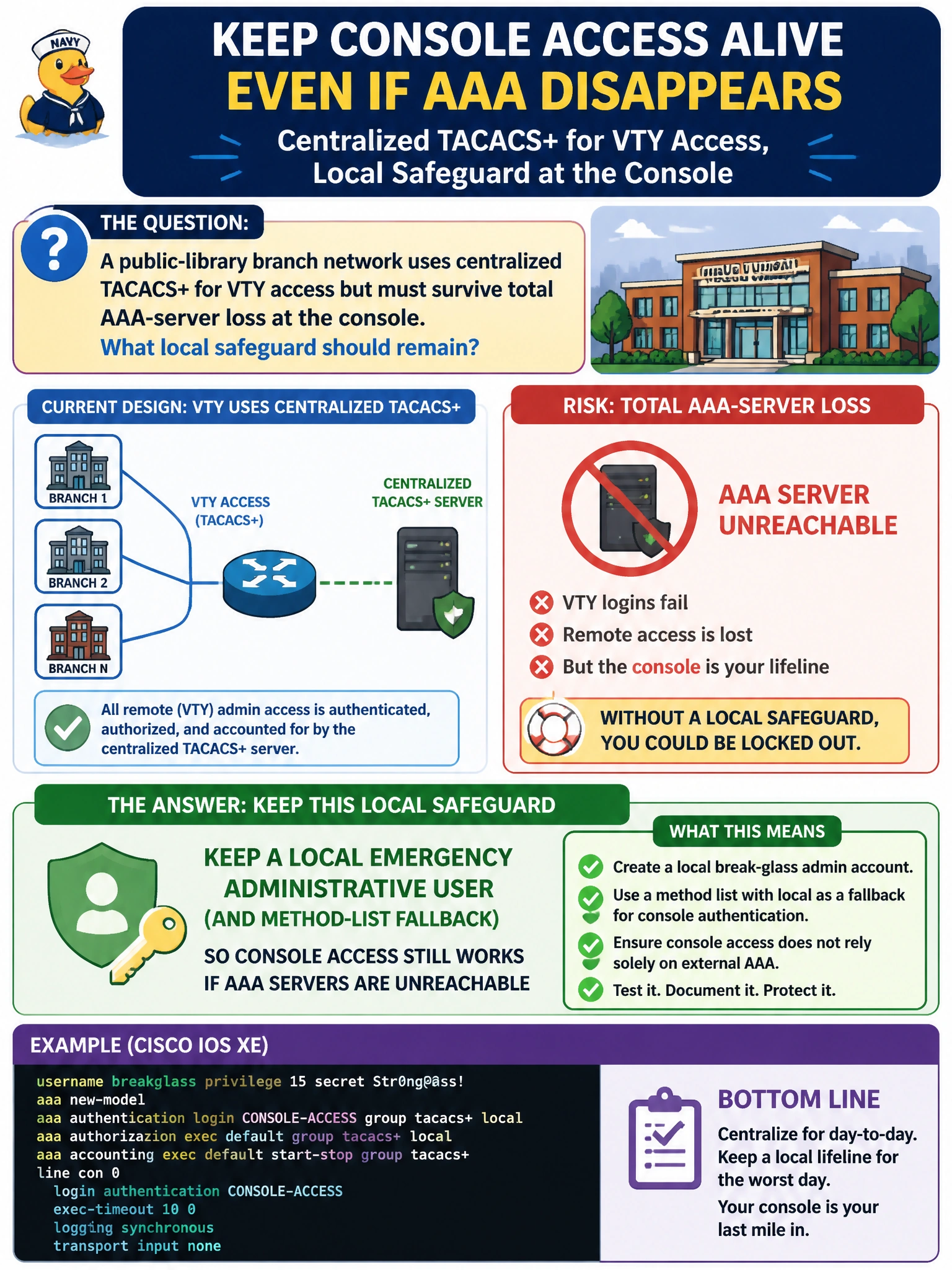
A public-library branch network using centralized TACACS+ for VTY access must still survive total AAA-server loss at the console. Keep a local emergency administrative user and method-list fallback so console access works when AAA servers are unreachable—otherwise a TACACS outage becomes a lockout during the exact incident when library routers need hands-on recovery from staff or contractors on site.
Deleting every local username so console login fails closed with no recovery path is an anti-pattern for break-glass access. Disabling the console line entirely whenever TACACS+ is configured removes the most reliable out-of-band recovery path. Relying on anonymous HTTP to the router as the only break-glass path is insecure and often unavailable when IP reachability or HTTP servers are down at the branch.
Exam caveat: centralized AAA plus local console fallback is the resilience pairing ENARSI-style operations expect. Operational check: verify a local privileged user exists, confirm the console method list falls back to local, test login with AAA blocked via terminal server or console cable, and document break-glass procedures for library staff without leaving anonymous HTTP enabled.