
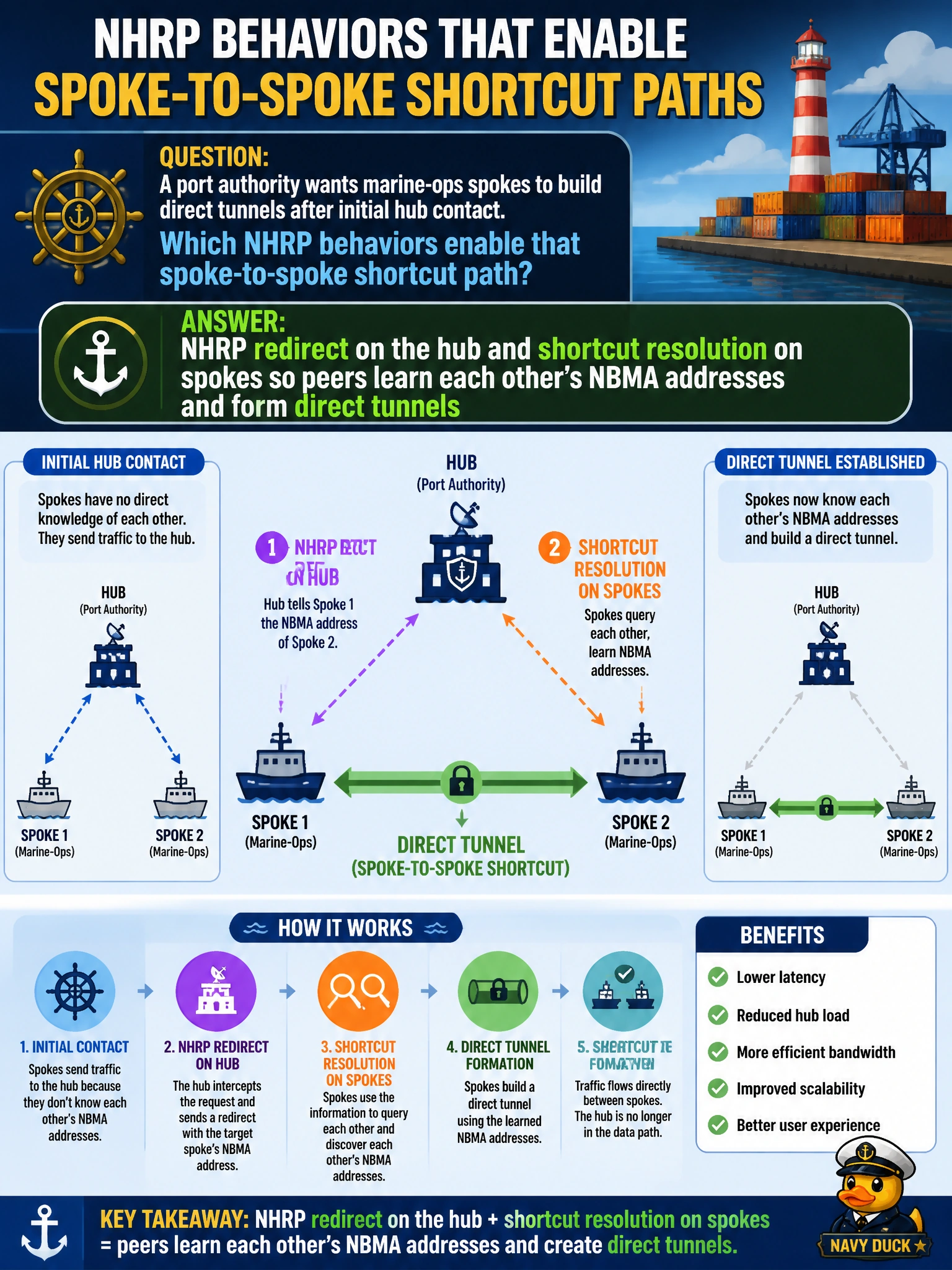
A port authority wants marine-ops spokes to build direct tunnels after initial hub contact. Which NHRP behaviors enable that spoke-to-spoke shortcut path?
Select an answer to reveal the explanation.
Short Explanation
The hub waves a redirect and spokes take the shortcut: NHRP tells them each other's real Internet address so they can build a direct tunnel.
Full Explanation
For a port authority that wants marine-ops spokes to build direct tunnels after initial hub contact, NHRP redirect on the hub and shortcut/resolution on spokes are the enabling behaviors. Traffic that initially hairpins through the hub triggers redirects; spokes resolve each other’s NBMA addresses and dynamically form spoke-to-spoke tunnels so subsequent marine-ops flows skip the hub path when policy allows. That keeps berth and vessel-ops video or SCADA bursts from permanently depending on hub hairpin capacity.
Disabling NHRP entirely removes dynamic mapping; flooding GRE to every NBMA address is not a substitute and does not scale across harbor sites. Forcing spokes into OSPF totally stub areas does not create IPsec peerings or NBMA discovery. Configuring Frame Relay Inverse-ARP in place of NHRP on mGRE interfaces imports an obsolete WAN mechanism that is not how Internet DMVPN learns spoke NBMA addresses.
Exam caveat: at single-hub ENARSI depth, redirect plus shortcut explain spoke-to-spoke without requiring dual-hub Phase lab stories. Operational check: enable redirect and shortcut per design, send spoke-to-spoke traffic between marine-ops routers, then confirm new dynamic mappings and direct tunnels in show dmvpn and show ip nhrp, and verify reduced hub hairpin counters for that flow class.