
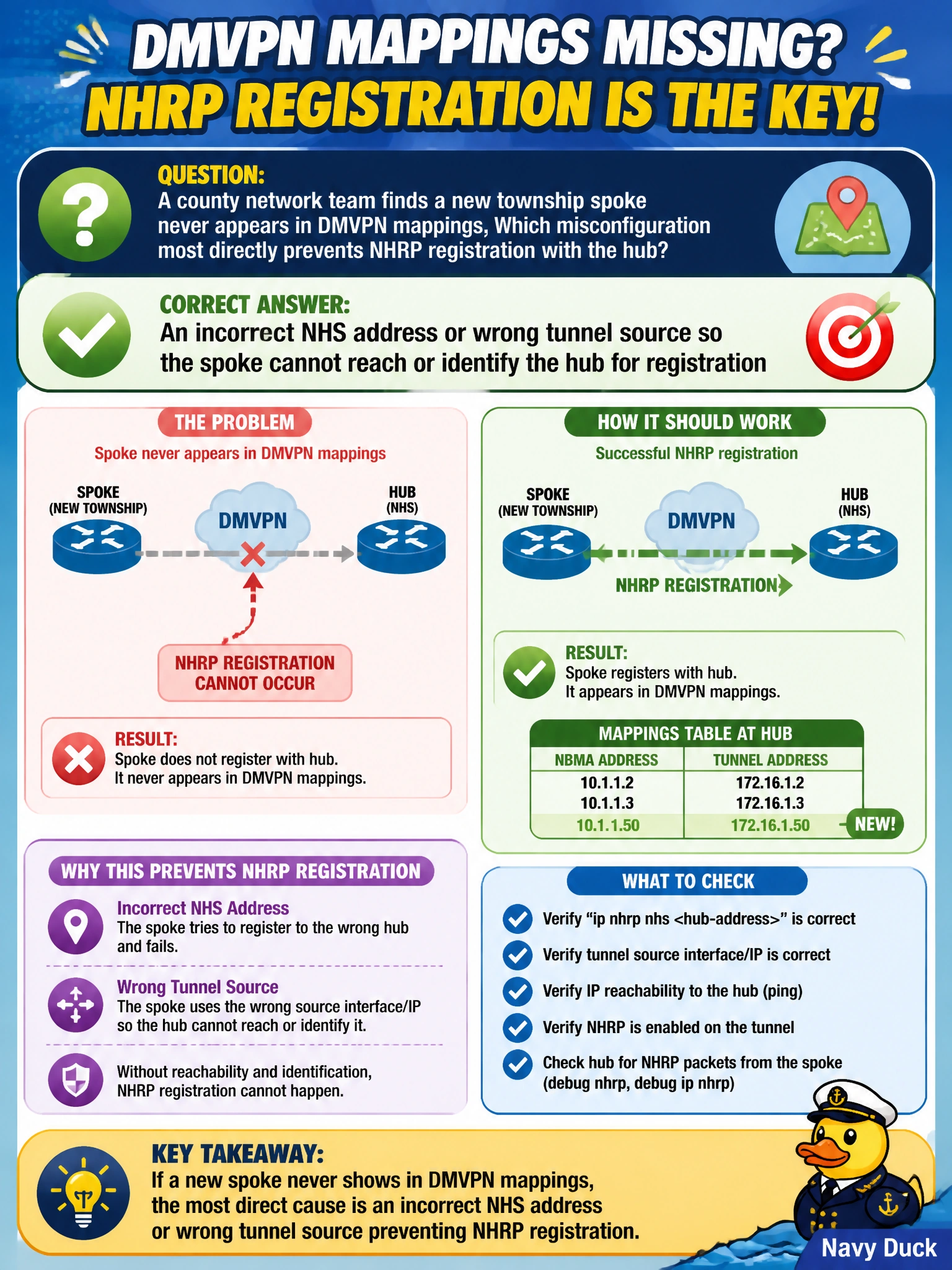
A county network team finds a new township spoke never appears in DMVPN mappings. Which misconfiguration most directly prevents NHRP registration with the hub?
Select an answer to reveal the explanation.
Short Explanation
When your spoke uses the wrong NHS address or tunnel source, it cannot reach or identify the hub for registration, so no mapping appears. Check that identity and reachability match the hub’s configuration.
Full Explanation
When a new township spoke never appears in DMVPN mappings, the most direct cause among these choices is an incorrect NHS address or tunnel source: the spoke must reach the intended hub and identify itself with the tunnel source used on the underlay path. If either is wrong, NHRP registration cannot complete and the hub cannot install a dynamic mapping. An OSPF stub area flag on an unrelated LAN VLAN does not govern NHRP registration between the spoke and hub. BGP route refresh on a separate PE-CE session elsewhere in the county is unrelated to the DMVPN mapping process. EIGRP variance set to 1 on the spoke LAN affects unequal-cost route use; it does not block GRE encapsulation or prevent NHRP traffic from traversing the tunnel. Exam caveat: keep the scope of each setting in mind—the NHS address and tunnel source determine hub registration, while unrelated LAN or PE-CE settings do not explain this symptom. Practical check: from the spoke, verify underlay reachability to the hub’s NHS address, then compare its configured NHS address and tunnel source with the network design and inspect DMVPN and NHRP status on both devices for registration and mapping entries.