
An assessor’s office brings a new spoke online in a single-hub DMVPN. What does NHRP registration accomplish for that spoke?
Select an answer to reveal the explanation.
Short Explanation
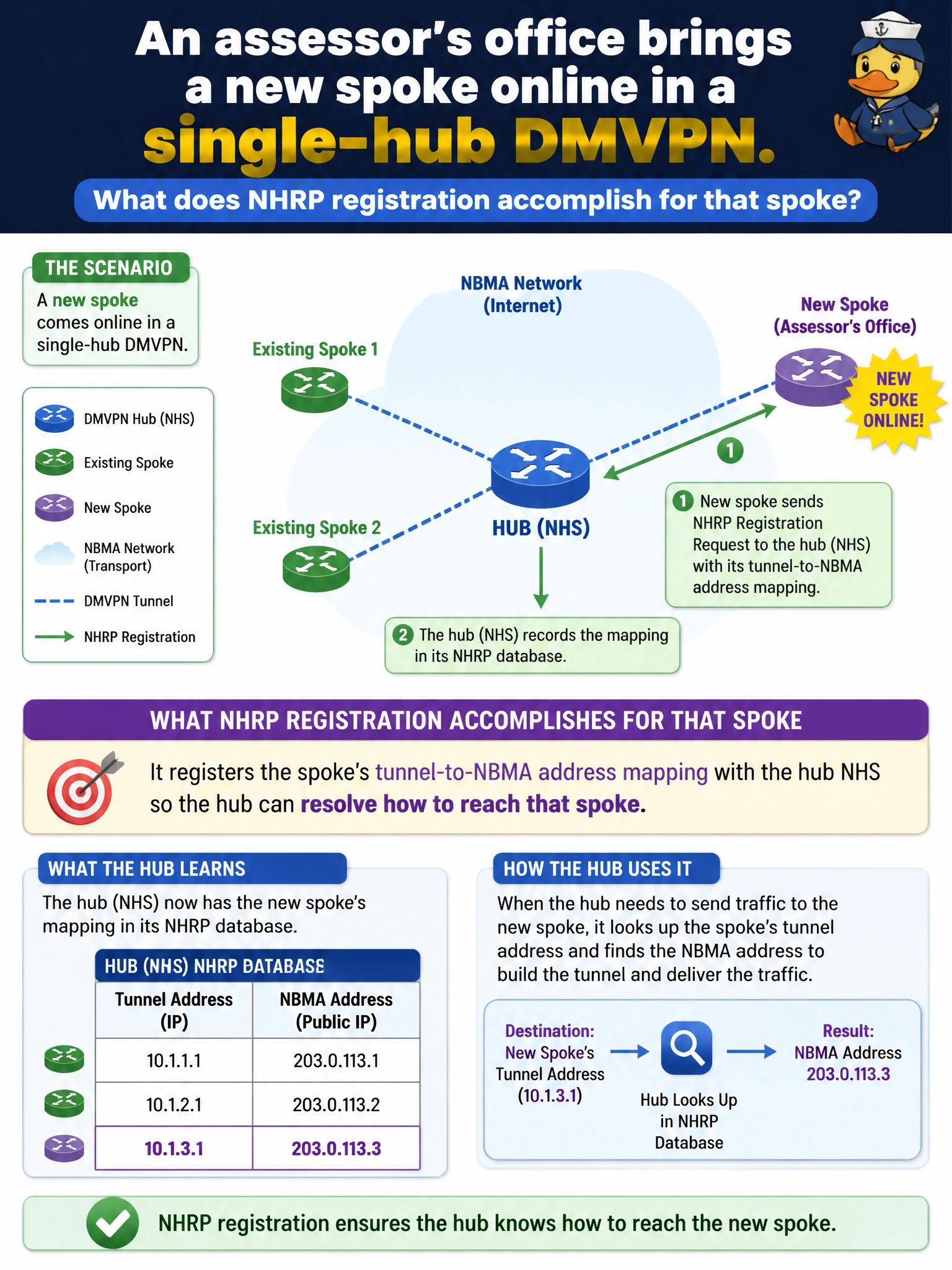
NHRP registration is the spoke checking in at HQ’s front desk: here’s my public street address so you can find me. Without that mapping, the hub has no NBMA path to the spoke. Dynamic DMVPN depends on that check-in.
Full Explanation
When an assessor’s office brings a new spoke online in single-hub DMVPN, NHRP registration publishes the spoke’s tunnel-to-NBMA (public underlay) address mapping to the hub Next Hop Server. The hub then knows how to encapsulate return traffic to that spoke’s current public address. Without registration, the hub lacks a dynamic binding for the spoke’s NBMA endpoint, and multipoint reachability fails even if underlay IP ping to the Internet works. Registration is the dynamic directory function that replaces per-spoke static maps on the hub.
NHRP registration does not assign MPLS VPN labels for a spoke VRF on a provider P core; that is L3VPN machinery. It does not force static crypto maps to every other spoke’s public IP—that is what DMVPN avoids. It does not convert the underlay into an MPLS LSP or turn CE routers into LSRs; the underlay remains IP, and the overlay remains GRE/mGRE plus NHRP.
Exam caveat: registration to the hub is necessary for hub-spoke tunnels; spoke-to-spoke shortcuts additionally need redirect/resolution depending on DMVPN phase. Operational check: on the new spoke confirm ip nhrp nhs points at the hub tunnel address, then on the hub verify a dynamic NHRP mapping for the spoke’s NBMA (show ip nhrp / show dmvpn) and successful overlay ping before troubleshooting routing protocols.