
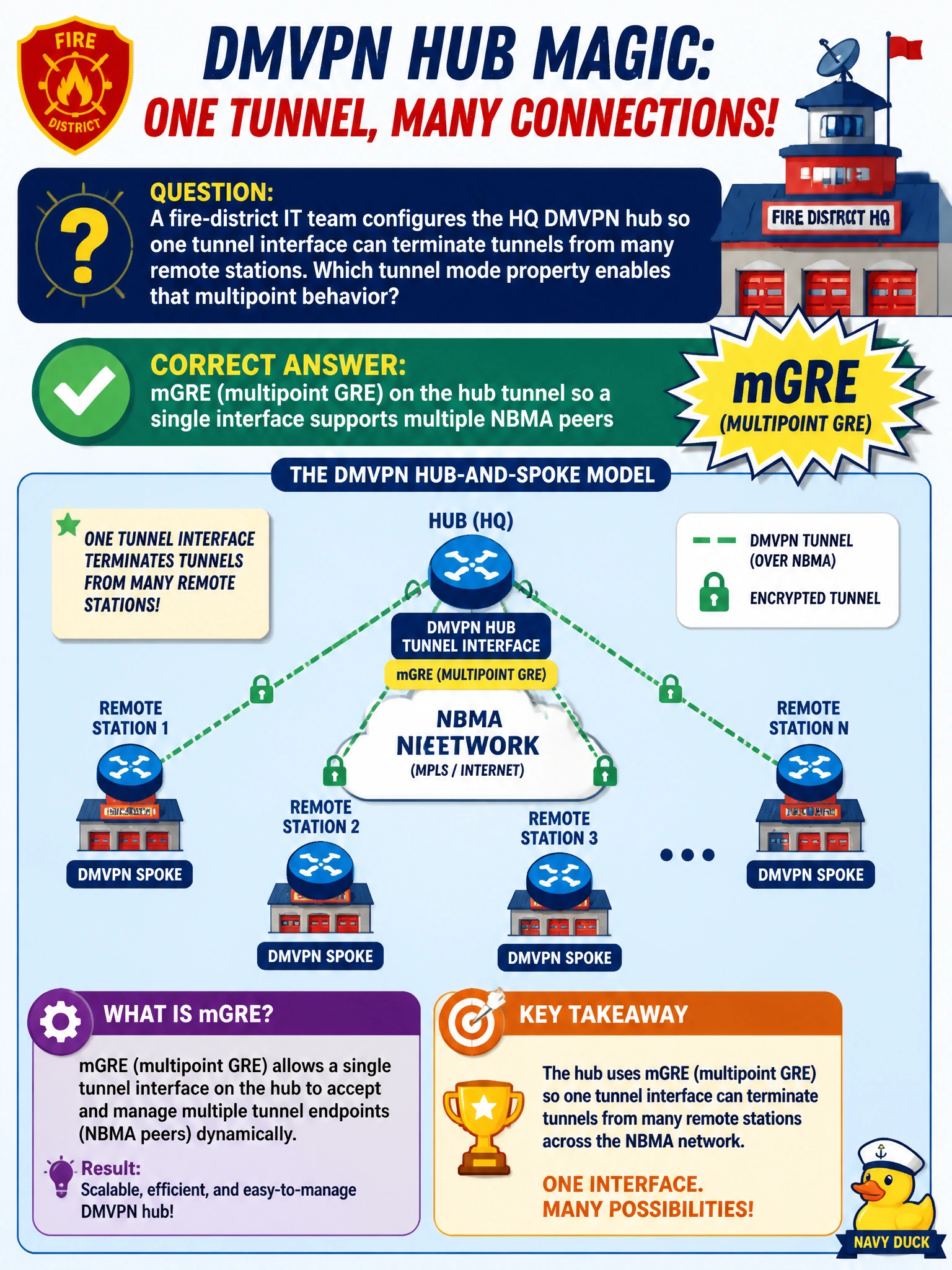
A fire-district IT team configures the HQ DMVPN hub so one tunnel interface can terminate tunnels from many remote stations. Which tunnel mode property enables that multipoint behavior?
Select an answer to reveal the explanation.
Short Explanation
mGRE is the multipoint loading dock: one tunnel interface, many truck bays. Point-to-point GRE would make you build a separate dock door per station.
Full Explanation
For a fire-district HQ DMVPN hub that must terminate tunnels from many remote stations on one tunnel interface, the enabling property is mGRE (multipoint GRE). Multipoint mode allows a single tunnel interface to support multiple NBMA peers resolved via NHRP, instead of dedicating a point-to-point GRE tunnel interface per spoke. That is the foundational hub-side encapsulation choice for classic DMVPN scale-out across civic stations.
Point-to-point GRE with a unique tunnel interface per spoke works but defeats the operational goal of one hub tunnel serving many stations and does not match the multipoint DMVPN pattern. Pure IPsec VTI without GRE can encrypt point-to-point, but it is not the mGRE/NHRP multipoint model the stem describes for one interface terminating many dynamic peers. L2TPv3 bridging with no GRE or NHRP is a different Layer 2 tunneling technology and does not provide the DMVPN hub multipoint control plane.
Exam caveat: spokes may use mGRE or p2p GRE depending on phase/design, but the hub in multipoint DMVPN needs mGRE for many dynamic peers on one interface. Operational check: verify the hub tunnel is tunnel mode gre multipoint, confirm multiple dynamic NHRP mappings under one tunnel (show dmvpn / show ip nhrp), and ensure adding a station does not require a new hub tunnel interface.