
A parks department compares a carrier-managed MPLS L3VPN for dense campus sites against building DIY DMVPN over the Internet for a few sparse trailhead offices. When is the managed L3VPN service the more appropriate describe-level choice?
Select an answer to reveal the explanation.
Short Explanation
If you want the carrier to run the VRF-and-label heavy lifting across many sites, buy managed L3VPN. If you only need a few Internet spokes you operate yourself, DMVPN is the DIY overlay toolkit.
Full Explanation
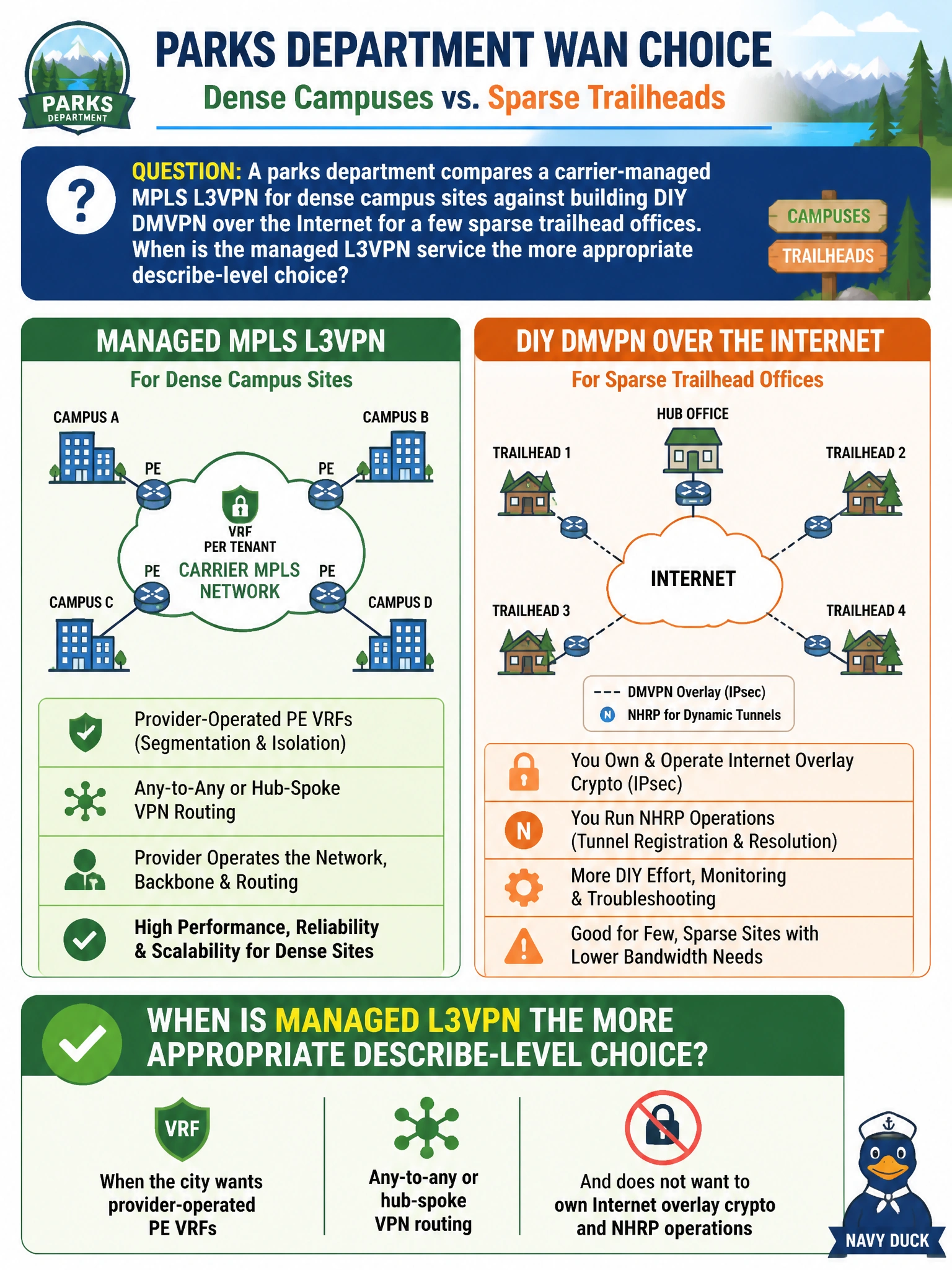
For a parks department choosing between a carrier-managed MPLS L3VPN for dense campus sites and DIY DMVPN over the Internet for sparse trailheads, managed L3VPN is the better describe-level fit when the city wants the provider to operate PE VRFs, offer any-to-any or hub-and-spoke VPN routing, and relieve civic staff from owning Internet overlay crypto, NHRP, and multipoint tunnel operations. The value is outsourced multi-site VRF VPN service with provider PE/P scale, not merely “tunnels somewhere.”
Limiting managed L3VPN to cases where every remote site must form encrypted spoke-to-spoke tunnels over public ISP addresses describes DMVPN/IPsec overlay goals, not the primary reason to buy MPLS L3VPN. Treating encryption of citizen data on the public Internet as the only requirement points to IPsec/DMVPN-style overlays; managed L3VPN typically assumes a provider MPLS backbone rather than public-Internet crypto as its defining feature. Requiring parks CE routers to run LDP and hold provider transport labels misunderstands the CE role in managed L3VPN and is not a selection criterion.
Exam caveat: both technologies can connect sites; the stem asks which is more appropriate when the city does not want to operate the Internet overlay control plane. Operational check: inventory whether sites already sit on provider PE attachments with VRFs/RTs versus Internet circuits needing mGRE/NHRP/IPsec; if staff must not run NHS registration and tunnel protection, prefer managed L3VPN and validate PE-CE routing and inter-site VRF reachability with the carrier.