
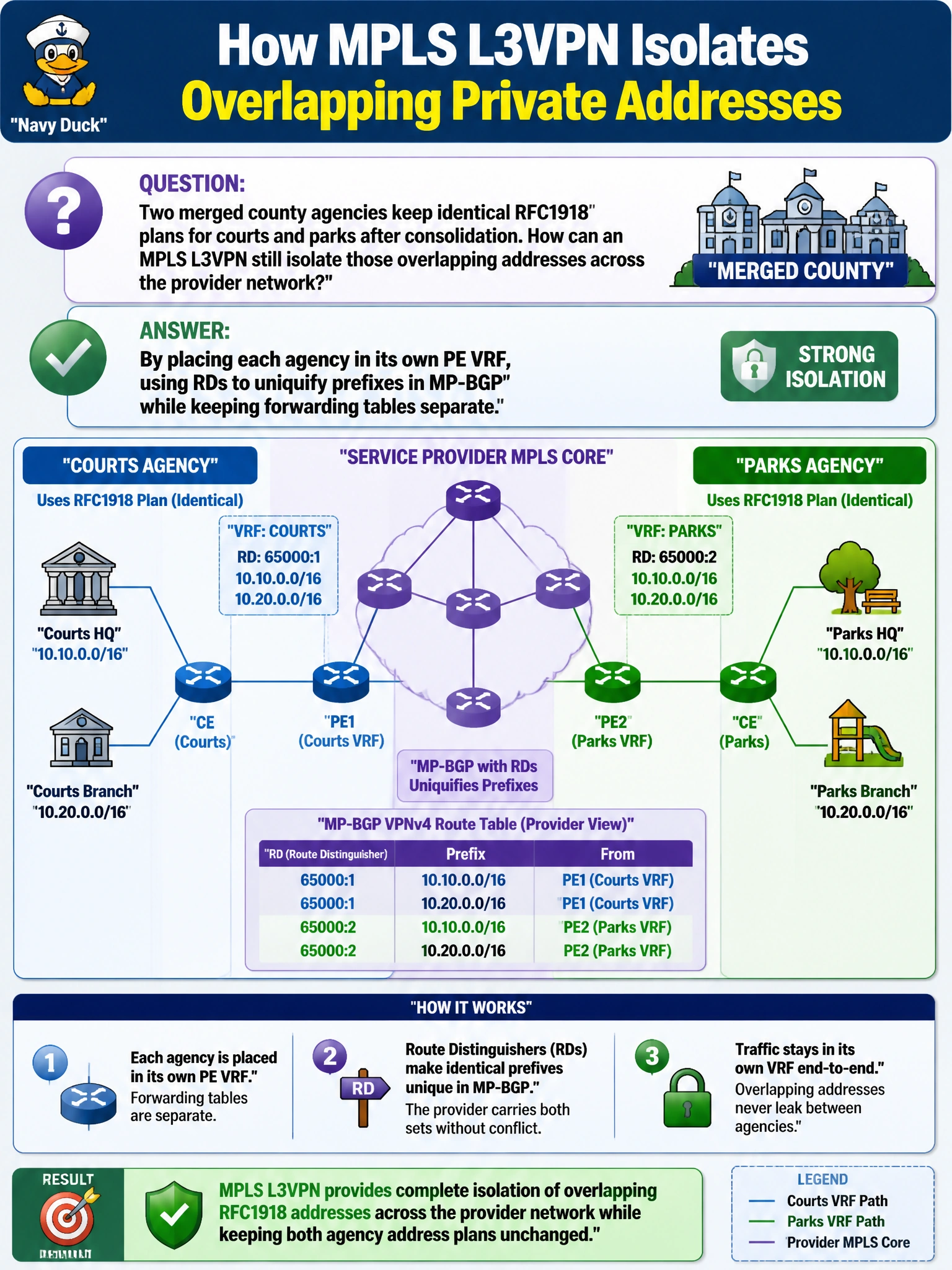
Two merged county agencies keep identical RFC1918 plans for courts and parks after consolidation. How can an MPLS L3VPN still isolate those overlapping addresses across the provider network?
Select an answer to reveal the explanation.
Short Explanation
Overlapping 10.0.0.0 plans are fine when each agency lives in its own VRF apartment. RDs make the prefixes unique in MP-BGP while the forwarding tables stay separate. That’s how merged courts and parks keep identical addressing without colliding.
Full Explanation
After county consolidation, courts and parks can keep identical RFC1918 plans because MPLS L3VPN isolates each agency in its own PE VRF. Route distinguishers prepend a unique value so overlapping prefixes become distinct VPNv4/VPNv6 NLRI in MP-BGP, while separate VRF forwarding tables keep packets from mixing. Route targets then control which VRFs import which VPN routes. Overlap is therefore a solved multi-tenancy problem rather than a reason to renumber before any connectivity exists.
Forcing both agencies into one global routing table with longer masks destroys isolation and still leaves duplicate addresses ambiguous inside one table. Disabling route distinguishers so prefixes collide is the opposite of L3VPN design and can prevent correct VPNv4 advertisement. Requiring every CE to renumber before PE adjacency forms may be an operational preference, but it is not required for MPLS L3VPN isolation—VRFs plus RDs exist specifically so overlapping civic plans can coexist across the provider network.
Exam caveat: RD uniqueness in MP-BGP is not the same as RT import policy; overlapping VRFs can still leak if RTs are mis-imported. Operational check for the merged county: place each agency in its VRF, assign distinct RDs, advertise via MP-BGP, then verify both 10.0.0.0/24-style prefixes appear as distinct VPNv4 entries and that show ip route vrf COURTS versus show ip route vrf PARKS remain separate while CE pings succeed only inside the intended VPN membership.