
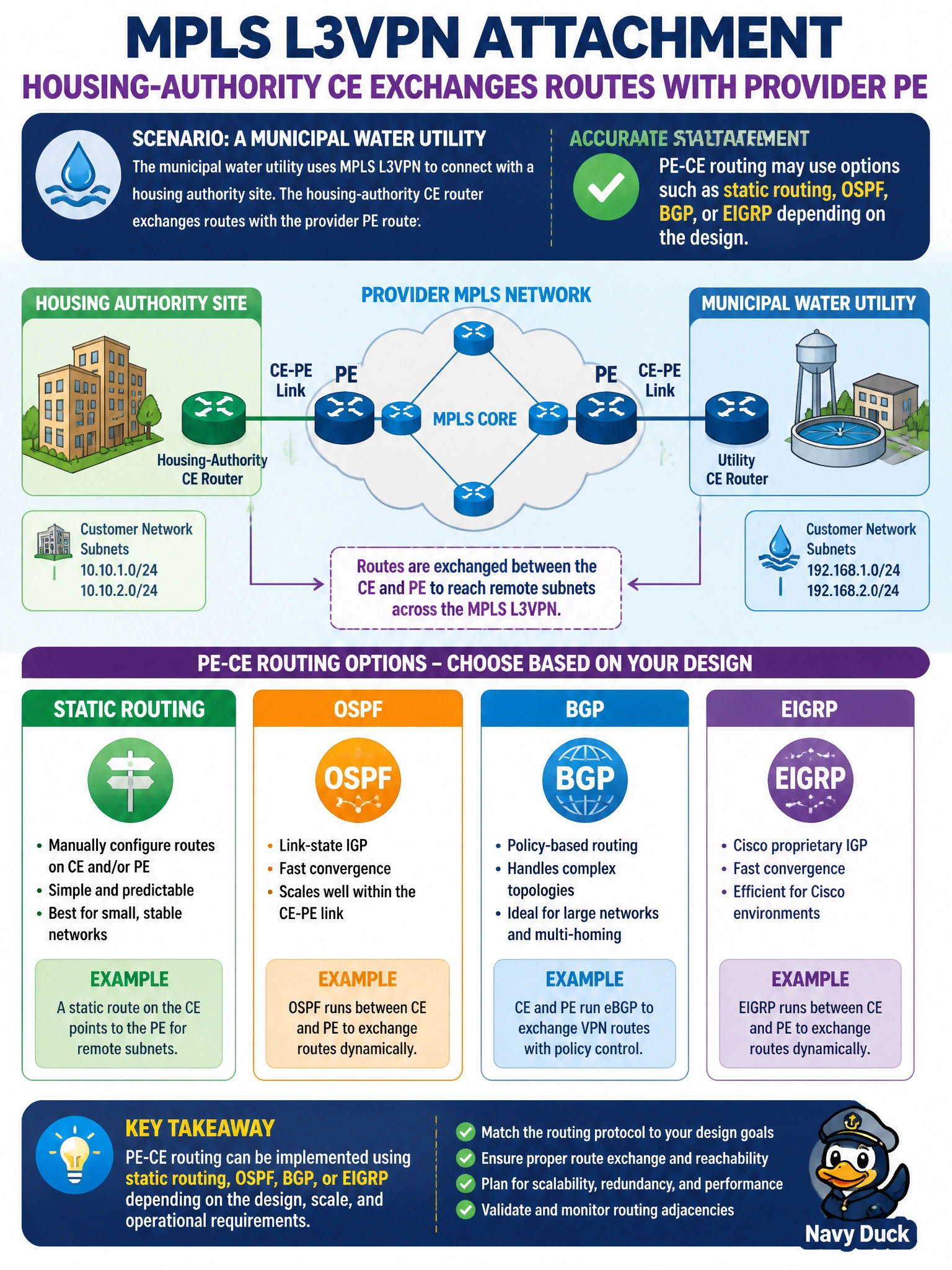
A municipal water utility describes how a housing-authority CE can exchange routes with the provider PE on an MPLS L3VPN attachment. Which statement is accurate at describe depth?
Select an answer to reveal the explanation.
Short Explanation
The PE-CE link is just the handshake at the curb—static is fine, or run OSPF, BGP, or EIGRP if the design calls for it. MPLS L3VPN does not lock you into one PE-CE protocol religion.
Full Explanation
A municipal water utility describing how a housing-authority CE exchanges routes with the provider PE on an MPLS L3VPN attachment should know that PE-CE routing is flexible at describe depth. Designs may use static routing, OSPF, BGP, or EIGRP (among common options) depending on operational preference, overlapping address needs, and provider support. The PE places those learned routes into the appropriate VRF and then advertises them into MP-BGP as VPNv4 for other sites; the PE-CE protocol choice is independent of the PE-PE MP-BGP core mechanism.
Only static routing being supported, with dynamic PE-CE protocols prohibited on ENARSI L3VPN designs, is false. Dynamic PE-CE is widely used and examined; static is an option, not the sole allowed method.
PE-CE must always be DMVPN mGRE with NHRP because MPLS L3VPN cannot attach CEs otherwise confuses two architectures. DMVPN is an overlay VPN model; MPLS L3VPN attaches CEs via ordinary PE-CE IP routing without requiring mGRE/NHRP.
PE-CE adjacency formed only with LDP directly between the CE and every P router misplaces LDP into the attachment circuit and core roles. CEs typically do not run LDP to every P; LDP runs among provider LSRs for transport labels.
Exam caveat: when PE-CE is OSPF or EIGRP, remember VRF-aware process/instance separation and PE as superbackbone quirks for OSPF. BGP PE-CE often uses different ASNs or allowas-in/as-override for overlapping designs. Know the options without claiming only one is legal.
Operational check: verify the designed PE-CE method (static vs protocol) is up in the correct VRF; confirm prefixes appear in show ip route vrf on the PE and as VPNv4 on MP-BGP; ensure the housing-authority CE is not expected to peer LDP with P routers. Test failover if dual PE-CE links exist.