
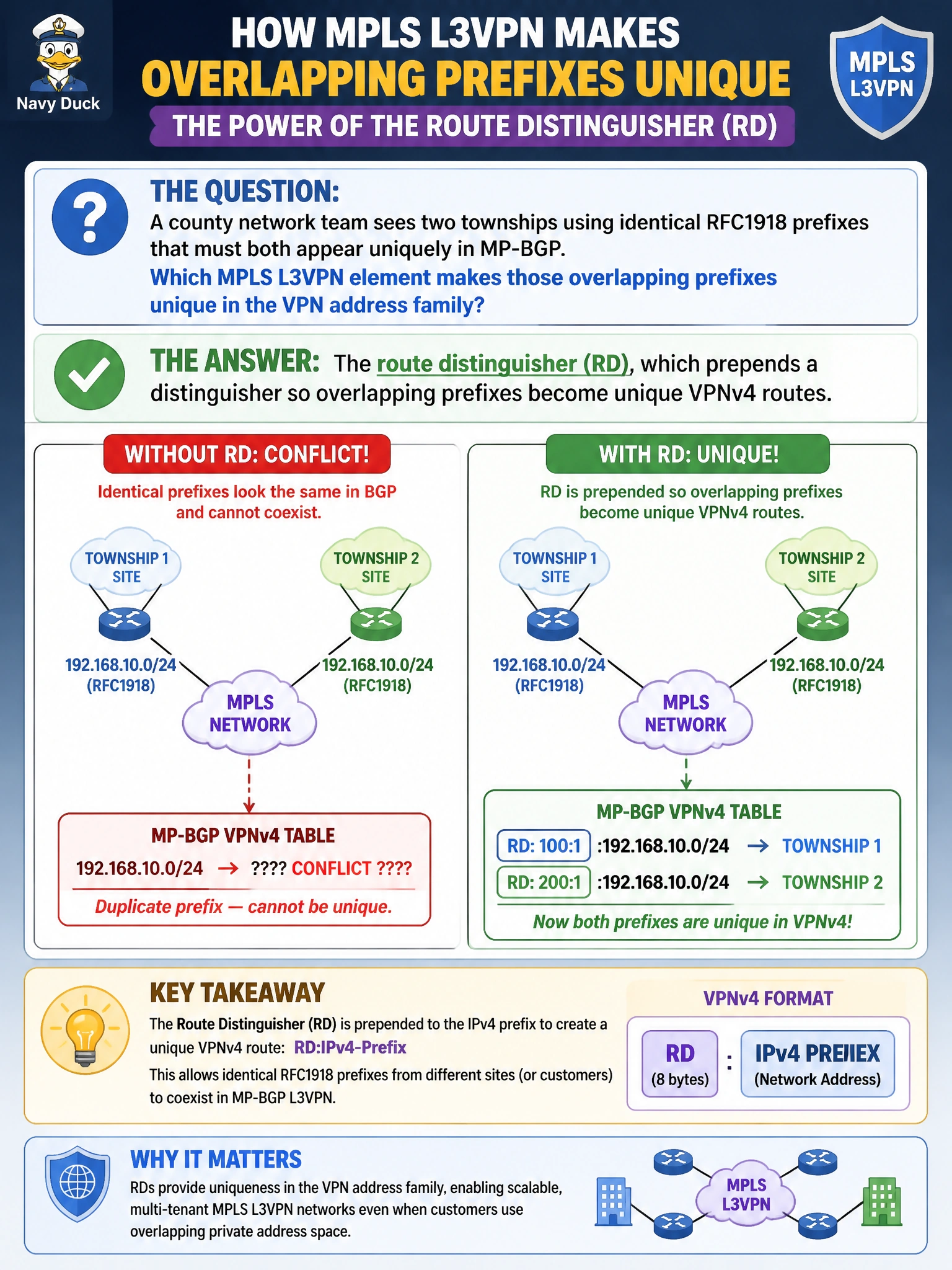
A county network team sees two townships using identical RFC1918 prefixes that must both appear uniquely in MP-BGP. Which MPLS L3VPN element makes those overlapping prefixes unique in the VPN address family?
Select an answer to reveal the explanation.
Short Explanation
You can keep both townships’ identical prefixes distinct with a route distinguisher. It prepends a unique value to each customer prefix, so MP-BGP carries them as separate VPNv4 routes.
Full Explanation
The route distinguisher (RD) makes overlapping customer IPv4 prefixes unique in the VPN address family. Prepended to a customer prefix, it forms a VPNv4 route, allowing MP-BGP to carry both townships’ identical prefixes as distinct NLRI. Identical route targets do not collapse duplicate prefixes into a single uniquely identified route: route targets govern which VRFs import and export routes, while the RD supplies prefix uniqueness. Penultimate-hop popping removes the transport label near the egress; it does not make overlapping customer prefixes unique in MP-BGP. A shared CE BGP ASN does not force the townships into one global routing table or distinguish their overlapping VPNv4 prefixes; the RD provides that distinction. Exam caveat: RD formats such as ASN:nn or IP:nn provide uniqueness in MP-BGP, whereas RTs control VRF membership, so do not confuse their roles. As a practical check, use show bgp vpnv4 unicast all | include <prefix> to verify that the townships’ prefixes appear as two VPNv4 entries with different RDs. Within each VRF, route installation still depends on import policy; changing an RD alone does not change that membership.