
An assessor's office defines how labeled packets traverse the provider cloud toward a remote township. What does an LSP represent in that MPLS model?
Select an answer to reveal the explanation.
Short Explanation
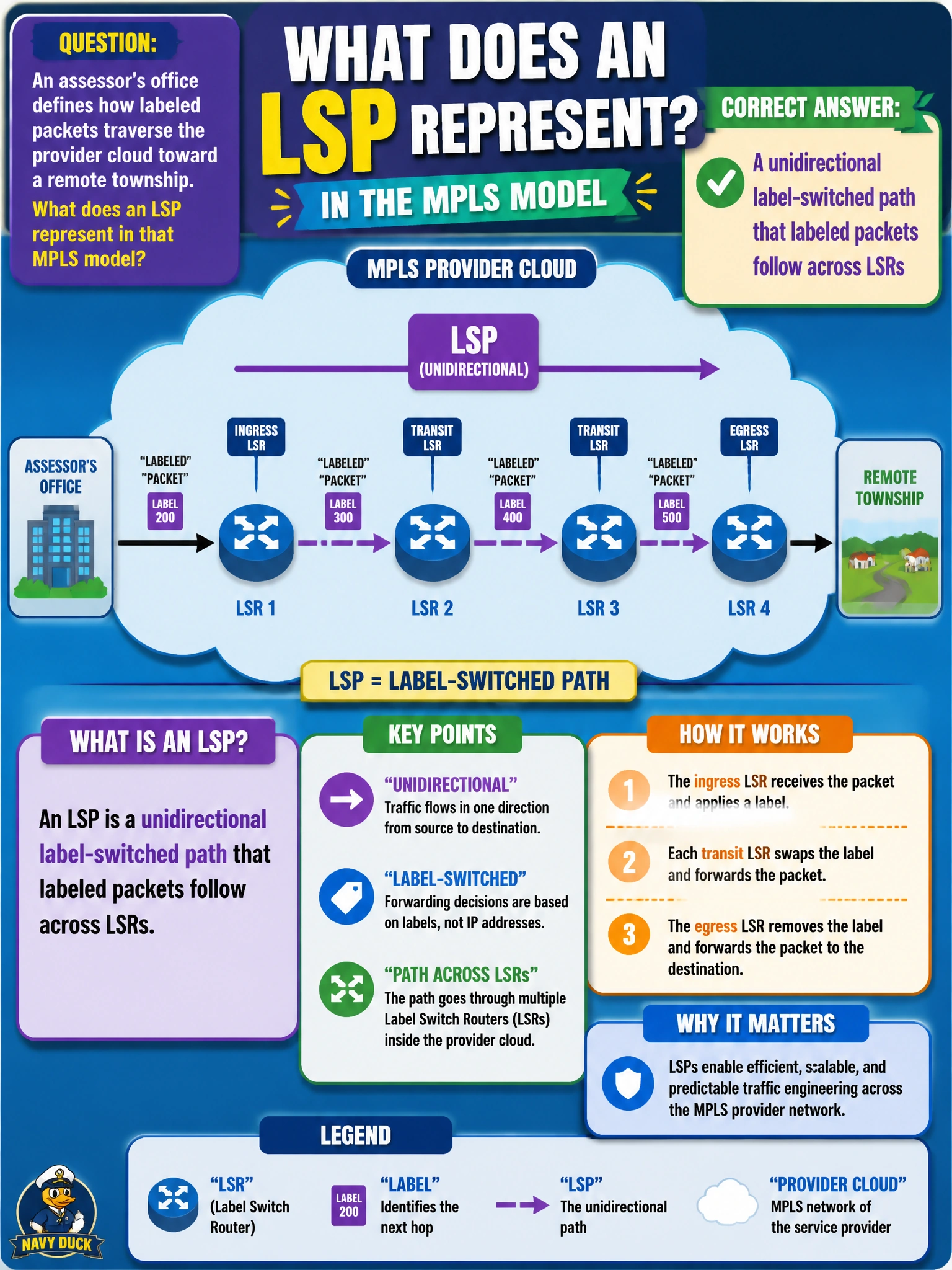
An LSP is a one-way labeled freeway across the provider cloud. Packets ride the label hops in one direction; return traffic needs its own path the other way—not a magical two-lane GRE by default.
Full Explanation
For an assessor's office sending labeled packets across the provider cloud toward a remote township, a Label Switched Path (LSP) is the unidirectional sequence of label-forwarding hops the packet follows through the MPLS domain. Each LSR along that path performs the programmed label operation (push/swap/pop) so the packet advances toward the egress FEC. Return traffic is not assumed to reuse that same LSP as a bidirectional circuit; a separate LSP (or path) exists in the reverse direction under normal hop-by-hop LDP designs.
Calling an LSP a bidirectional GRE tunnel that must be mirrored with identical keys on both PEs fails by concept. GRE is an IP encapsulation tunnel model; LSPs are label-switched paths and are unidirectional by definition unless a specific bidirectional TE construct is explicitly built.
A VRF route-target community used only for importing parks department prefixes is an MP-BGP VPN membership attribute, not the forwarding path itself. RTs control which VPN routes enter a VRF; they are not the LSP.
An IPsec crypto ACL that replaces LDP whenever the IGP metric changes confuses security policy with label signaling. Crypto ACLs select interesting traffic for IPsec; they do not define MPLS LSPs or replace LDP when metrics change.
Exam caveat: questions often test unidirectionality and the impose/swap/dispose model. Traffic engineering may create explicit LSPs, but the stem's provider-cloud labeled traversal still centers on LSP as the labeled path, not GRE, RT, or IPsec.
Operational check: identify the FEC and walk show mpls forwarding-table hop by hop from ingress to egress; confirm labels change (swap) at transit; verify reverse-direction bindings separately. Do not troubleshoot "one LSP" as if it automatically carries township-to-assessor return flows.