
A port authority learns the same permit-portal prefix as an intra-area OSPF route, an inter-area route, and an external route. Which preference order should guide troubleshooting?
Select an answer to reveal the explanation.
Short Explanation
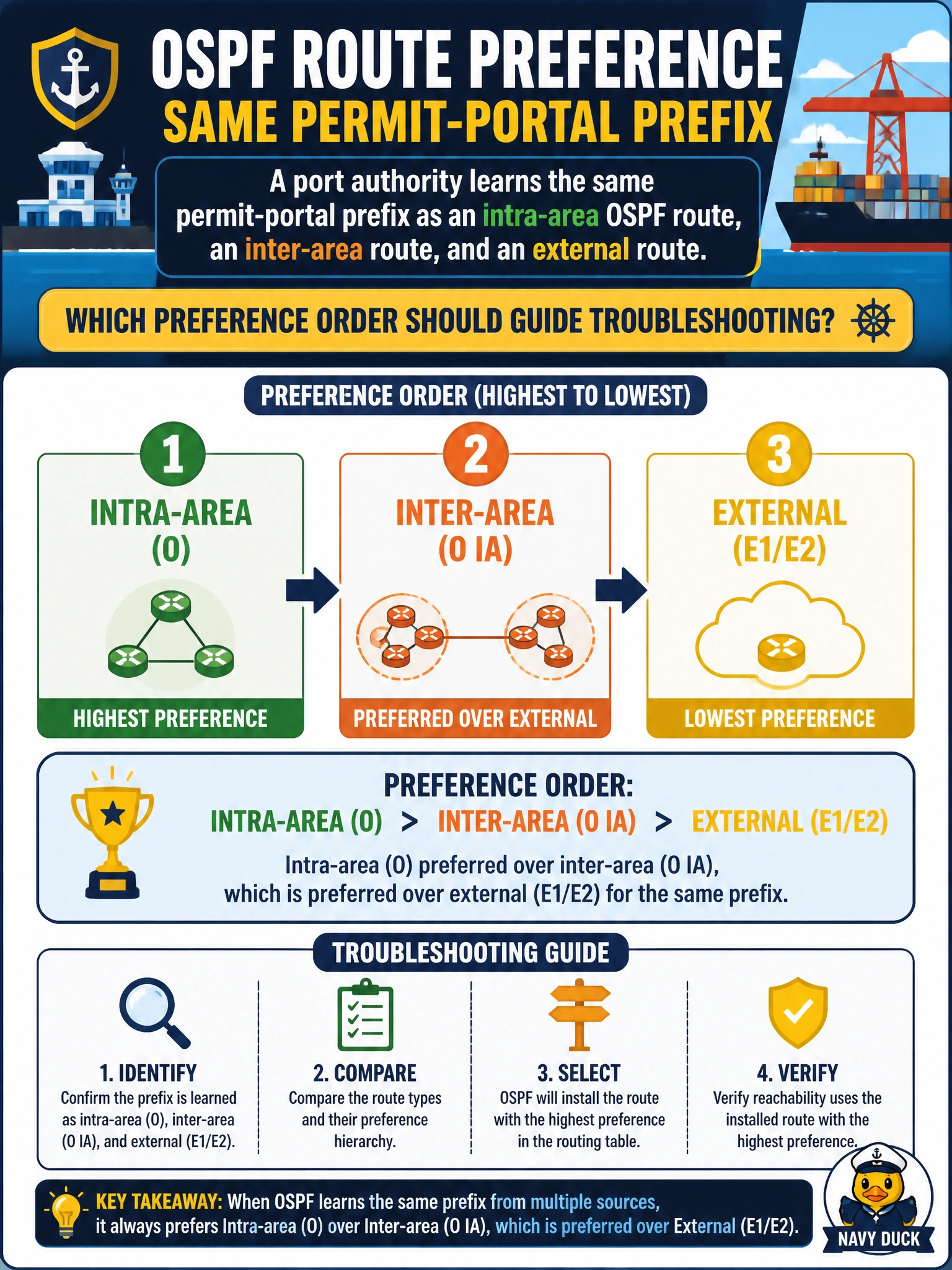
OSPF likes the story closest to home first. Routes born in your area beat summaries from another area, and those beat "external" stamps from outside OSPF. When three flavors show up for one permit portal, start with that order.
Full Explanation
When a port authority learns the same permit-portal prefix as an intra-area OSPF route, an inter-area route, and an external route, OSPF prefers the most “internal” path type first: intra-area (O) over inter-area (O IA) over external (E1/E2). That order exists so topology knowledge from the local area wins over ABR summaries, which win over redistribution from outside OSPF. Troubleshooting should therefore expect the O path to install when all three describe the same prefix—matching the correct preference statement. External Type-5 first, then inter-area, then intra-area reverses the preference ladder and would make redistributed paths override local topology knowledge incorrectly. Inter-area always beating intra-area when the ABR has a higher router ID invents a RID-based override that does not replace path-type preference. Installing all three as equal-cost paths without type preference is wrong; OSPF does not ECMP across O, O IA, and external as equivalent types for the same prefix. Exam caveat: within externals, E1 still beats E2; the O > O IA > E rule is the broader ladder ENARSI expects you to recite during dual-path confusion. Operational check: show ip route for the permit-portal prefix and note the code (O vs O IA vs E1/E2); inspect competing LSAs in the database; if an unexpected type wins, look for area misassignment, ABR filtering, or accidental redistribution creating a shadow copy of an internal prefix.