
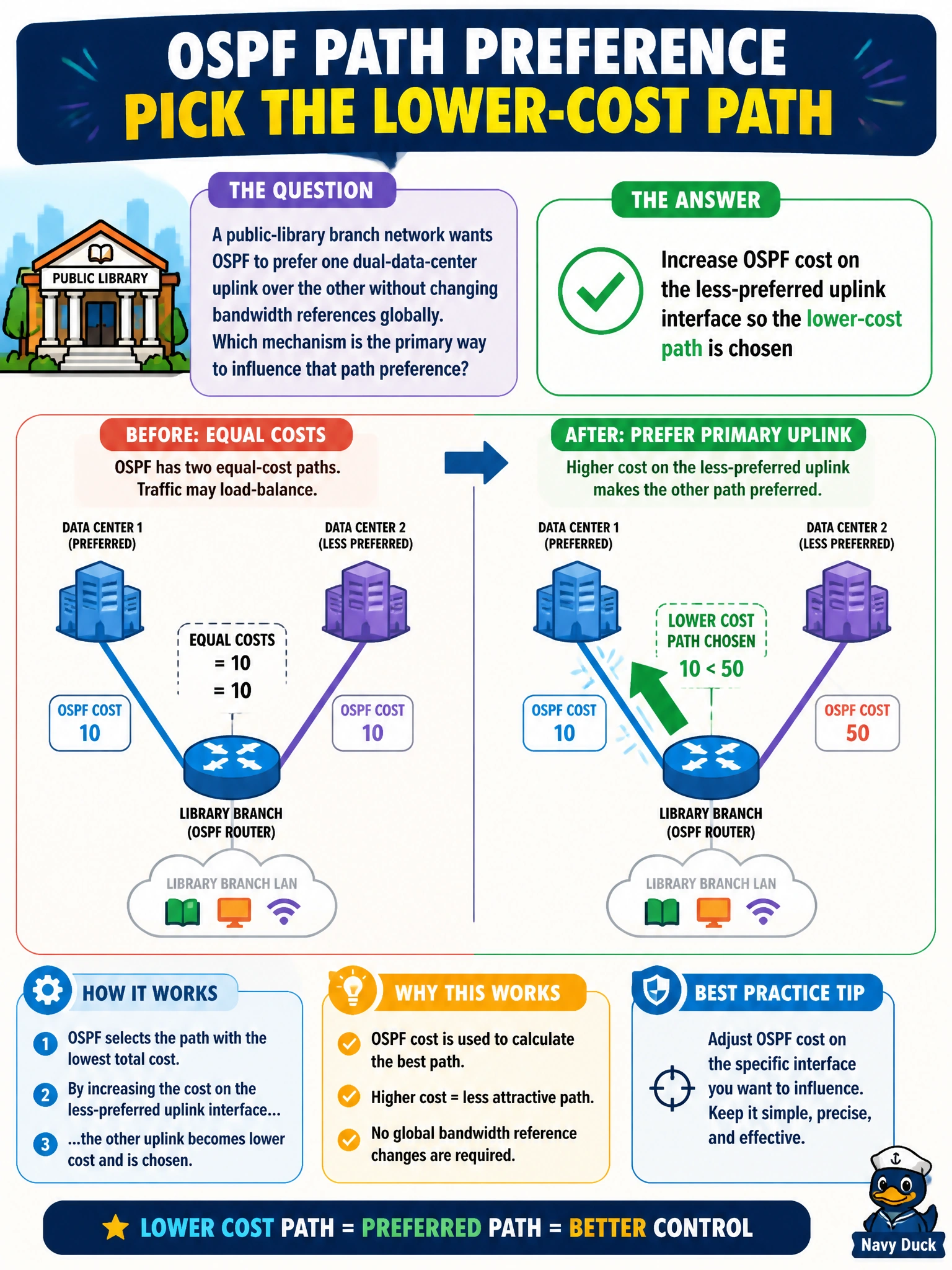
A public-library branch network wants OSPF to prefer one dual-data-center uplink over the other without changing bandwidth references globally. Which mechanism is the primary way to influence that path preference?
Select an answer to reveal the explanation.
Short Explanation
OSPF path picking is mostly "cheapest total toll." Bump the cost on the ugly uplink and the library traffic takes the nicer road to the data center—simple and local to that interface.
Full Explanation
A public-library branch that wants OSPF to prefer one dual-data-center uplink over the other without changing bandwidth references globally should raise the OSPF cost on the less-preferred uplink interface. OSPF selects the path with the lowest cumulative cost to the destination; increasing cost on the undesirable interface makes that path less attractive while leaving reference bandwidth and unrelated interfaces unchanged. That local, interface-scoped metric change is the primary, standard way to influence OSPF path preference in this scenario. Raising BGP Weight on the library edge so OSPF ignores interface metrics fails conceptually because Weight is a BGP attribute and does not override OSPF’s cost-based SPF decision inside the OSPF domain. Enabling split horizon on both uplinks to delete the higher-cost path misapplies a distance-vector loop-prevention idea to OSPF link-state selection and does not implement preference. Disabling hellos on the preferred link makes that adjacency fail, which is the opposite of preferring it and creates instability rather than traffic engineering. Exam caveat: cost changes affect OSPF path selection; they do not automatically engineer BGP inbound/outbound Internet preference—keep IGP TE and BGP TE separate on dual-homed library edges. Operational check: set ip ospf cost on the less-preferred uplink; compare show ip ospf interface costs; confirm show ip route to data-center prefixes exits via the lower-cost uplink; document the intentional asymmetry for change control.