
A city IT team must advertise VRF-connected court case-management subnets into BGP for a cloud handoff. Which redistribution pattern correctly injects those connected prefixes?
Select an answer to reveal the explanation.
Short Explanation
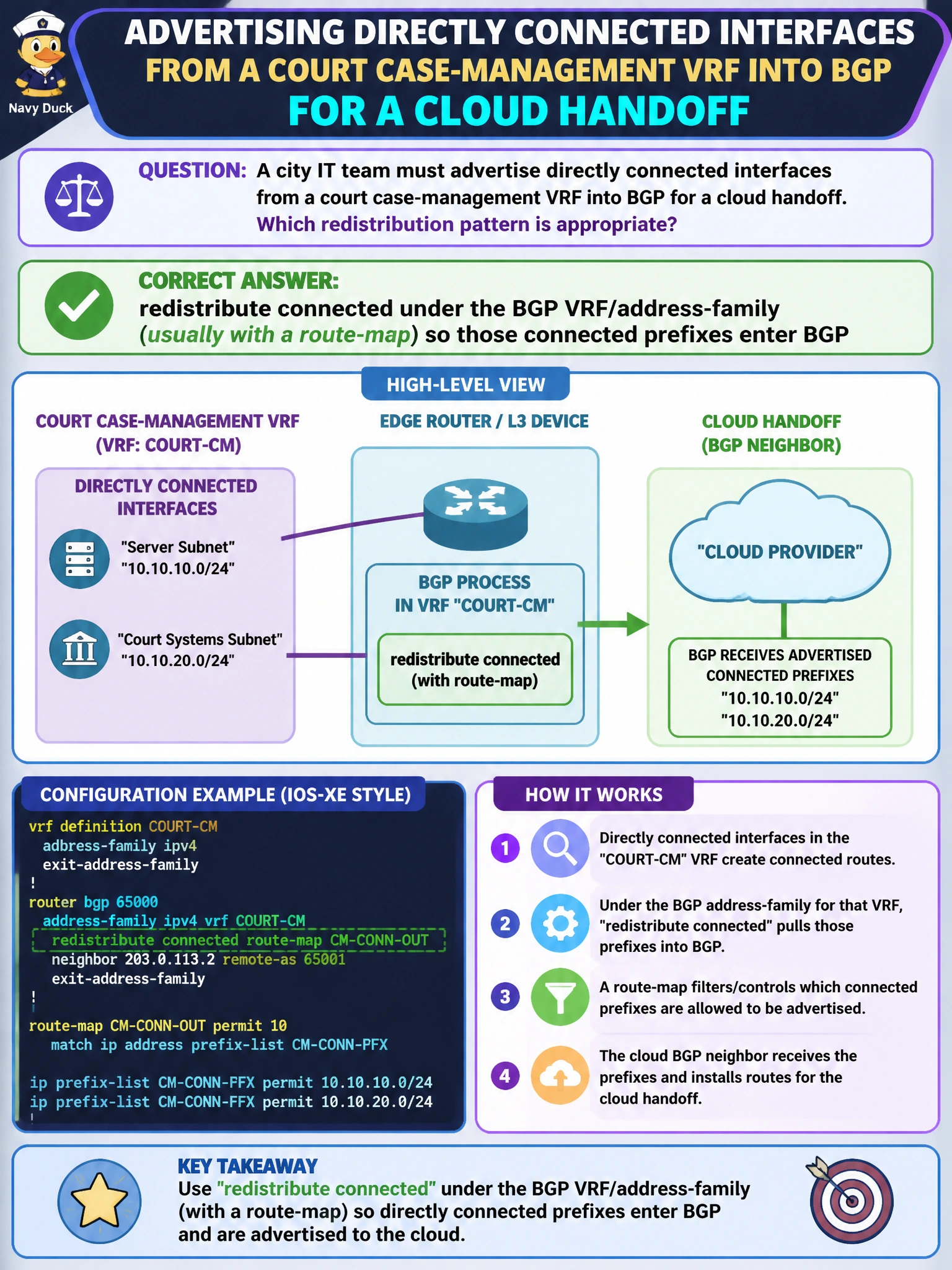
Your court VLANs are connected routes, and BGP won’t invent them. Use redistribute connected under the VRF’s BGP address family, with a route-map if you want to limit advertisements to case-management nets.
Full Explanation
Connected VRF interfaces holding the court case-management subnets are not automatically in BGP. To advertise them for the cloud handoff, use redistribute connected under the correct BGP address family for the VRF, optionally with a route-map that permits only the case-management subnets. This injects those connected prefixes into BGP so they can be advertised to the cloud peer. Redistributing OSPF with a metric does not create these connected routes in a routing context, so it cannot inject them as described. A default static route to null0 alone does not publish all VRF-connected prefixes into BGP. Neighbor default-originate advertises a default route to each peer; it does not originate the local court connected prefixes. Exam caveat: VRF-aware BGP requires redistribution within the VRF address family, not merely under global BGP; route distinguishers and route targets also affect VPNv4/cloud handoff, so check that route-target export includes the intended prefixes. Practical check: verify the prefixes in the VRF BGP table and confirm the configuration has redistribute connected under the VRF address family; then check the cloud neighbor’s advertised routes and the VRF routing table for the connected source interfaces.