
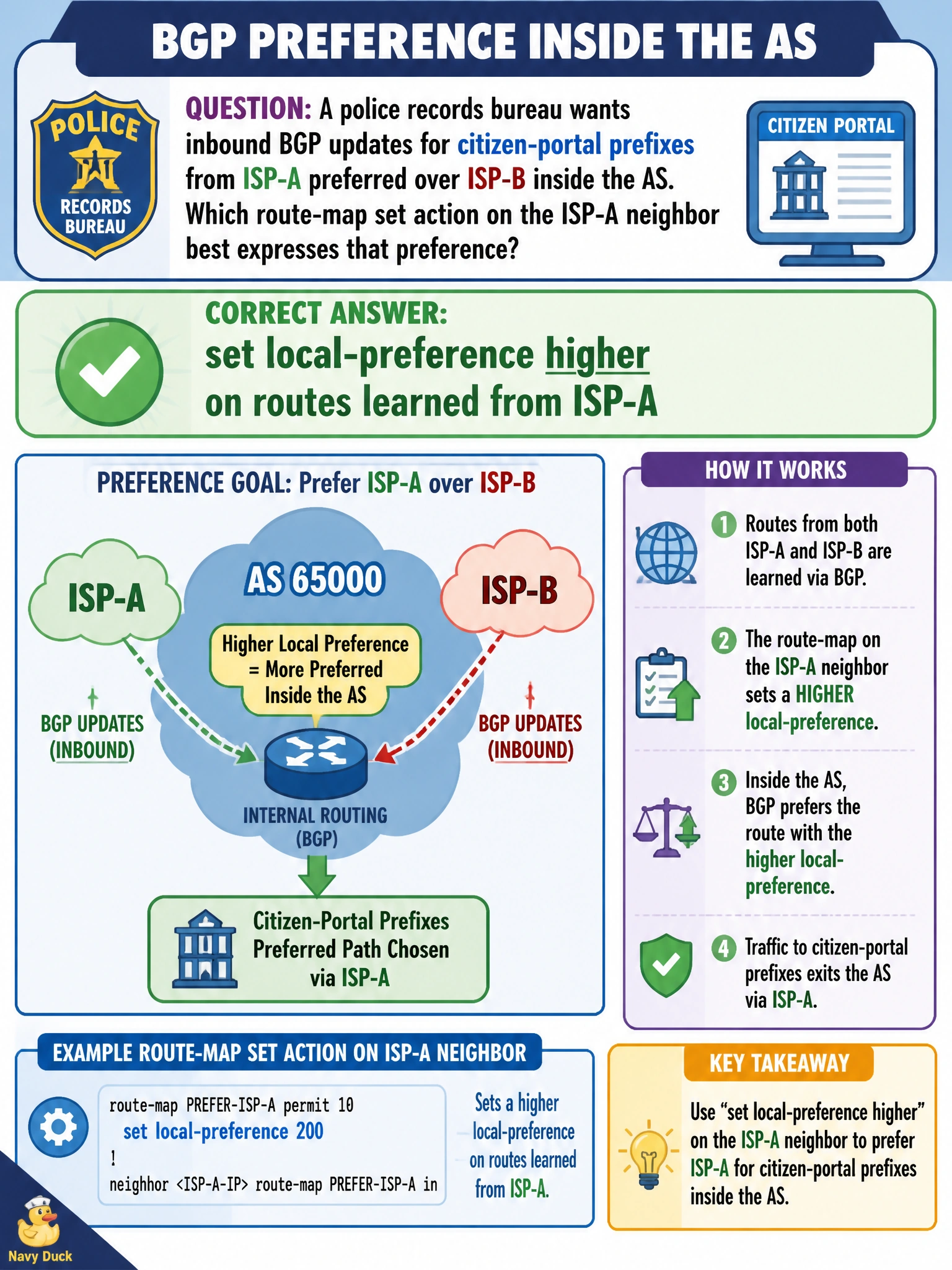
A police records bureau wants inbound BGP updates for citizen-portal prefixes from ISP-A preferred over ISP-B inside the AS. Which route-map set action on the ISP-A neighbor best expresses that preference?
Select an answer to reveal the explanation.
Short Explanation
You can make ISP-A the preferred exit by setting a higher local preference on its citizen-portal routes. That preference is shared across your AS, so its iBGP routers favor ISP-A for those destinations.
Full Explanation
Inside one AS, local preference is the primary BGP attribute for choosing an exit for a prefix. To prefer ISP-A for citizen-portal routes, apply an inbound route-map to the ISP-A neighbor, match the relevant prefixes, and set local preference higher than the default 100 or higher than the value on ISP-B’s paths. The bureau’s iBGP routers then prefer the ISP-A path when BGP selects a best path. Setting weight only on the ISP-B session does not make remote ASes honor it: weight is local to one Cisco router, and applying it to ISP-B alone does not express the requested bureau-wide preference. Setting metric-type type-1 is an OSPF redistribution concept; BGP peers do not treat it as local preference. Setting tag 0 does not force MED comparison ahead of hot-potato IGP costs, and a tag is not a substitute for local preference. Exam caveat: local preference is carried within the AS through iBGP but is not sent to eBGP peers. Practical check: inspect the citizen-portal prefix with show ip bgp <citizen-portal-prefix> and confirm the ISP-A path has the higher LocalPref and is best; check the inbound route-map on ISP-A and, if needed, refresh inbound routes with clear ip bgp <isp-a> soft in.