
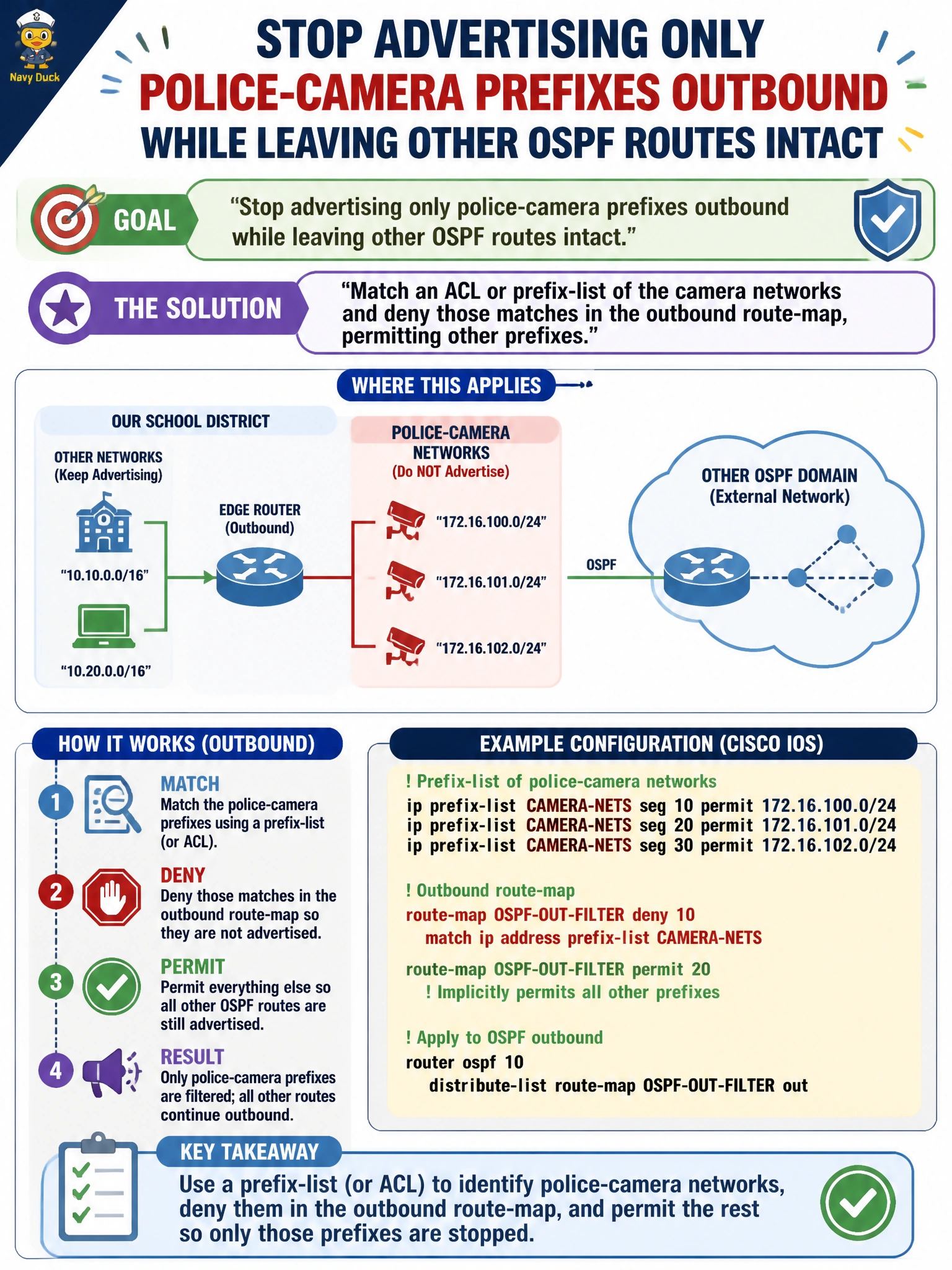
A school-district WAN team must stop advertising only police-camera prefixes outbound while leaving other OSPF routes intact. Which route-map approach achieves that selective filter?
Select an answer to reveal the explanation.
Short Explanation
You need a bouncer, not a wrecking ball. Match the camera prefixes in a route-map, deny just those, and let everything else through so the school WAN keeps talking.
Full Explanation
Selective outbound filtering requires matching the unwanted prefixes and denying only those matches while permitting the remainder. For a school-district WAN that must stop advertising police-camera prefixes outbound without disturbing other OSPF routes, build an ACL or prefix-list that identifies the camera networks, reference it in a route-map with an early deny clause for those matches, then permit other prefixes (explicitly or via a later permit any). Apply that route-map outbound on the redistribution point, distribute-list, or neighbor/out policy appropriate to the protocol context described in the design.
The approach that clears the OSPF process so camera routes age out without a filter is disruptive and temporary; camera routes reappear when LSAs are relearned, and it is not a filter. The approach that raises administrative distance on all OSPF routes to 255 to suppress advertisements suppresses local installation broadly and is not a surgical outbound advertisement control for camera nets alone. The approach that disables split horizon globally, which blocks only camera /32s, misuses split horizon: split horizon stops advertising a route back out the interface on which it was learned; it is not a global camera-/32 filter and disabling it increases loop risk rather than solving selective export.
Exam caveat: remember route-map order—deny camera matches first, then permit the rest. An implicit deny at the end will drop everything if you forget a final permit. Prefix-lists are usually clearer than numbered ACLs for IPv4 prefix length matching on camera /28s vs summary /16s. Also distinguish filtering advertisements (control plane) from interface ACLs that drop data-plane camera packets.
Operational check: before the change, show ip route and the outbound advertisement (for example show ip ospf database external, show ip eigrp topology, or show ip bgp neighbors <x> advertised-routes depending on context) listing camera prefixes. After applying the deny/permit route-map, confirm camera prefixes are gone from advertisements while other school WAN OSPF routes remain. show route-map and show access-lists / show ip prefix-list verify hit counters increment on the deny clause.