
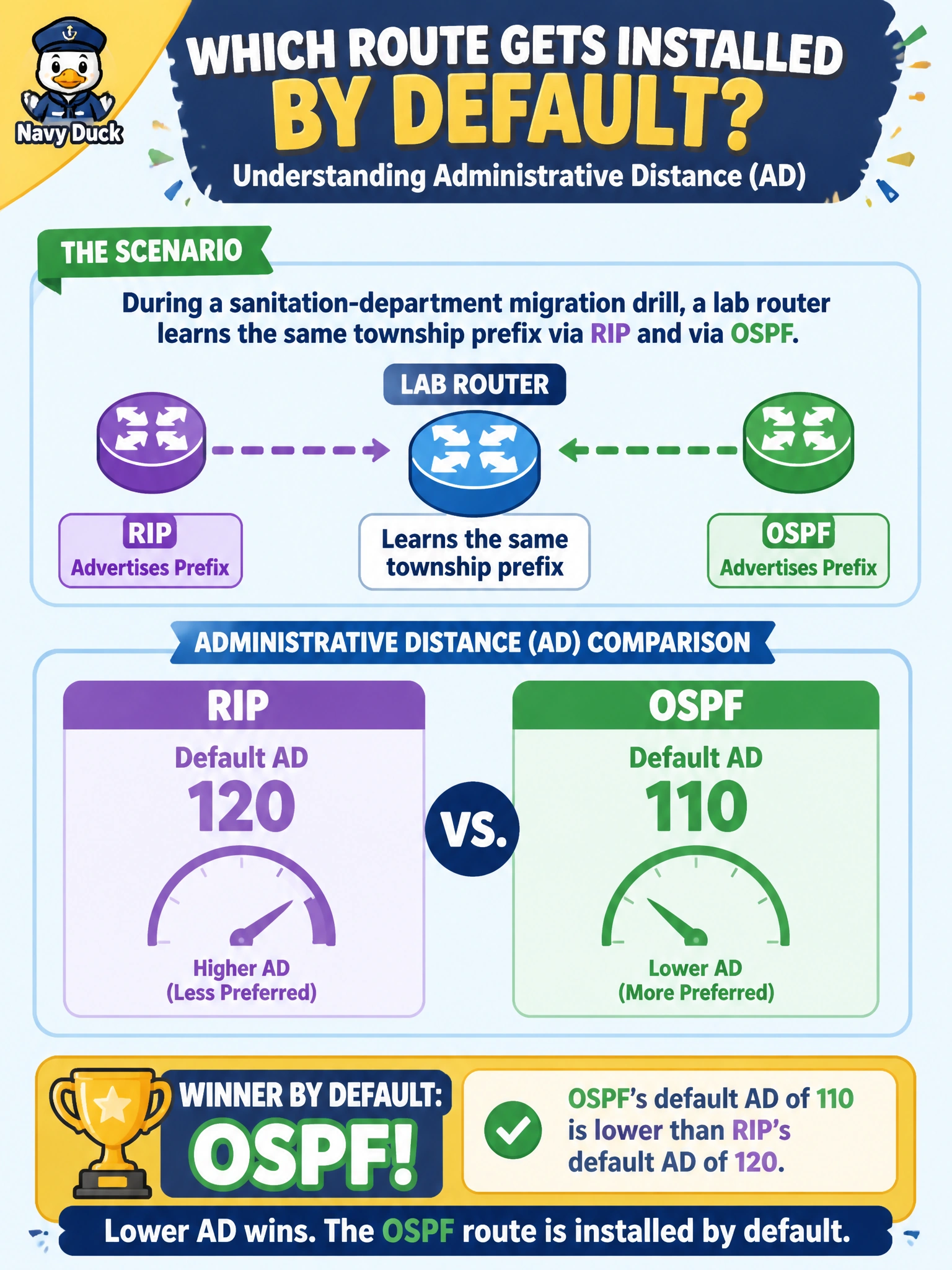
During a sanitation-department migration drill, a lab router learns the same township prefix via RIP and via OSPF. Which protocol’s route is installed by default?
Select an answer to reveal the explanation.
Short Explanation
Even in a dusty lab, AD still decides the beauty contest, and you get OSPF because its 110 beats RIP’s 120. The township prefix lands as OSPF unless someone overrides the distances.
Full Explanation
During the sanitation-department migration drill, both RIP and OSPF offer the same township prefix to the lab router. Default administrative distances are OSPF 110 and RIP 120. The lower AD installs, so the OSPF route enters the RIB. Hop count (RIP’s metric) and OSPF cost never compete directly across protocols; each protocol computes its own metric, then AD chooses which protocol’s best path is eligible for forwarding.
The claim that RIP wins because hop count always outranks OSPF cost fails because hop count does not outrank OSPF cost across sources—metrics are not compared between RIP and OSPF. The claim that neither route installs until redistribute connected is configured invents a redistribute connected requirement; learning a township prefix via RIP and via OSPF already provides two candidates without redistributing connected. The claim that RIP wins because legacy protocols receive preferential AD 90 invents a preferential AD 90 for legacy protocols; RIP’s default remains 120, while AD 90 belongs to internal EIGRP.
Exam caveat: RIPv2 may still appear in ENARSI scenarios for migration and redistribution labs. Engineers sometimes lower RIP’s distance to keep a temporary RIP domain preferred; if that temporary distance is left below 110 after OSPF cutover, township traffic may stick to RIP unexpectedly. Also remember that “same prefix” means identical length; a RIP /16 and an OSPF /24 are different routes and both can install.
Operational check: show ip route <township-prefix> should display the OSPF route code with [110/cost]. show ip rip database and show ip ospf database (or show ip route rip / show ip route ospf) verify both protocols still know the prefix while only OSPF is forwarding. After the drill, remove RIP carefully and confirm no leftover distance rip configuration remains under show run.