
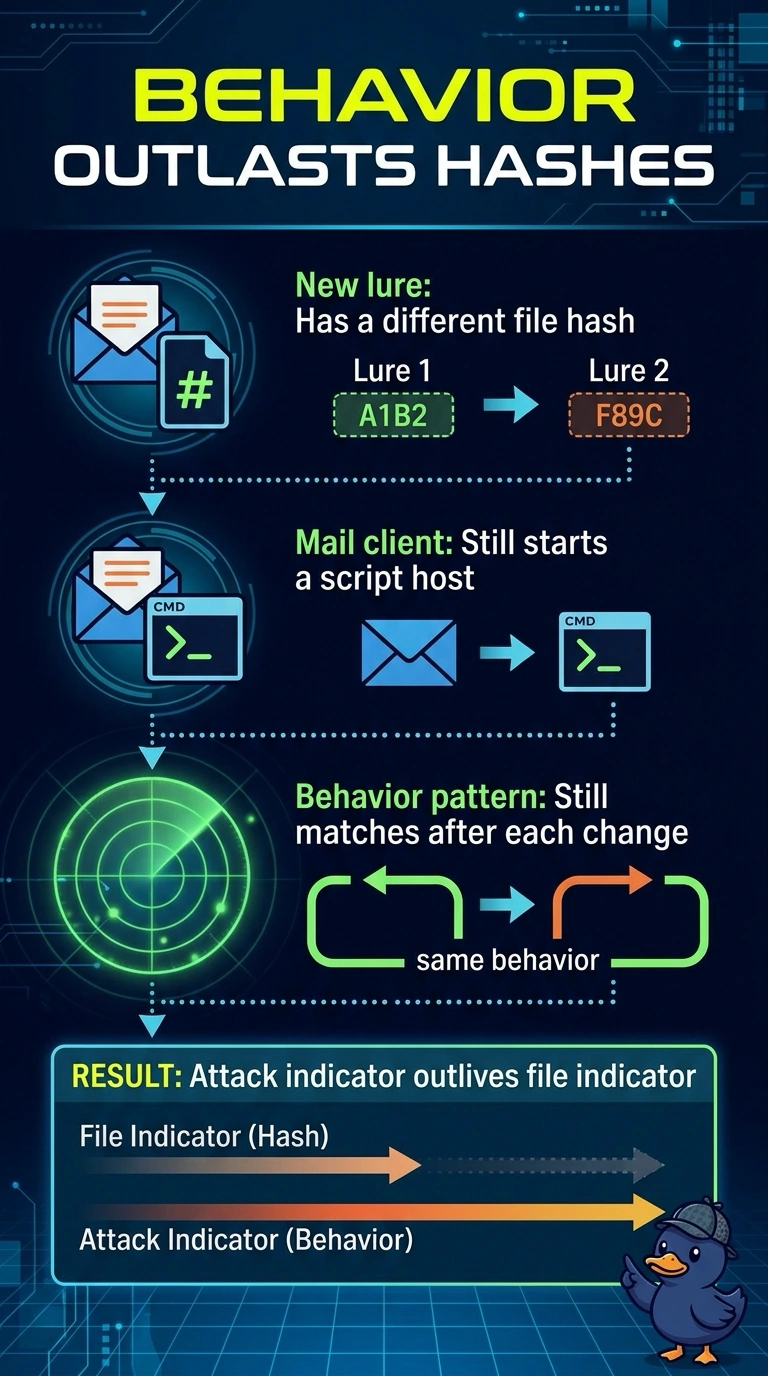
Each new lure in a software-company campaign has a different file hash, yet the mail client still starts a script host. Why does that indicator of attack outlive the hash indicator of compromise?
Select an answer to reveal the explanation.
Short Explanation
Chasing each new hash is like confiscating every new coat while the same person keeps walking in. You keep the behavior pattern, the mail client starting a script host, because that attack indicator outlives the file indicator. A fresh hash list goes stale the next time the lure is rebuilt.
Full Explanation
Polymorphic malware changes a wrapper or a key and keeps the same behavior, so each rebuilt lure has a new file hash while the mail client still starts a script host. The behavior pattern still matches after every hash change, so the attack indicator outlives the file indicator. An indicator of attack is that sequence, and A digest-specific IOC stops matching the changed variant but remains valid for the original bytes. Retire the behavior rule and keep chasing each new hash as the durable indicator and you drop the stable signal in favor of a value the campaign can rotate. The mail-client hash is not the only indicator that remains useful once the lure is rebuilt; the mail client is the parent in the behavior, not the malicious file you hash. Quarantine of one lure removes a single copy and does not remove the need to keep a behavior rule for the next rebuild. Exam caveat: a hash indicator is still worth deploying for the builds you already know, and it supplements the behavior rule rather than replacing it. Operational check: search endpoint telemetry for the mail client spawning a script host across the last set of lure hashes and confirm the same parent-child pair appears under more than one digest.