
A commercial feed shared with a retail SOC contains only a SHA-256 value for a loader. Why is that value an indicator of compromise and not, by itself, an indicator of attack?
Select an answer to reveal the explanation.
Short Explanation
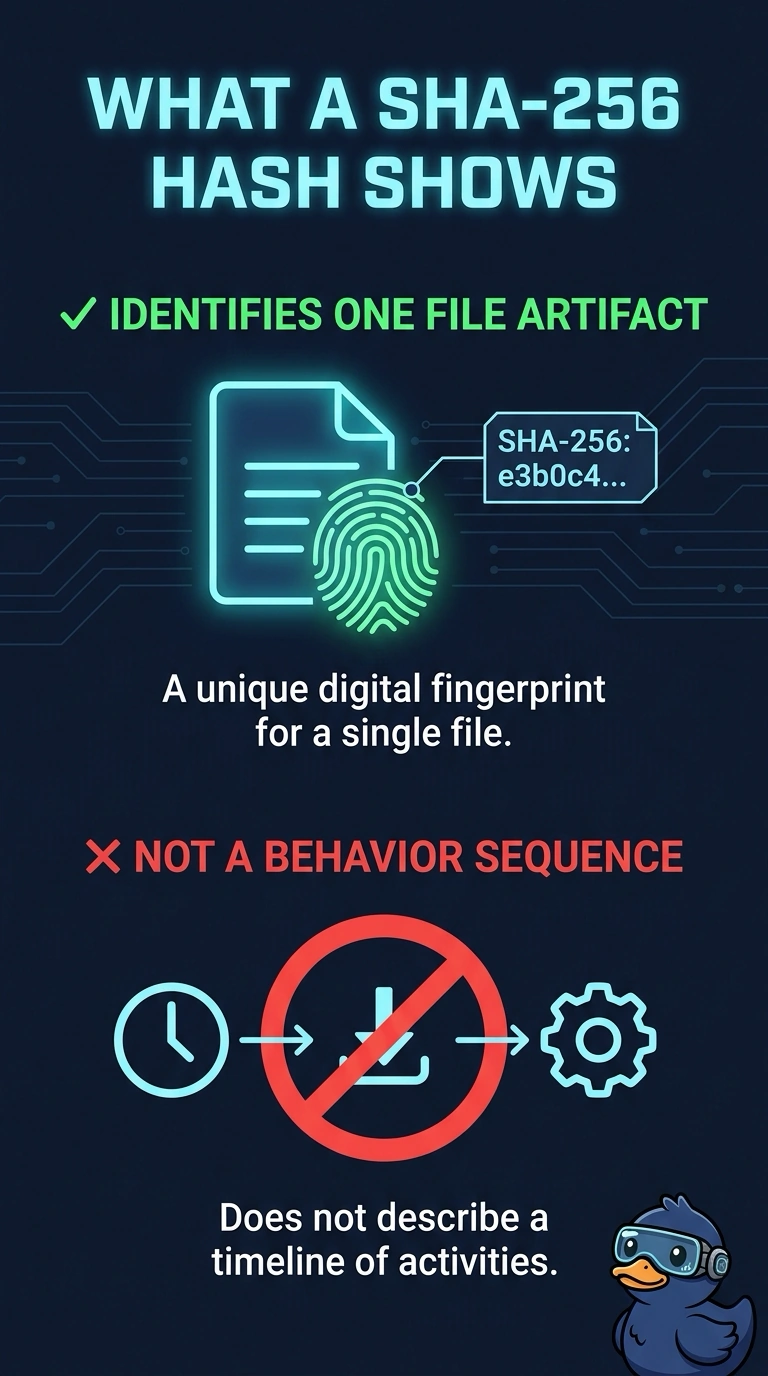
A hash is a fingerprint on a folder, not a film of what the person did. You have a name for one file artifact, not a behavior sequence that would show an attack in motion. A later match still does not describe how the intrusion unfolded.
Full Explanation
A SHA-256 value names one file artifact. That is an indicator of compromise: a concrete object you can search for on disk, in telemetry, or in a feed. It does not describe a behavior sequence such as which process launched what, so by itself it is not an indicator of attack. Calling the hash an attack indicator and treating any later match as a live intrusion skips the missing behavior and confuses presence of a file with an observed technique. You do not wait until an analyst watches the file execute before the hash counts; the artifact is already a compromise indicator. It also does not act as a vulnerability identifier in the way a published flaw name does, because a digest identifies bytes, not a product defect. Exam caveat: a behavior sequence observed in endpoint telemetry can be an indicator of attack even when the hash is brand new. Operational check: pair the hash hit with process-creation telemetry and see whether a behavior sequence is present, rather than promoting the digest alone into an attack narrative. Write down the parent process if that sequence exists.