
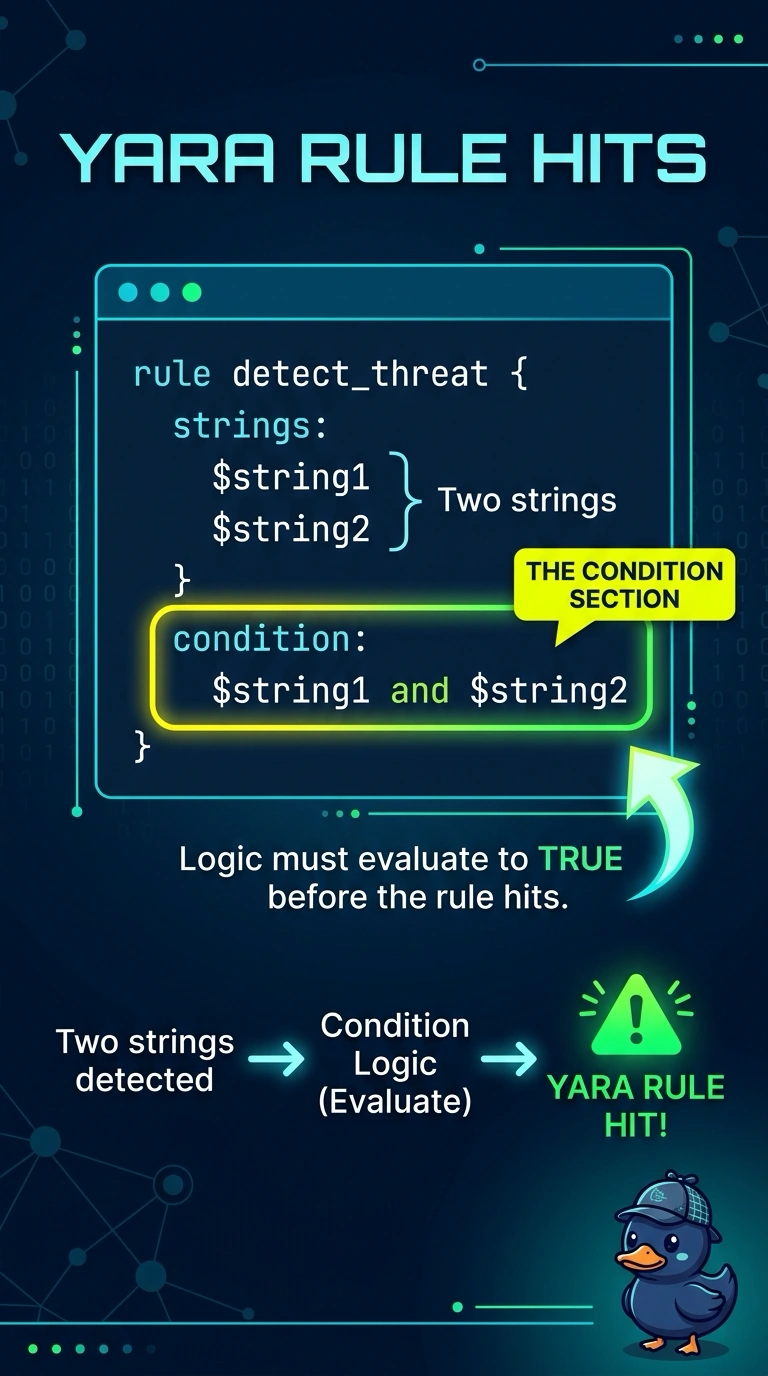
A YARA rule used in a hospital case has meta, strings, and a condition that requires two of the strings. Which section decides whether the rule hits a file?
Select an answer to reveal the explanation.
Short Explanation
Meta is the label on the jar, and strings are ingredients on the shelf. You get a hit only when the condition says the mix is right, including a rule that demands two of those strings. Listing a pattern, or writing a description, does not by itself decide the match.
Full Explanation
YARA evaluates the condition section to decide a hit. Here the condition section is the logic that must evaluate true before the rule hits, and that logic requires two of the strings, so one lonely pattern is not enough. The meta section, where the author stores a description and external references, is documentation for humans; meta does not match bytes and does not decide the hit. The strings section alone, with any listed pattern enough to force a hit, would be a different rule; this condition demands two matches, and merely listing patterns does not alert. The rule filename, treated as the expression that YARA evaluates against the file, is only a name in the ruleset; YARA does not use the filename as the matching expression. Exam caveat: a condition can refer to file size or entry-point checks as well as strings, but in this rule the condition is still the section that decides. Operational check: run the rule against a file that contains only one of the strings and confirm it does not hit, then against a file that contains two of them.