
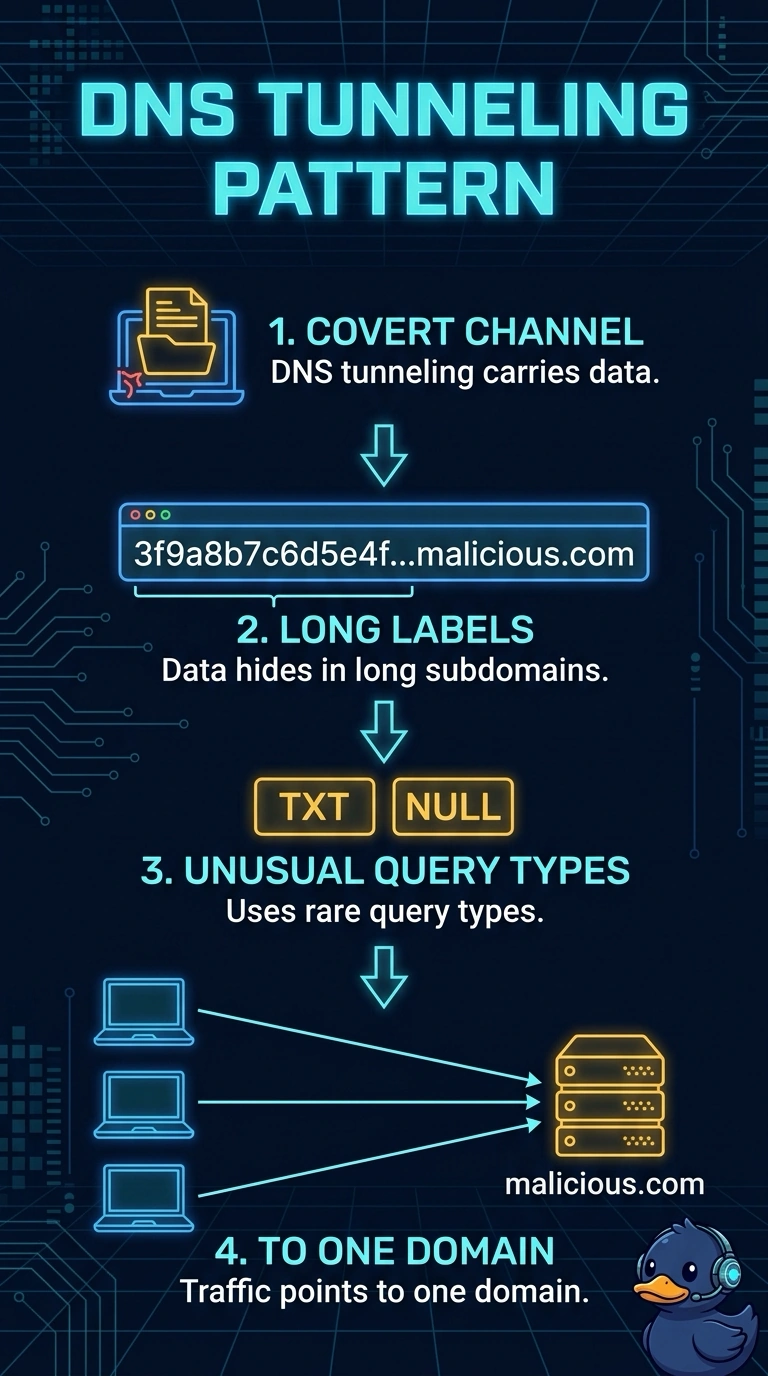
DNS queries from one lab host use very long labels and unusual query types, all pointed at a single domain. What covert channel does that pattern suggest?
Select an answer to reveal the explanation.
Short Explanation
These query shapes are consistent with DNS tunneling; legitimate services can also produce long labels or unusual types. Check domain ownership, encoding, baselines and endpoint context before concluding covert data transfer. You can still flag this single-domain shape for follow-up over a timer, sweep, or normal browsing.
Full Explanation
DNS tunneling hides data inside DNS messages, often by stuffing payload into long labels and by using unusual query types aimed at a domain the attacker controls. These query shapes are consistent with DNS tunneling; legitimate services can also produce long labels or unusual types. Check domain ownership, encoding, baselines and endpoint context before concluding covert data transfer. That caution still leaves DNS tunneling that carries data in long labels and unusual query types toward one domain as the best fit. Beaconing outbound to one external address on a fixed timer, with no query names involved, describes cadence rather than query shape, not label length and type. An internal sweep of many hosts on the Windows file-sharing service port would involve many internal destinations on a file-sharing port, not DNS questions to one domain. Ordinary resolution of short hostnames during normal user web browsing typically uses short labels and common query types across many domains, so it does not explain persistent long labels and unusual types to one parent domain without further checks. Exam caveat: the pattern suggests a covert channel; it does not by itself decode hidden data or name the tool. Operational check: sort this host's queries by label length and query type, and confirm they cluster on one parent domain rather than on many short public names.