
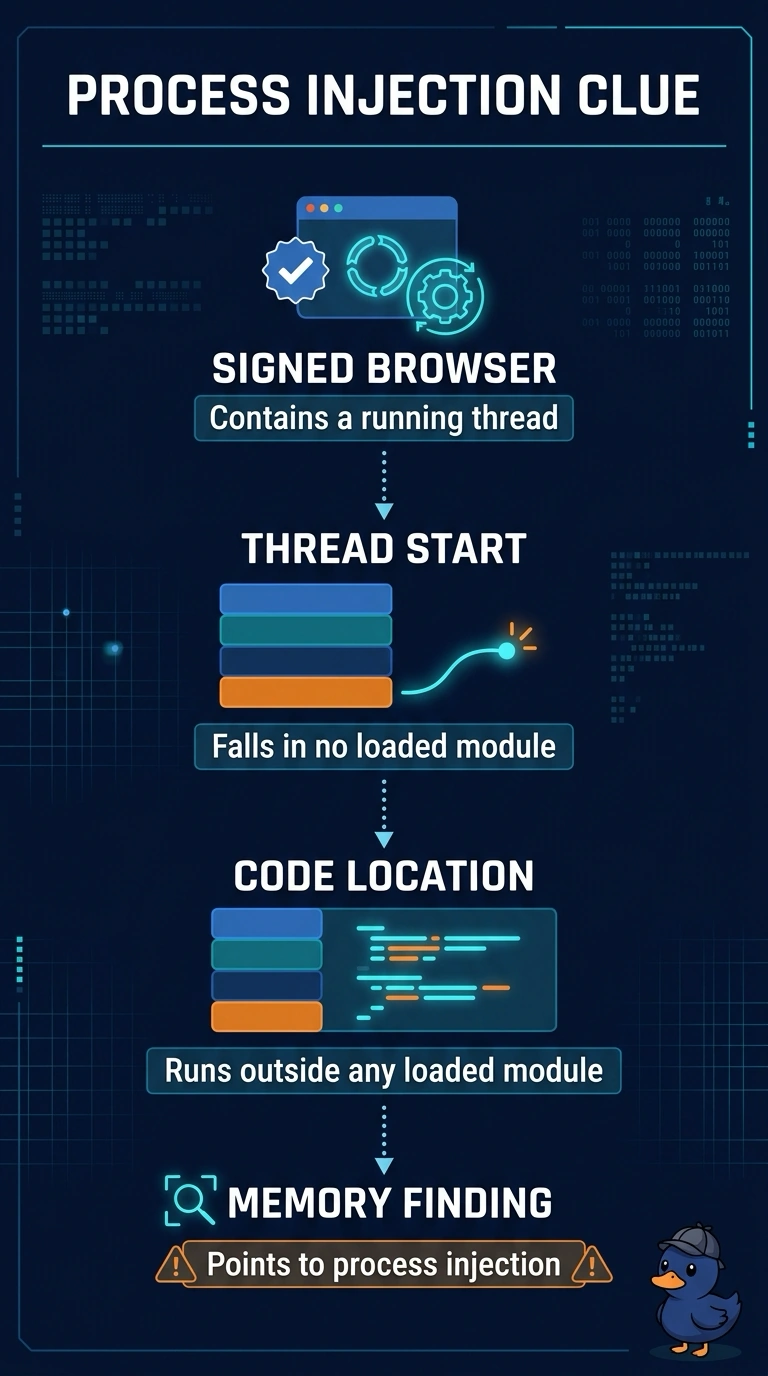
A signed browser process on a school laptop contains a thread whose start address falls in no loaded module. Which method does that memory finding point to?
Select an answer to reveal the explanation.
Short Explanation
You can think of the signed browser as a sealed envelope, and a thread starting outside every loaded module as a note slipped in after the seal. That points to process injection: code running in the trusted process from memory no loaded module owns. A logon task, a vendor-store extension, or a downloaded program would leave a different trail.
Full Explanation
Process injection places executable code inside a process that is already running, here a signed browser. A thread whose start address falls in no loaded module is the usual sign that the bytes did not come from a module the loader mapped. This points to code running in the signed browser from memory outside any loaded module. A scheduled task that starts the signed browser from a user-writable folder at every interactive logon is a persistence path for launching the browser, not an explanation of that unbacked thread start. A browser extension installed from the vendor add-on store and left enabled in the user profile is a component with its own files, not an anonymous thread start. Ordinary file execution of an unsigned program launched from the local downloads folder would show a separate process image on disk, not a thread inside the signed browser. Exam caveat: browsers also allocate private executable memory for just-in-time compilation, so confirm the start address, the protection, and the ancestry before you close the finding. Operational check: in the memory image, record the thread start address and show it sits outside every loaded module range for that browser process.