
County courts need an internal citizen-portal server reachable at a fixed public IP. Which inside source NAT method provides that one-to-one mapping?
Select an answer to reveal the explanation.
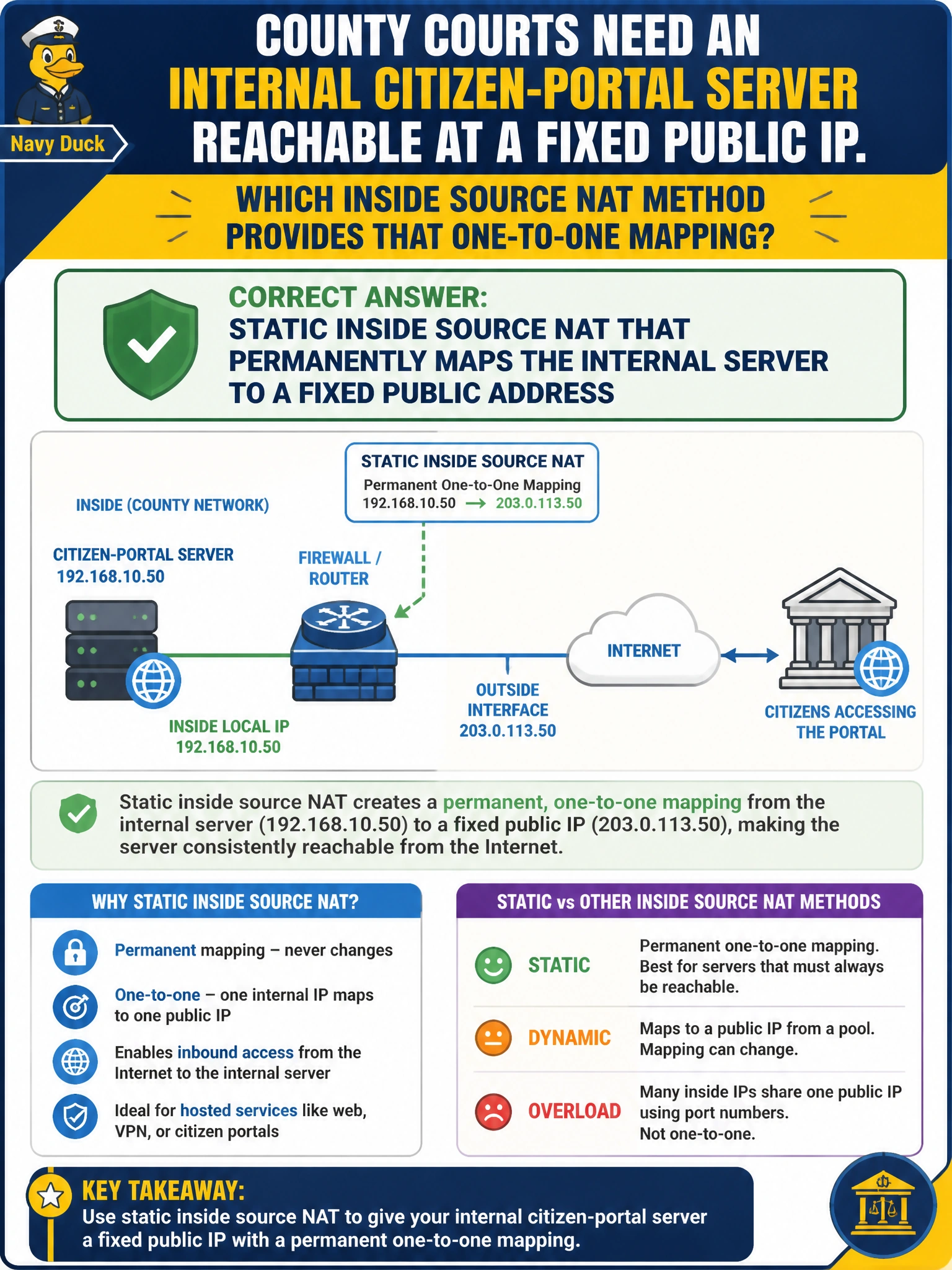
Short Explanation
A citizen portal that must always be at the same public IP needs a reserved nameplate—static inside source NAT. Dynamic pools are great for random clerk browsing, not for a fixed inbound/outbound server identity.
Full Explanation
County courts needing an internal citizen-portal server reachable at a fixed public IP require a persistent one-to-one mapping. Static inside source NAT permanently maps the server’s inside local address to a chosen inside global (public) address so clients and DNS can rely on that fixed identity for inbound or published reachability. That reserved mapping is what distinguishes static NAT from ephemeral pool translations.
Dynamic pool NAT alone with no reserved mapping for the server fails by concept: pool bindings are temporary and not guaranteed to keep the same public IP for a published portal. NTP client mode pointing at a public time server instead of any translation fails by concept: NTP synchronizes clocks; it does not publish a server’s address. Syslog severity filtering that substitutes for address translation on the edge fails by concept: log filtering is unrelated to IPv4 address translation.
Exam caveat: static NAT provides the fixed mapping; firewall/ACL policy must still permit the intended citizen-portal ports—NAT alone is not a security policy. Operational check: configure the static inside source mapping, resolve/test the fixed public IP from outside, and confirm bidirectional translation entries for the portal during access.