
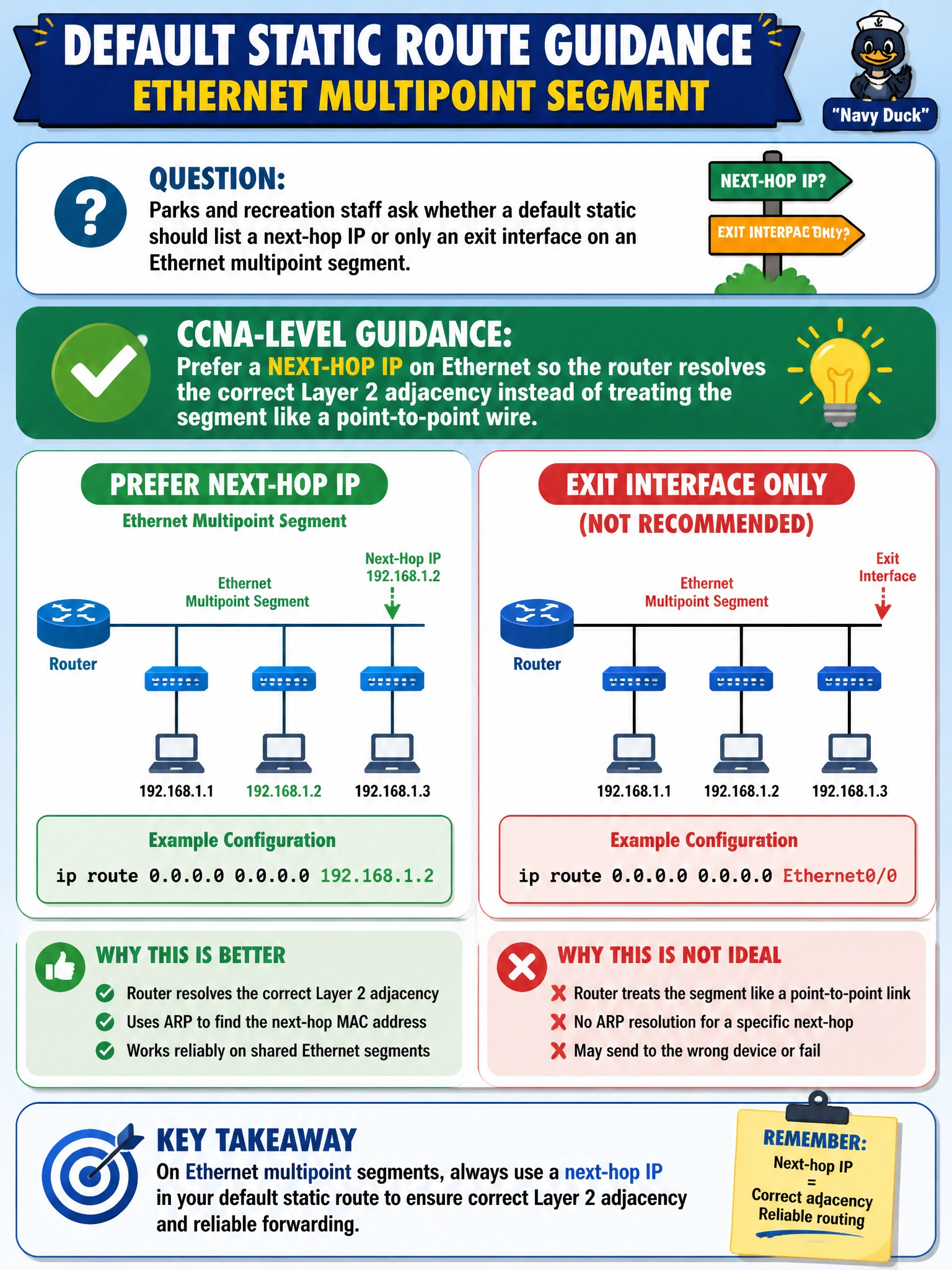
Parks and recreation staff ask whether a default static should list a next-hop IP or only an exit interface on an Ethernet multipoint segment. What CCNA-level guidance applies?
Select an answer to reveal the explanation.
Short Explanation
On shared Ethernet, naming the next-hop IP is like writing the neighbor’s street number—not just “send it out the driveway.” That avoids treating a multipoint LAN like a single wire.
Full Explanation
On an Ethernet multipoint segment used by parks and recreation, a default static should prefer an explicit next-hop IP. Ethernet is multi-access: many routers or hosts may share the broadcast domain. Specifying the next-hop IP lets the router ARP for that neighbor’s MAC and build the correct Layer 2 adjacency. Pointing a static only at an exit interface on Ethernet can cause the router to treat the link more like a point-to-point assertion—often relying on proxy ARP—which is fragile, less precise, and not the preferred CCNA-level design for LAN segments.
Omitting the next hop and relying on proxy ARP alone is not the only supported or recommended design; it shifts dependency onto another device answering ARP for remote prefixes. Claiming default statics cannot use a next-hop IP is false—next-hop IP is standard. Requiring exit-interface-only defaults on every Ethernet link for CEF is incorrect; CEF works with next-hop recursion and does not mandate interface-only statics on multipoint media.
Exam caveat: on true point-to-point serial links, exit-interface-only statics are commonly acceptable because there is only one possible Layer 2 neighbor; do not blindly apply that habit to Ethernet. Operational check: configure the default with the firewall or ISP next-hop IP, verify ARP resolution for that next hop, confirm the routing table shows the default via that IP, and capture or traceroute to ensure frames use the intended neighbor MAC rather than an unexpected proxy-ARP responder.