
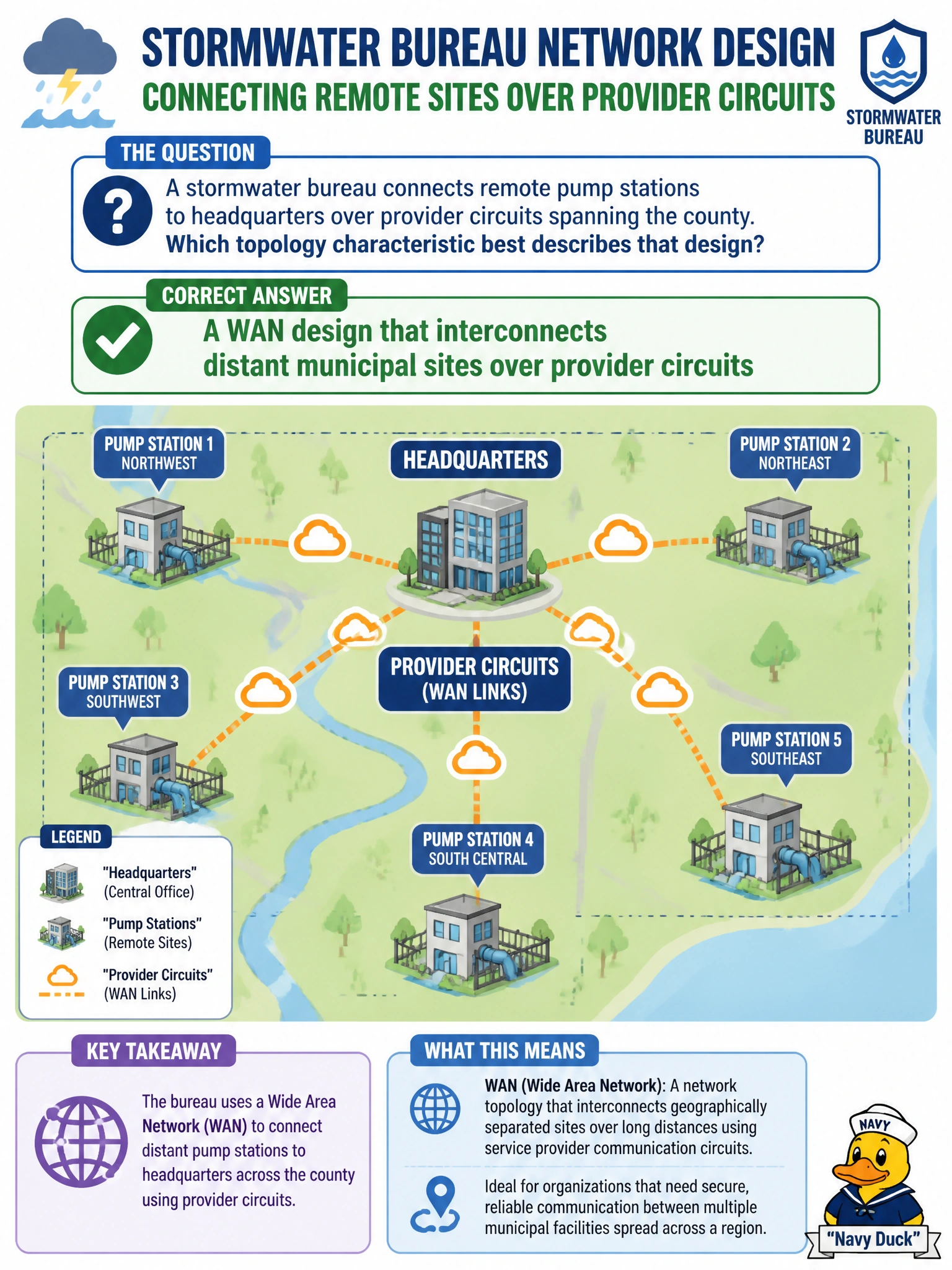
A stormwater bureau connects remote pump stations to headquarters over provider circuits spanning the county. Which topology characteristic best describes that design?
Select an answer to reveal the explanation.
Short Explanation
Pump stations miles apart aren't on the same closet switch—they're out on the wide area. Provider circuits between HQ and those sites are WAN territory. LAN Wi-Fi and one-floor access stay local.
Full Explanation
Remote stormwater pump stations connected to headquarters over provider circuits that span the county are a WAN design: geographically separated municipal sites interconnected by service-provider links rather than a single local closet LAN. The defining characteristic is distance plus provider circuits between sites, which places the design in wide-area territory even though each site still has its own LAN.
A single-closet LAN with all devices on one copper switch stack fails because pump stations miles apart are not colocated on one stack. An in-building Wi-Fi only design with no wired wide-area links fails by concept—it omits the provider WAN circuits the stem requires. A campus access layer limited to desks inside one city hall floor fails because that is local access-edge scope, not county-spanning site interconnection.
Exam caveat: LAN vs campus vs WAN is about geography and who provides the long links. Provider circuits between distant sites = WAN. Do not call a multi-site provider design a "LAN" just because Ethernet handoffs exist at each end.
Operational check: Inventory each pump station's handoff (MPLS, Metro-E, broadband, cellular, etc.), confirm routing between site subnets and HQ, and verify monitoring of the provider circuits. If all devices truly share one copper stack with no provider span, you do not have the WAN topology the bureau described.