
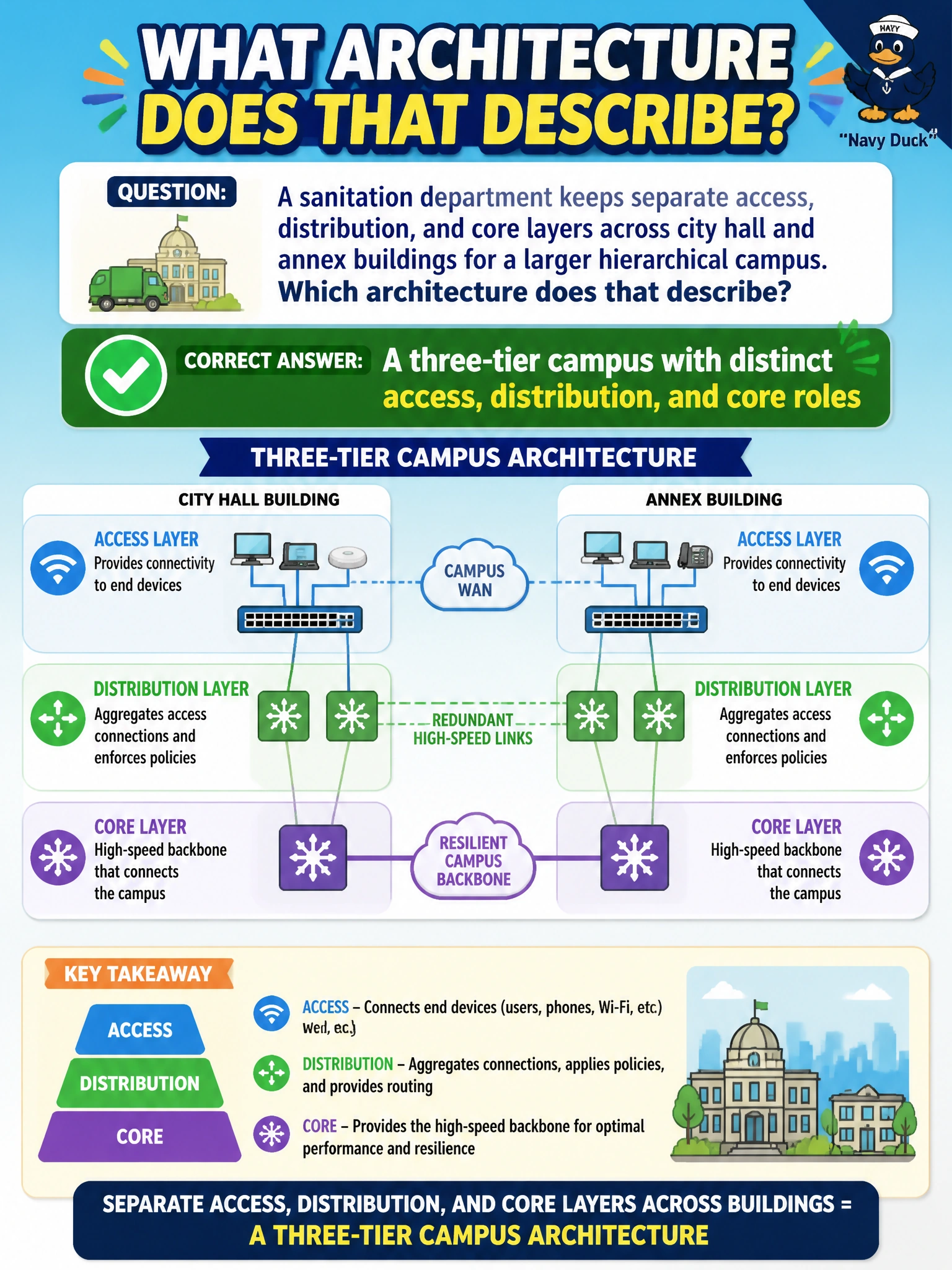
A sanitation department keeps separate access, distribution, and core layers across city hall and annex buildings for a larger hierarchical campus. Which architecture does that describe?
Select an answer to reveal the explanation.
Short Explanation
Big city campuses are like a highway system: local streets (access), on-ramps (distribution), and freeways (core). Keeping those three layers separate is classic three-tier. Collapsed core merges the top two; SOHO is tiny-office scale.
Full Explanation
A larger hierarchical campus spanning city hall and annex buildings with separate access, distribution, and core layers is a classic three-tier campus architecture. Access connects end devices, distribution aggregates access and applies policy/routing boundaries, and core provides high-speed, highly available transport between distribution blocks. The sanitation department's description of keeping those three layers distinct matches three-tier campus design, not a collapsed or flat alternative.
A two-tier collapsed core with no distinct core layer fails because the stem keeps a separate core. A single flat Layer 2 domain with no hierarchical tiers fails by concept—it lacks the hierarchical roles and usually scales poorly across buildings. A SOHO star with one consumer router and a few PCs fails because that small-office pattern does not describe multi-building municipal campus tiers.
Exam caveat: Size and hierarchy drive the answer. Larger multi-building campuses commonly map to three-tier; smaller sites often collapse core and distribution. Read whether the stem keeps core distinct or merges it.
Operational check: Trace a path from an access closet through distribution aggregation to the core interconnect between city hall and annex, and verify each tier's role (edge ports vs aggregation/policy vs high-speed transport). If distribution and core are the same devices with no separate core role, you are in collapsed core—not the three-tier model described here.