
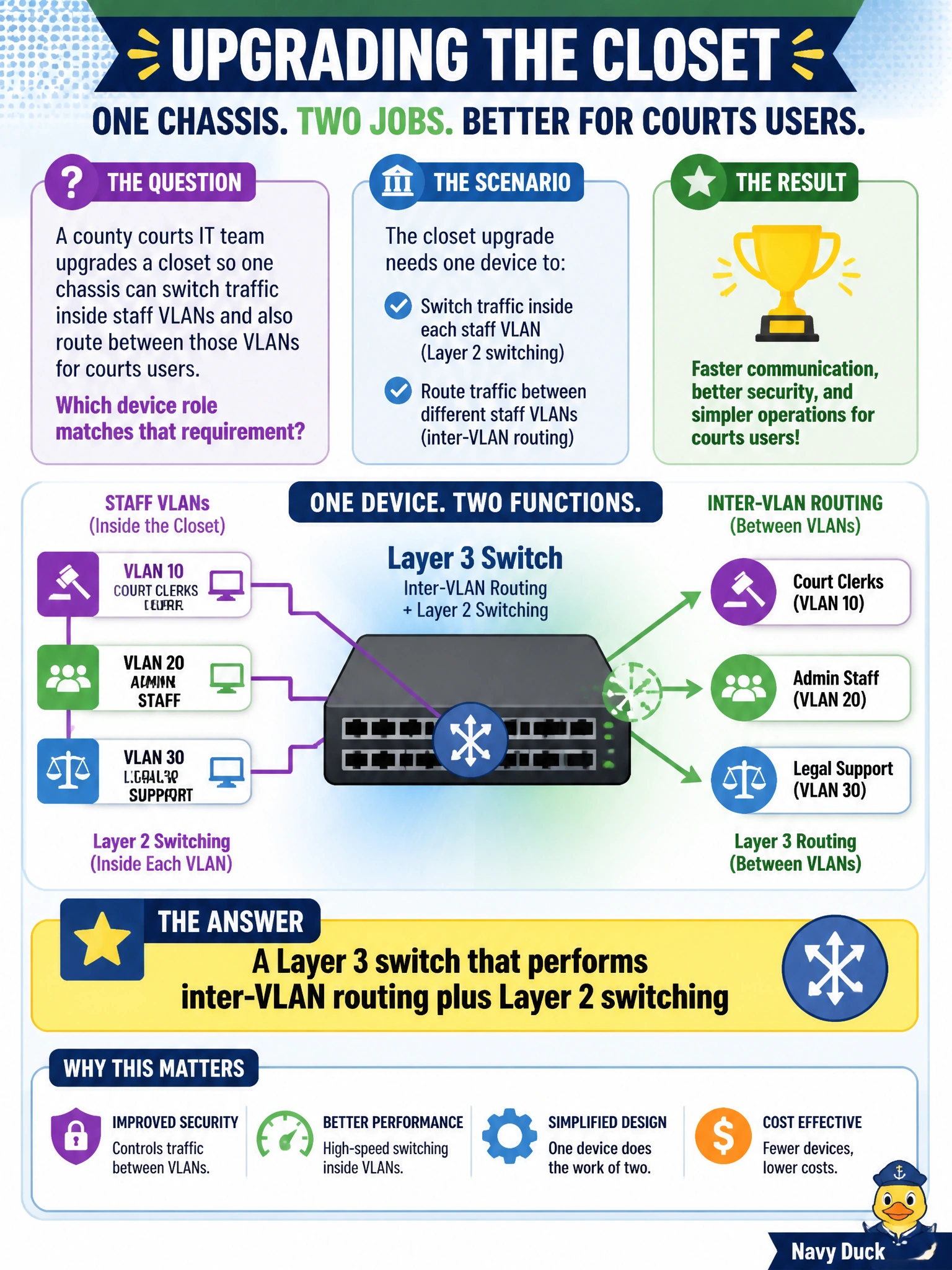
A county courts IT team upgrades a closet so one chassis can switch traffic inside staff VLANs and also route between those VLANs for courts users. Which device role matches that requirement?
Select an answer to reveal the explanation.
Short Explanation
Think of it like a courthouse elevator that both moves people on one floor and also takes them between floors. An L3 switch switches inside a VLAN and routes between VLANs. A pure L2 box needs an outside router for that second job.
Full Explanation
County courts often consolidate closet roles so one chassis can both switch traffic inside staff VLANs and route between those VLANs for courts users. That combined requirement is the classic Layer 3 switch (multilayer switch) role: it performs hardware Layer 2 switching within each VLAN and provides inter-VLAN routing (SVIs or routed interfaces) so users in different staff VLANs can reach each other without an external router-on-a-stick as the only path. For a compact courthouse upgrade, one L3-capable chassis matching that dual role reduces hops and simplifies the design.
A Layer 2-only switch that cannot route between VLANs without an external router fails because it only bridges within each VLAN; inter-VLAN traffic still needs a separate Layer 3 device. A wireless LAN controller that only manages AP configurations fails by concept—it centralizes WLAN control-plane functions and does not replace campus inter-VLAN routing for wired courts staff VLANs. A modem that only converts analog circuits to Ethernet for a single WAN link fails because modem/WAN conversion is an access technology, not a device that switches inside VLANs and routes between them on the LAN.
Exam caveat: "Can switch and route" points to Layer 3 switching. Do not pick WLC or modem just because they appear in other campus stories. Also remember that L2-only switches remain valid access devices, but they do not satisfy a stem that explicitly needs inter-VLAN routing in the same chassis.
Operational check: Confirm SVIs (or equivalent routed interfaces) exist for each staff VLAN, that IP routing is enabled on the switch, and that courts users in different VLANs can ping across VLAN boundaries using the L3 switch as gateway. If east-west traffic between VLANs still hairpins to an external router only, the closet upgrade has not actually taken on the Layer 3 role the design called for.