
Hotel firewall logs on the outside show one public address in use by many front-desk PCs at the same time. What is required to name the specific inside PC for one of those sessions?
Select an answer to reveal the explanation.
Short Explanation
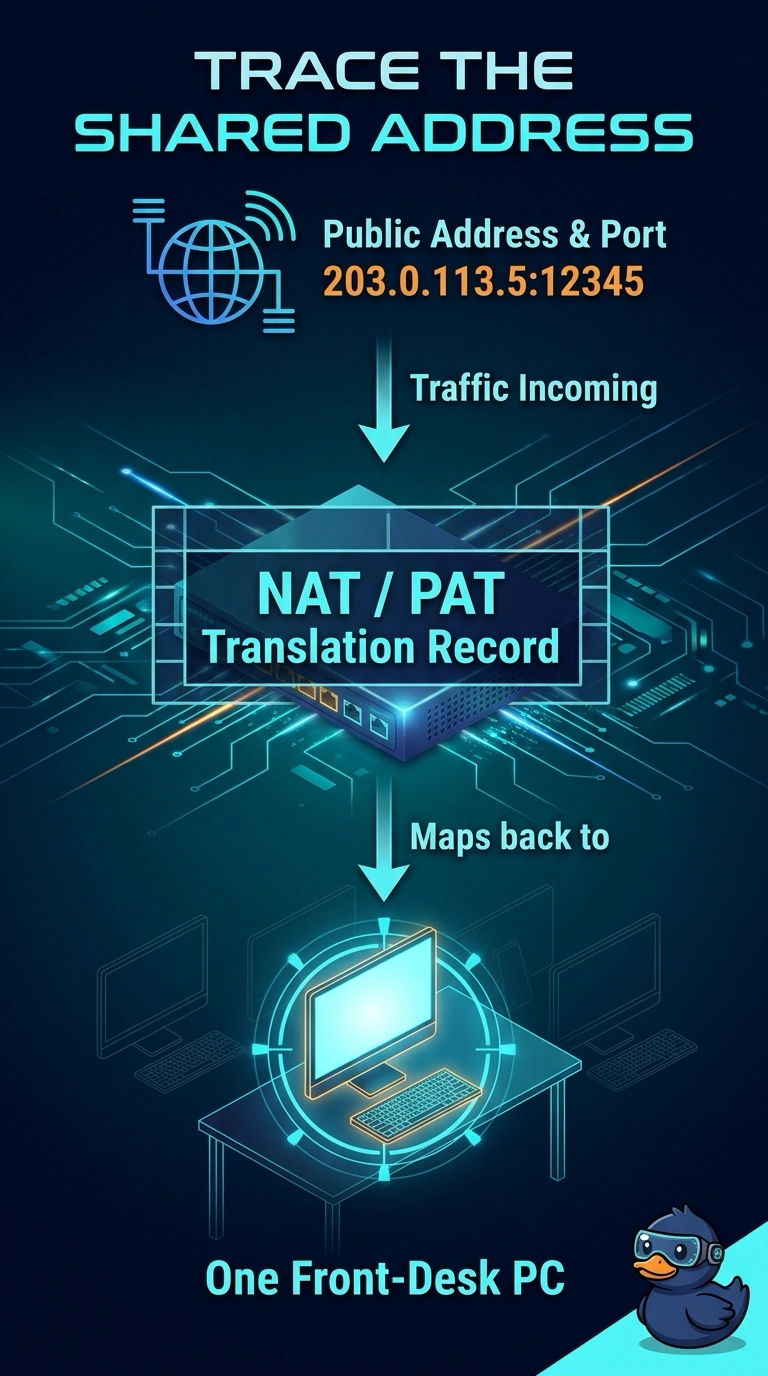
One return address on a stack of postcards does not name the desk that sent each card. Outside logs show a single public address for many front-desk PCs, so you need the NAT or PAT translation record. The public address alone, a longer flow timeout, and a new cipher do not draw that map.
Full Explanation
Many inside hosts can share one public address, so the outside address does not name a single front-desk PC. The NAT or PAT translation record that maps the public address and port back to one front-desk PC is the record that binds a session to one inside host. The single public address alone, shared by every front-desk PC behind the translator, is ambiguous for that reason. A longer NetFlow inactive timeout, with no map from that public address to one inside PC, changes how long a flow summary is kept and does not create the inside mapping. A new cipher suite on the hotel VPN, with no map from the shared public address to one PC, changes how a tunnel is negotiated and does not identify the PC. Without that session mapping, every front-desk PC behind the same public address remains a candidate. Exam caveat: under port translation the mapping is per session, address plus port, so one public address can represent many PCs at the same moment. Operational check: look up that public address, the outside port, and the timestamp in the translation log, then match the inside address to the front-desk asset list.