
At a hospital, the imaging server cannot be reached from the guest network, and that server still runs an unpatched service. Which statement is the vulnerability?
Select an answer to reveal the explanation.
Short Explanation
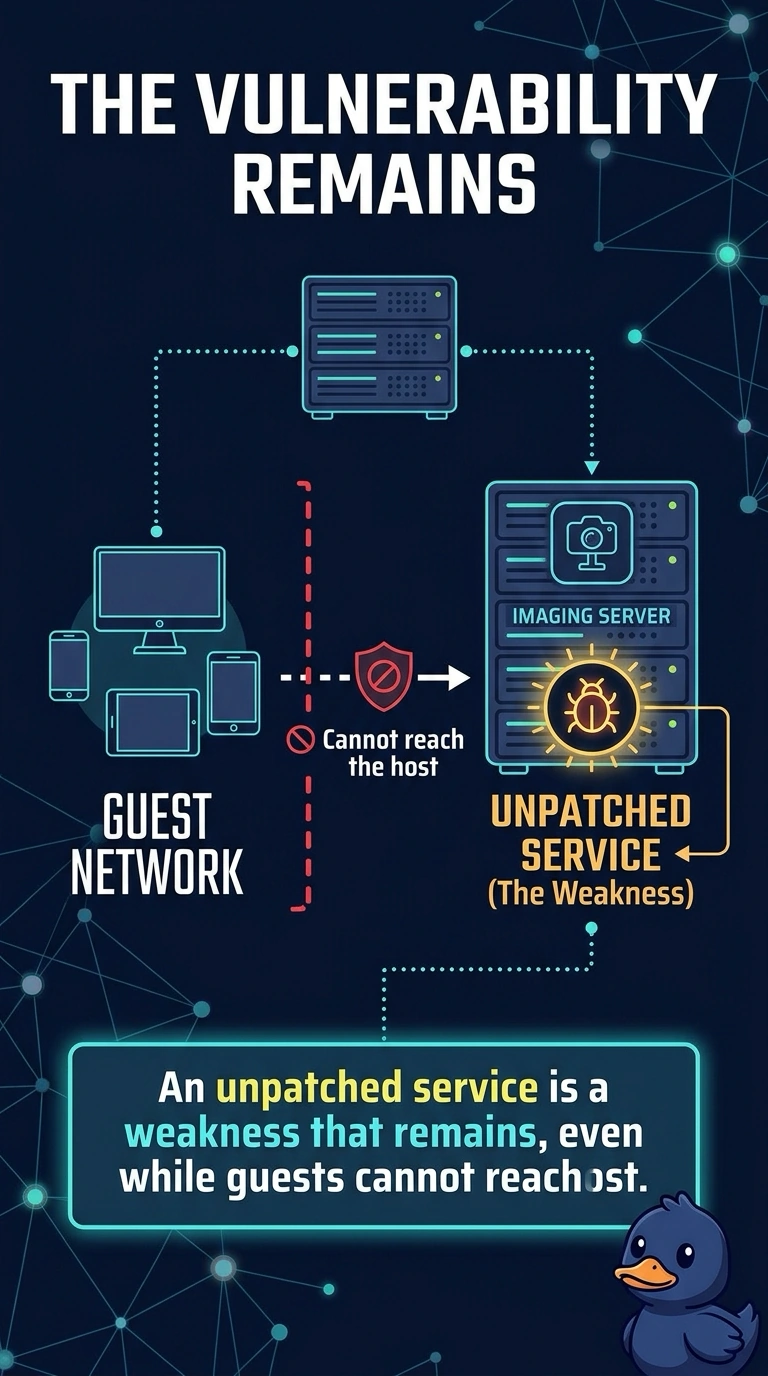
Boarding up a side path does not repair the crack in the wall. You still have an unpatched service on the imaging server, and that weakness remains even while guests cannot reach it. The trap is blaming the guest network, the server's existence, or the rule that blocks guests.
Full Explanation
The unpatched service on the imaging server, a weakness that remains even while guests cannot reach the host is the vulnerability. A vulnerability is a weakness in something you run. The imaging server still has an unpatched service. Guests cannot reach that host, but the missing fix does not disappear when one path is closed. The guest network itself, treated as a weakness simply for sitting beside clinical systems treats the guest network as the weakness. A network is a place traffic comes from. It is not a defect in the imaging service, and moving guests somewhere else would not patch the service. The imaging server existing on the hospital network, with no weakness named in the service treats the server's existence as the weakness. A server that is supposed to be there is not, by itself, a vulnerability. The scenario names a real weakness only when it says the service is unpatched. The firewall rule that keeps guest devices from reaching the imaging server at all is a control that keeps guests away from the host. A blocking rule reduces who can attempt the weakness. It is not the weakness, and deleting that rule would make the situation worse rather than fix the service. Exam caveat: a control that limits reachability does not erase an unpatched service. The weakness and the path that can reach it are separate statements. Operational check: compare the running imaging service with the vendor's current fixed release, and record that result apart from the guest-network rule.