
At a SaaS company, the identity system records who connected, the source they used, and the API they called, and it writes that record only after the call has already been allowed. Which AAA function is that record?
Select an answer to reveal the explanation.
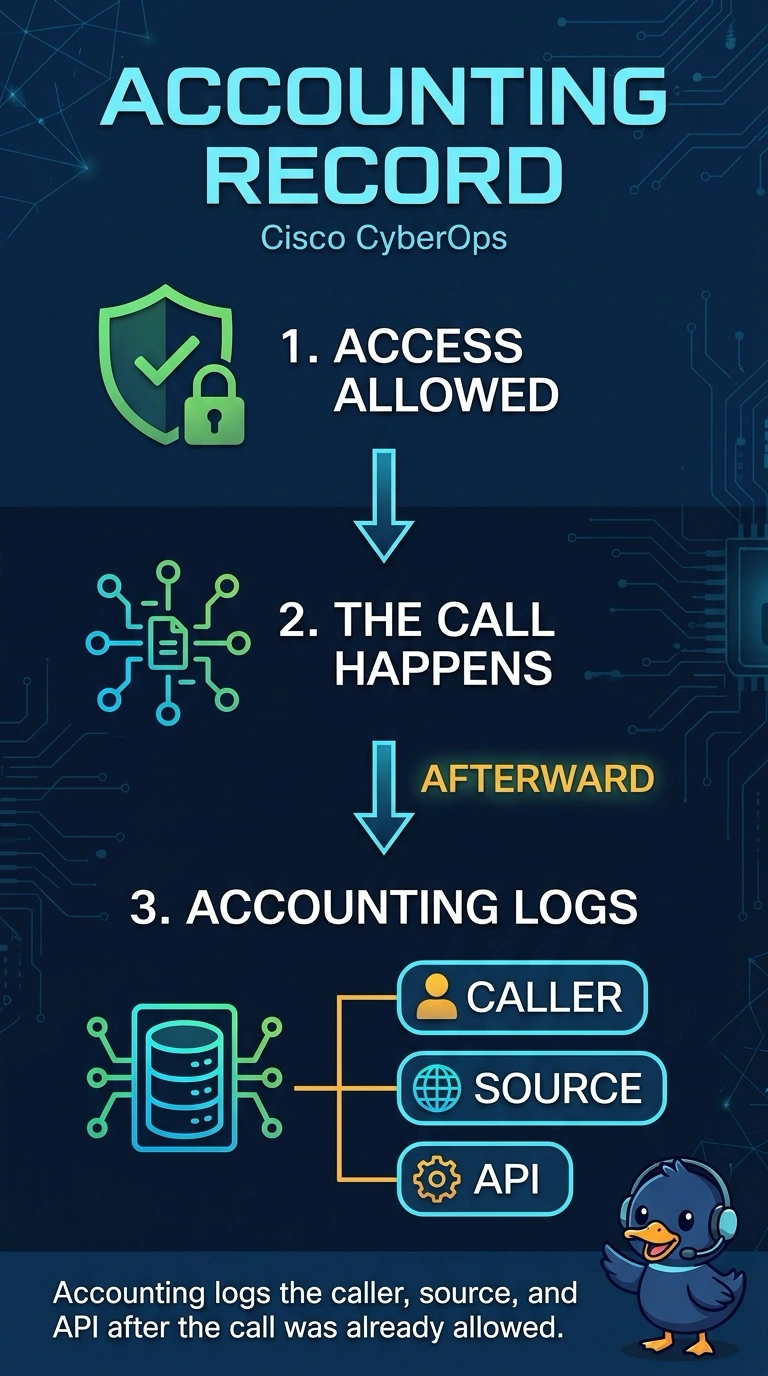
Short Explanation
Think of AAA as a badge check, a door lock, and the logbook at the desk. You are reading the logbook, the line written after the door already opened. The trap is calling that line a fresh allow-or-deny decision.
Full Explanation
Accounting is the AAA function that records an action after the decision to allow it. The SaaS identity system writes the caller, the source, and the API only once the call has already been permitted, so the record is a history of what happened rather than a gate in front of the call. The matching choice is "Accounting that logs the caller, the source, and the API after the call was already allowed". "Authentication that proves the caller owns the account before any API request is accepted" is the earlier proof of identity, and this entry is written after the call instead of being that proof. "Authorization that decides whether this identity may invoke the API before the call proceeds" is the allow-or-deny decision, which the scenario says has already been made. "Availability that keeps the identity service up so callers can finish the API request at all" belongs to the confidentiality, integrity, and availability triad, not to AAA, and nothing here says the service was unreachable. Exam caveat: the three A's are authentication, authorization, and accounting, and availability will not be the audit line written after an allow. Operational check: open one identity audit event for an API call and confirm it names the actor, the source, and the action, with a timestamp at or after the allow rather than in place of the allow policy.