
At a bank, dependency checks and secret checks run in the build pipeline and block the deploy whenever a check fails. What term names that practice?
Select an answer to reveal the explanation.
Short Explanation
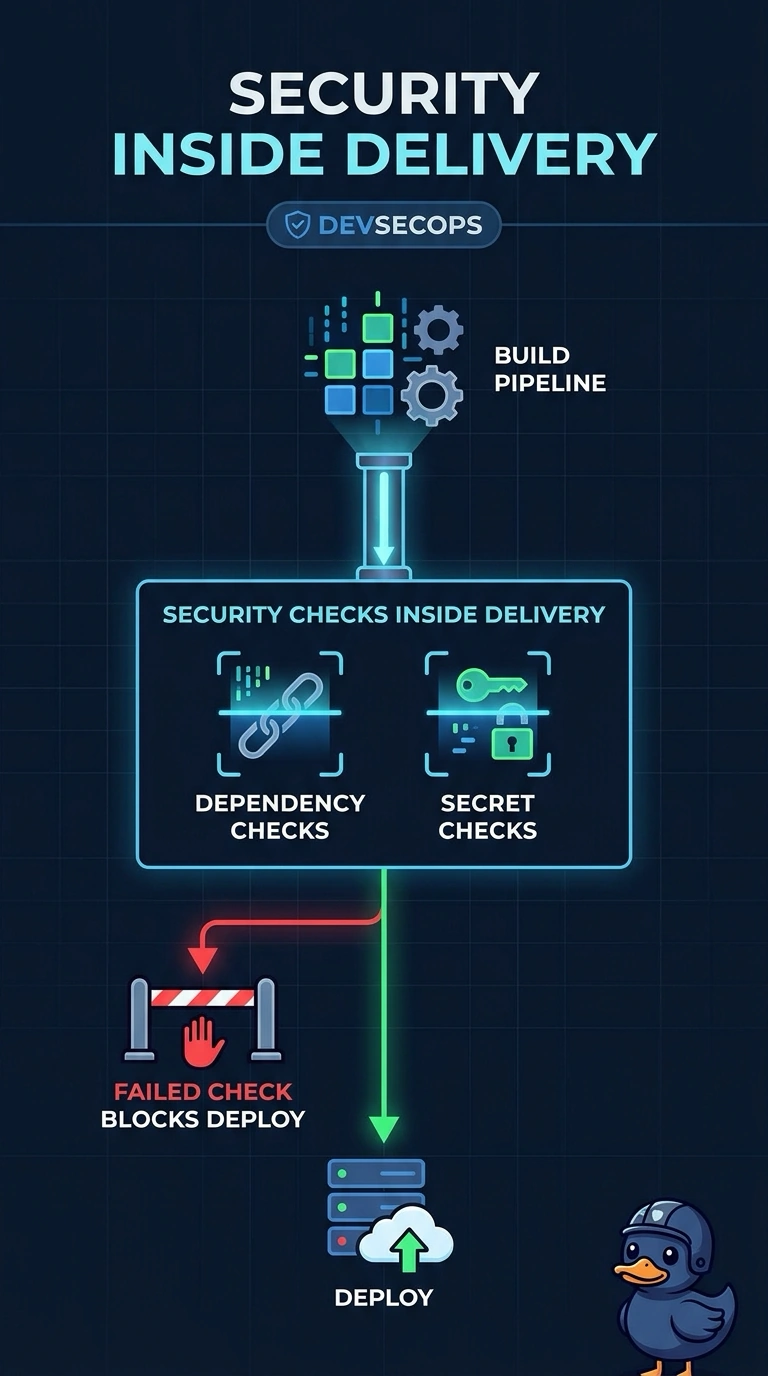
A loading-dock inspector who can refuse the truck is not the guard watching the store after the shelves are stocked. You are looking at security inside delivery, called DevSecOps. The trap is a production SOC watch, a password reset, or a paper risk register.
Full Explanation
Checks that run in the build pipeline and can stop a release are DevSecOps: security is part of delivery, not a review that begins after the software is already serving customers. These dependency and secret checks change the release outcome at the bank, so the name has to be the delivery practice itself. "DevSecOps, with security checks inside delivery so a failed check blocks the deploy". It places the checks on the path the build must pass, and a failure holds the deploy. "A SOC use case that watches the bank's production systems after the code is already live". That is detection content for systems already in production. It can watch live traffic, and it does not execute during the build or refuse a promotion. "A help-desk password reset that gives a locked-out teller access to the banking portal again". That restores one person's access to an application. It does not inspect libraries or embedded secrets, and it has no place in the promotion decision. "A yearly risk register that lists bank systems on paper and does not run in the build pipeline". That is a governance list kept on a calendar. A register that does not run inside the pipeline cannot fail a check or hold an artifact. Exam caveat: the exam lists DevSecOps as its own job, separate from SOC monitoring and from a risk register, so a pipeline gate is not renamed into a detection use case. Operational check: open the pipeline definition and confirm that a failed dependency check or a failed secret check stops the artifact from being promoted.