
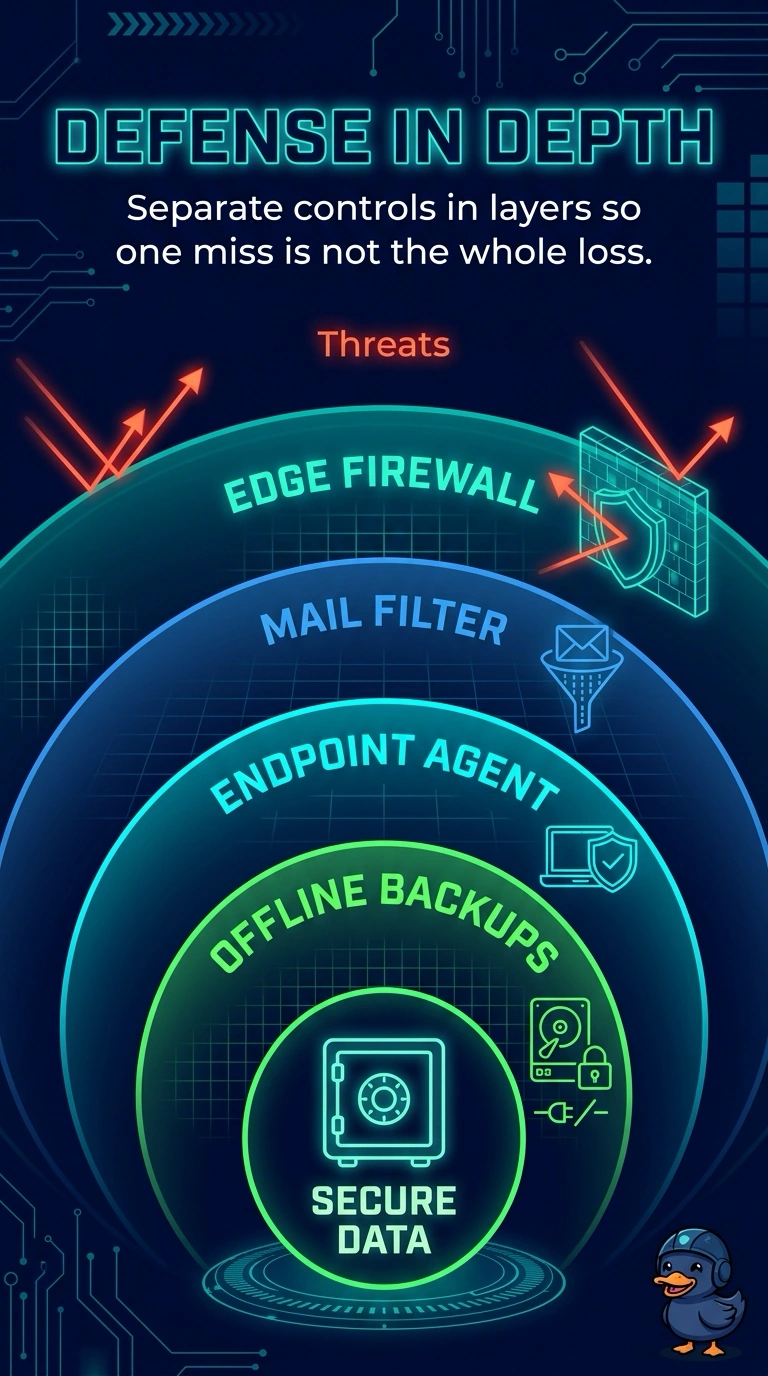
At a bank, the edge firewall, the mail filter, the endpoint agent, and the offline backups are all in place so one miss is not the whole loss. Which principle does that arrangement illustrate?
Select an answer to reveal the explanation.
Short Explanation
One locked door is not the whole building. You have defense in depth when the firewall, the mail filter, the endpoint agent, and the offline backups are different layers. The trap is replacing that stack with a bigger firewall, a single account limit, or a shorter password.
Full Explanation
Defense in depth is a set of different controls arranged so that a failure in one layer does not decide the whole outcome. The bank kept an edge firewall, a mail filter, an endpoint agent, and offline backups, and each one covers a different kind of miss. The principle is Defense in depth: separate controls in layers so one miss is not the whole loss. The value is the difference among the layers, not the strength of a single box. One stronger edge firewall that replaces the mail filter, the agent, and the backups collapses the design back to one control and recreates a single point of failure. Least privilege on a single user account, with no other control along the path is a real access idea, and it is not what this stack of different controls is doing. A shorter password on the firewall admin login, with every other control removed is a credential change, and shortening a secret is not a layered design. Exam caveat: one stronger control is not a substitute for the other layers the scenario already names. Operational check: name the control that would still limit the loss if the edge firewall allowed a bad message, a bad file, or a destroyed online copy, and confirm those later layers are actually in place.