
At a SaaS company, a file moved inside TLS. The packet capture contains those packets, and the team does not have the server private key. What will TCP stream reassembly produce?
Select an answer to reveal the explanation.
Short Explanation
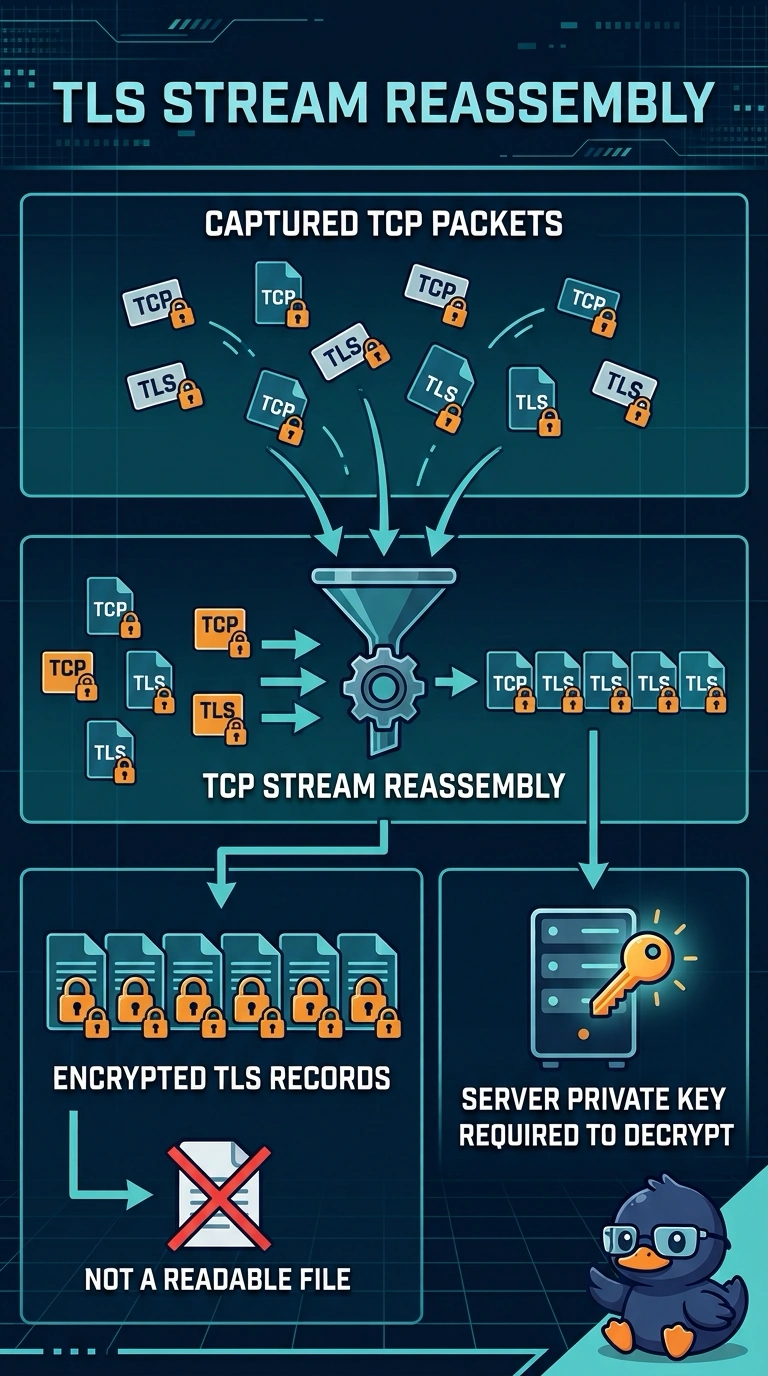
Taping a torn envelope shut does not unlock the letter inside. You will recover encrypted records rather than the clear file, because this capture has no private key. The trap is believing reassembly defeats TLS or that the stream yields the server key or the client password.
Full Explanation
TCP stream reassembly concatenates the payload of one session in order. When that payload is TLS and the team has no private key, the concatenated bytes stay encrypted. What reassembly produces is The encrypted TLS records from that stream, not a readable copy of the file. The private key is not something the capture hands over, and the file bytes after the handshake stay protected without it. The cleartext file, on the claim that putting the TCP stream back together defeats TLS treats reordering segments as decryption, and reordering is not decryption. The server private key, pulled out of the TCP payload by putting the stream together assumes a key the server does not send in the session, and reassembly cannot derive that key from ciphertext alone. The client account password, pulled out of the TCP payload by putting the stream together assumes the password is sitting in the capture as readable text, and a TLS session without the key does not yield it. Exam caveat: following the stream shows the bytes that were captured, and those bytes remain ciphertext unless a key or a separate decrypted copy was stored. Operational check: confirm no session secret and no decrypted copy exist before you tell the requester the file can be read from this capture.