
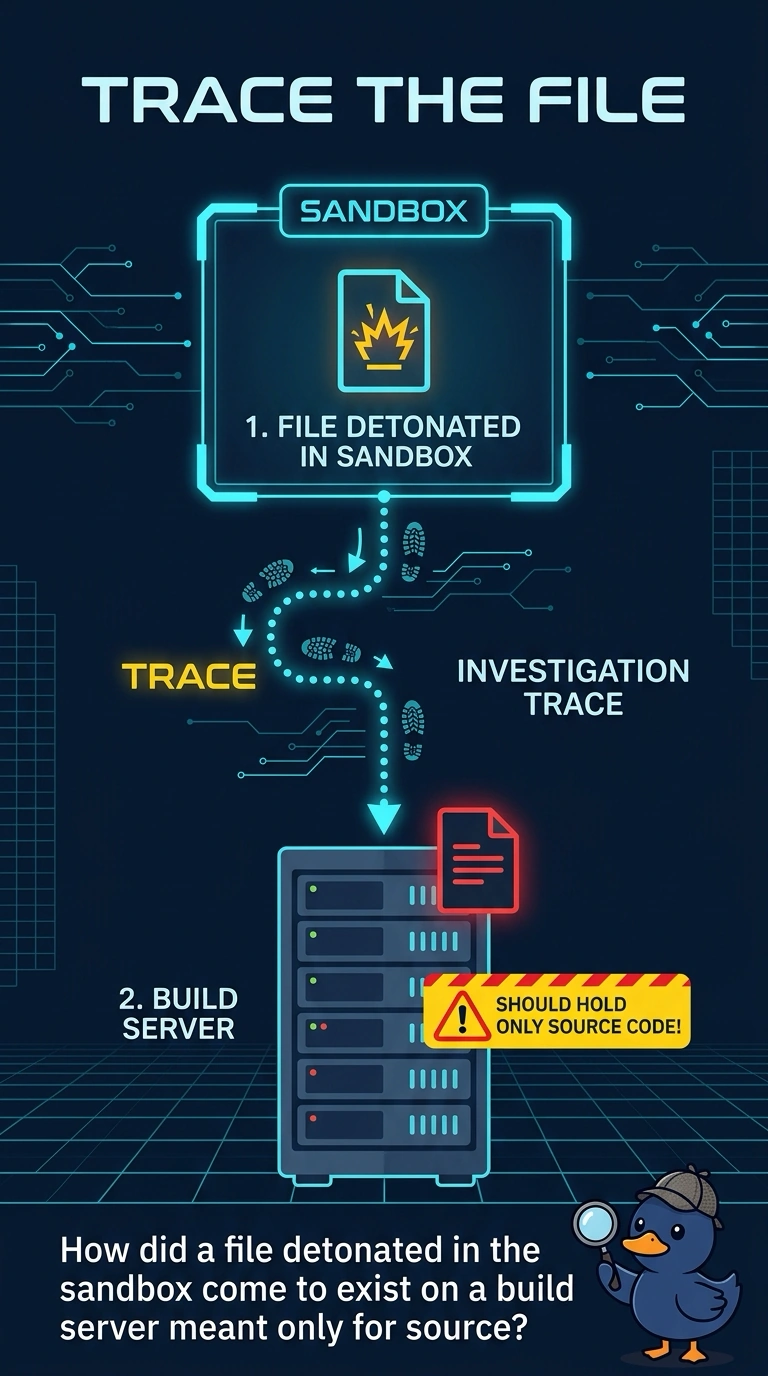
At a SaaS company, the same file hash appears in a sandbox detonation and on a build server that is supposed to hold only source code. What should the analyst ask first?
Select an answer to reveal the explanation.
Short Explanation
The same library stamp on a vault copy and a workshop copy means you ask how the book moved. You should ask how that detonated file got onto a build server meant to hold only source. The trap is a TLS version, a full NAT pool, or a cipher-suite guess.
Full Explanation
A matching hash means the build server holds the same file contents that were detonated. That server is supposed to store source, so the first question is how those contents arrived there. Protocol settings and address translation do not explain a file that should not be present. "How a file detonated in the sandbox came to exist on a build server that should hold only source" is the first question. "Whether TLS 1.3 is enabled for every listener running on that build server" asks about a protocol version and does not account for the file. "Whether the office NAT address pool has been exhausted by workstation traffic" is a capacity question with no link to this hash. "Whether that hash string is actually the name of a negotiated cipher suite" misreads a file digest as an algorithm name. Exam caveat: the hash shows the contents match and does not by itself name the account that copied the file. Operational check: confirm the two digests match, then review the file creation time and the account that wrote the file on the build server. Start with that path.