
On a bank workstation, HKLM\Software\Microsoft\Windows\CurrentVersion\Run contains a new value pointing at a user-writable path. What does that value do?
Select an answer to reveal the explanation.
Short Explanation
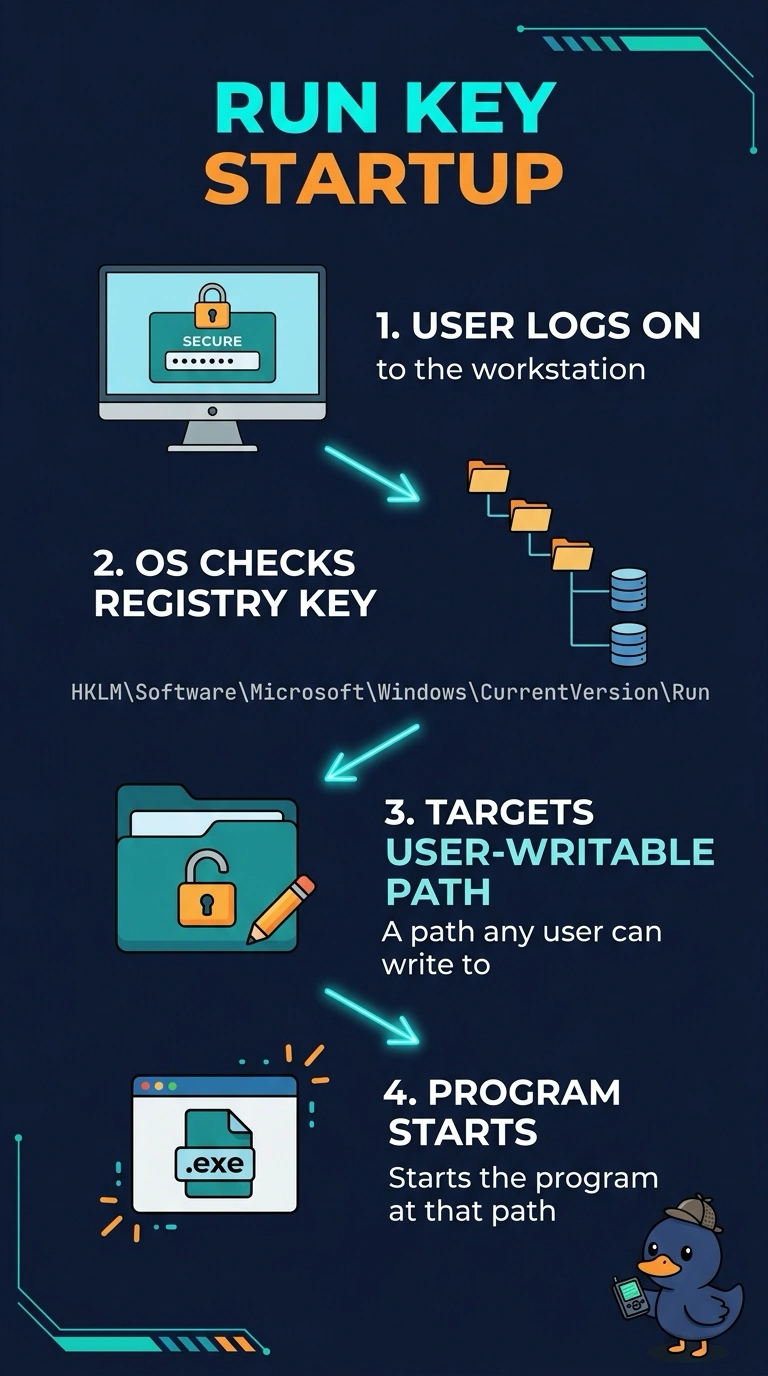
A note on the door that says to launch a program when you walk in is a startup hook, not a spare key. That Run value starts the program at the user-writable path at logon. The trap is calling it firewall policy, a Kerberos ticket, or the disk encryption key.
Full Explanation
It starts the program at that user-writable path when a user logs on to the workstation is what the value does. The Run key under that Windows path is a logon startup location: when a user logs on, Windows launches the program the value names. Pointing it at a user-writable path means the file that starts can be replaced without editing the value again. It holds the host firewall policy the workstation applies to inbound and outbound packets confuses this value with firewall policy. A Run value does not store the rules that permit or block packets. It stands for a Kerberos ticket-granting ticket of the kind Windows event 4768 records confuses a registry startup value with an authentication event. Event 4768 records a Kerberos ticket-granting ticket request, which is not what a Run value holds. It keeps the disk encryption key for the workstation volume as the value's defined role treats the value as a disk-encryption key store. A Run value names a program to launch; it is not defined as the place the volume key is kept. Exam caveat: a Run value shows that a program is launched at logon. It does not by itself prove the file is malicious, so the path still has to be examined. Operational check: hash the file at the user-writable path, compare it with the command named in the Run value, and see whether a non-admin user can replace that file.