
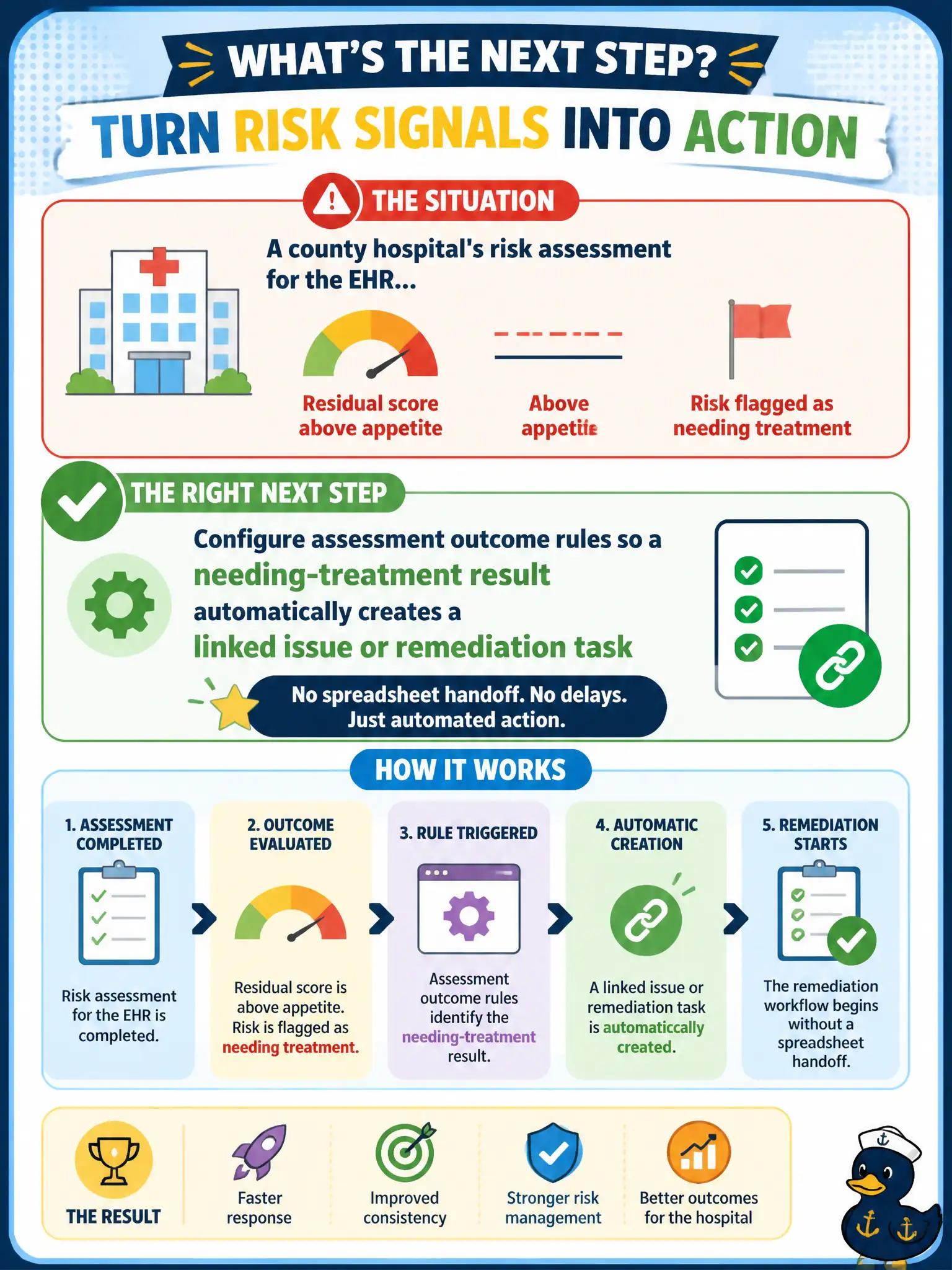
A county hospital's risk assessment for the EHR marks the residual score above appetite and flags the risk as needing treatment. How should the IRM admin wire the next step so remediation work starts without a spreadsheet handoff?
Select an answer to reveal the explanation.
Short Explanation
Think of the assessment like a gate that should open a work order when the score says 'treat me.' Wiring outcome rules to spawn a linked issue keeps remediation on the same risk trail instead of a sticky-note chase. Spreadsheets and verbal go-aheads lose the audit thread.
Full Explanation
When a county hospital EHR risk assessment marks residual above appetite and flags needing treatment, IRM should configure assessment outcome rules so that result automatically creates a linked issue or remediation task. Outcome-to-issue wiring keeps treatment on the same governed trail as the assessment instead of relying on spreadsheet handoffs or verbal go-aheads. Civic remediation accountability starts the moment the score demands treatment, not when someone remembers to open a ticket later.
Emailing the residual score to the CIO and waiting for a verbal go-ahead before opening any record fails because informal approval is not a durable remediation object and breaks auditability. Closing the risk because treatment decisions supposedly belong only in the audit engagement module misassigns first-/second-line treatment to the third line and ends the risk prematurely. Raising a security incident in SIR for every score change regardless of response strategy floods incident management and ignores Mitigate/Accept/Transfer distinctions in Risk.
Exam caveat: assessment outcomes that require treatment should spawn IRM issues/tasks. CIS-RC distinguishes risk remediation objects from mandatory SIR cases and from audit-only decisioning.
Operational check: set an outcome rule for needing-treatment → linked issue; run a pilot assessment into that outcome; confirm an issue opens with linkage to the risk; verify no automatic SIR incident is required solely because residual changed.