
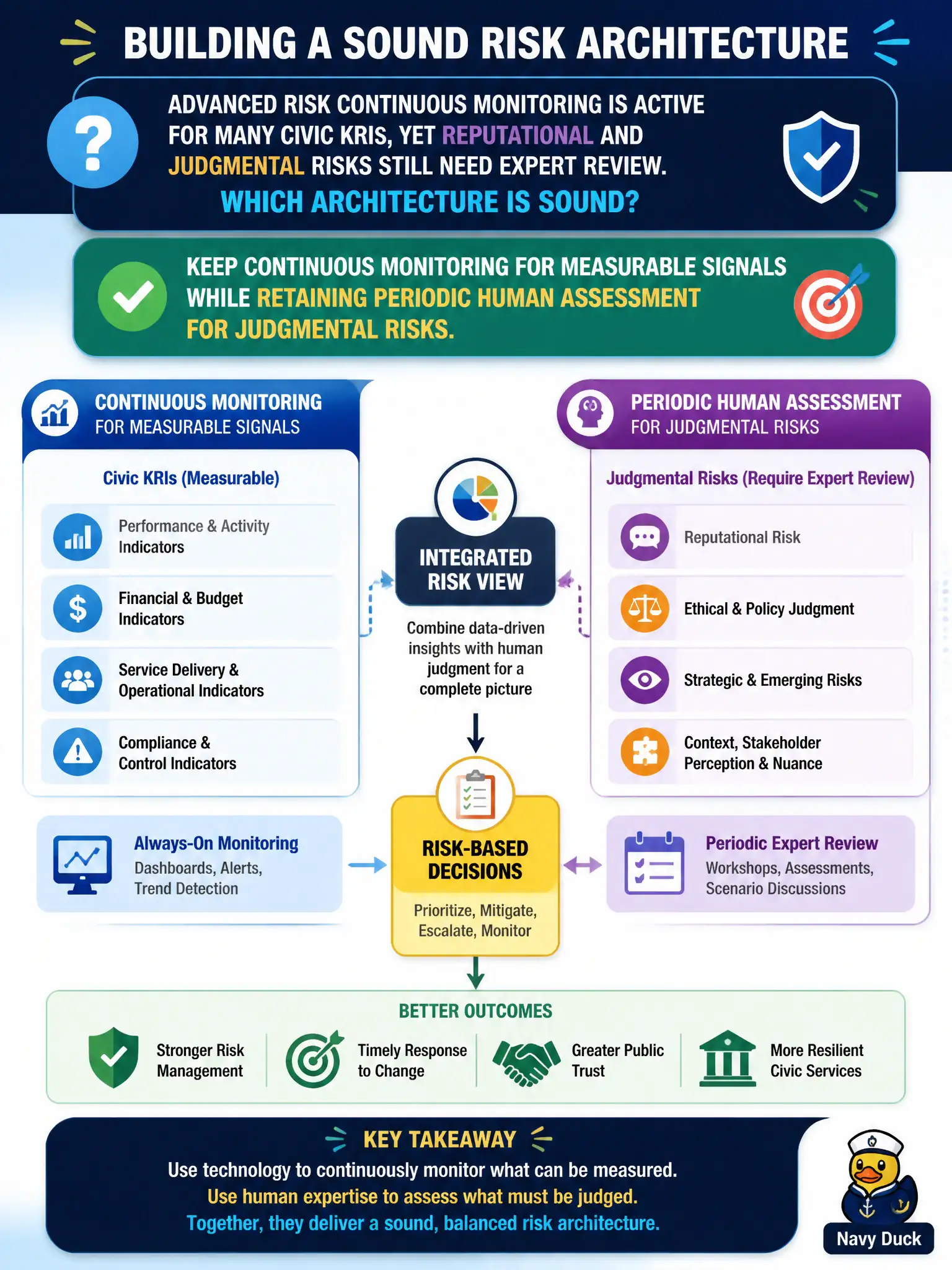
Advanced Risk continuous monitoring is active for many civic KRIs, yet reputational and judgmental risks still need expert review. Which architecture is sound?
Select an answer to reveal the explanation.
Short Explanation
Monitors are great smoke alarms, but some risks still need a firefighter’s judgment. Keep indicators humming for measurable signals, and still schedule human assessments where nuance matters.
Full Explanation
Sound Advanced Risk architecture for civic portfolios keeps continuous monitoring for measurable KRIs while retaining periodic human assessment for reputational and other judgmental risks. Automated indicators refresh objective signals between workshops; expert review remains necessary where nuance, stakeholder perception, or sparse instrumentation dominate. Hybrid design avoids both blind automation and workshop-only lag.
Turning off all continuous monitoring because workshops feel sufficient discards leading and between-cycle signal value. Treating indicator green status as permanent acceptance with no reassessment freezes residual falsely—green today is not perpetual acceptance. Automating residual scores for every risk type and banning qualitative workshops overreaches: not all civic risks are fully instrumentable.
Exam caveat: continuous monitoring complements, rather than universally replaces, human assessment. CIS-RC Advanced Risk items often test this hybrid boundary.
Operational check: classify top risks as measurable versus judgmental; ensure KRIs exist on measurable ones; schedule reassessment cadences for reputational/judgmental risks even when related indicators are green; document that green KRI status does not auto-accept residual.