
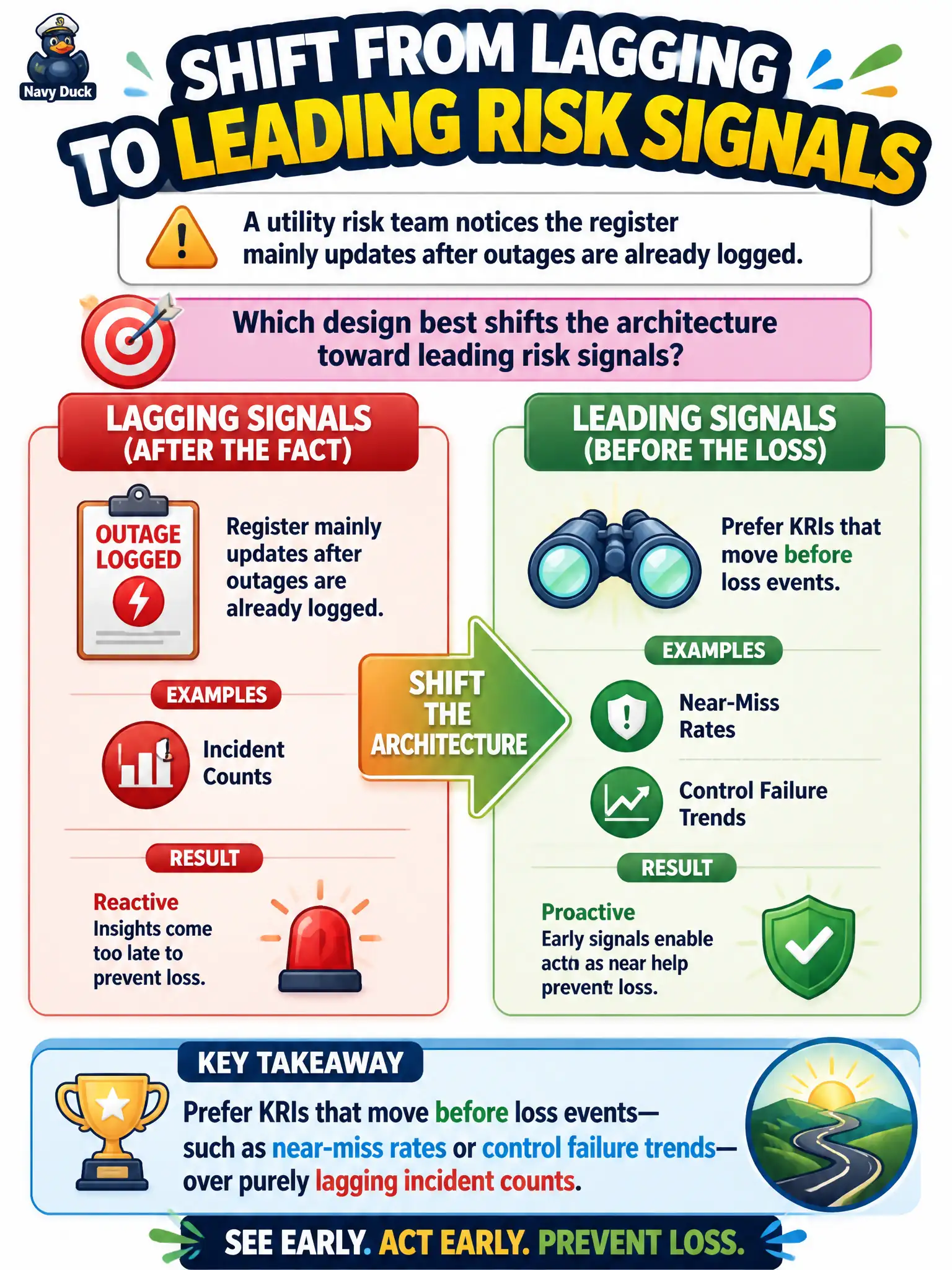
A utility risk team notices the register mainly updates after outages are already logged. Which design best shifts the architecture toward leading risk signals?
Select an answer to reveal the explanation.
Short Explanation
Lagging counts are like checking the garage after the car already hit the curb. Leading KRIs watch the warning lights—near misses, failing controls, rising exceptions—so the risk register can move before the outage write-up shows up.
Full Explanation
Leading risk architecture for a utility moves the register before loss events by preferring key risk indicators that change ahead of outages—near-miss rates, control-failure trends, exception growth—over purely lagging incident and outage counts. Lagging measures still matter for learning, but an IRM design that only refreshes residual posture after tickets close systematically reports yesterday’s harm. Civic risk teams should wire KRIs so residual and attention signals update when precursors move, enabling treatment before citizen-facing service failures accumulate.
Replacing every qualitative assessment with a single annual board memo fails because one narrative cannot provide continuous, risk-level signal architecture or timely residual movement. Counting closed tickets only and treating backlog as the sole risk score remains lagging operational throughput, not leading exposure. Deleting KRIs and relying on after-action reports for residual ratings deliberately postpones residual updates until after harm has been analyzed, which is the opposite of leading design.
Exam caveat: distinguish leading indicators (predictive or precursor signals) from lagging loss and incident counts. CIS-RC Advanced Risk items often tempt candidates to equate ticket volume or post-incident write-ups with a complete monitoring architecture.
Operational check: inventory KRIs on critical utility risks; tag each as leading or lagging; ensure at least one leading measure (near miss, failed control test trend, or threshold exception) exists on high residual risks; demonstrate a residual or attention change when a leading KRI breaches before an outage record is filed.