
An Advanced Risk designer asks how assessment configuration typically nests. Which awareness is correct?
Select an answer to reveal the explanation.
Short Explanation
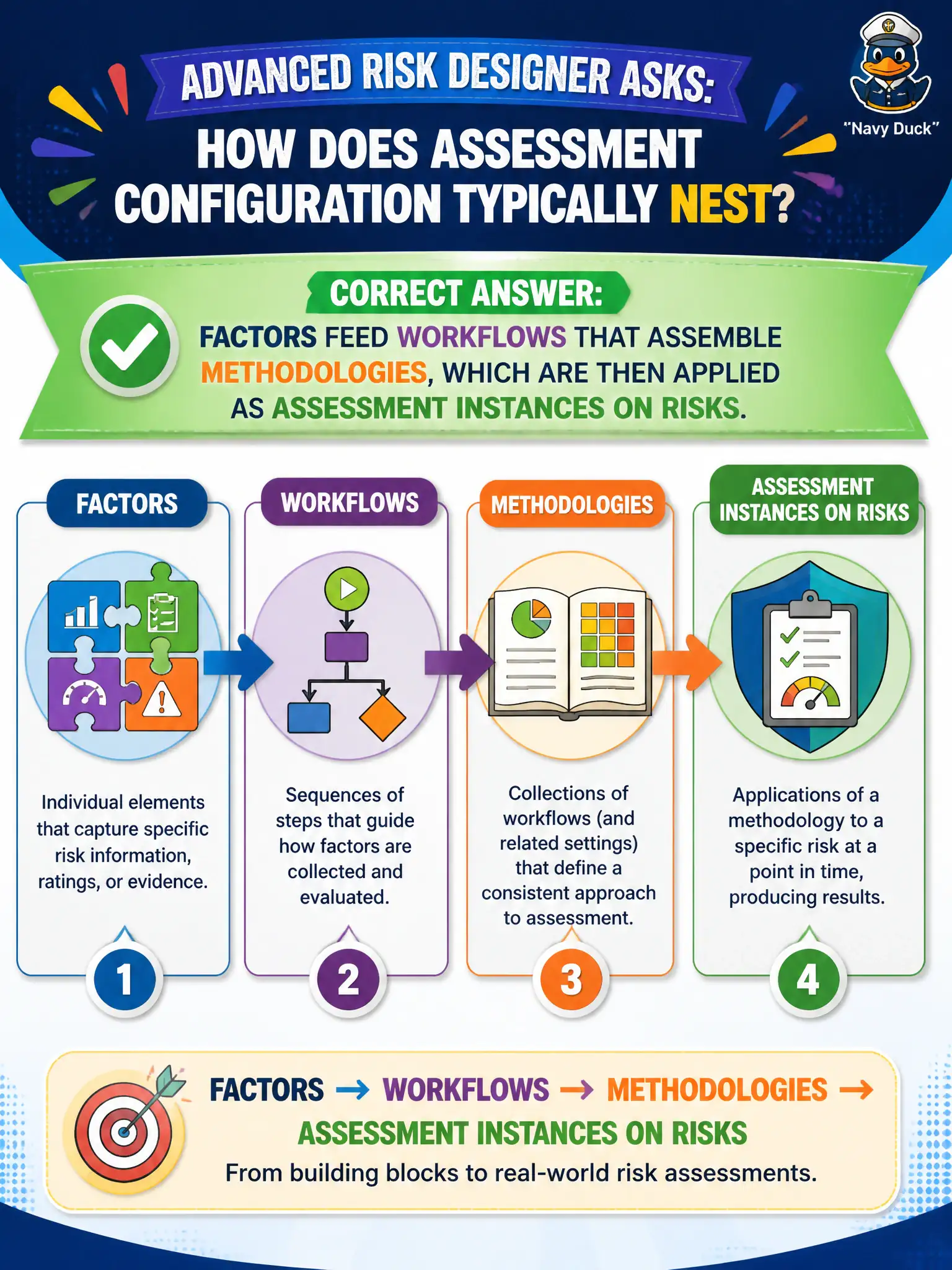
Think Lego layers: factors → workflows → methodologies → the assessment instance on a real risk. You do not invent the bricks after the house is scored, and a PDF in email is not the nested model.
Full Explanation
Assessment configuration in Advanced Risk typically nests as factors feeding workflows that assemble methodologies, which are then applied as assessment instances on risks. That Lego layering keeps civic assessments reusable and consistent. Assessment instances inventing factors after scoring with no reusable methodology fails by concept because factors and methods must precede instance scoring. Methodologies existing only as PDF attachments outside IRM fails by concept because PDFs are not executable assessment configuration. Workflows replacing entities so assessments need no organizational scope fails by concept because assessments still apply to entity-scoped risks. Exam caveat: CIS-RC Advanced Risk nests factors → workflows → methodologies → assessment instances on risks. Operational check: inspect an assessment methodology, confirm it references workflows and factors, apply it as an assessment instance on a sample risk, and verify scores derive from configured factors rather than ad-hoc post-hoc invention. In civic IRM programs, retain configuration and decision evidence so examiners can reconstruct why this design supports public services. In civic IRM programs, retain configuration and decision evidence so examiners can reconstruct why this design supports public services.