
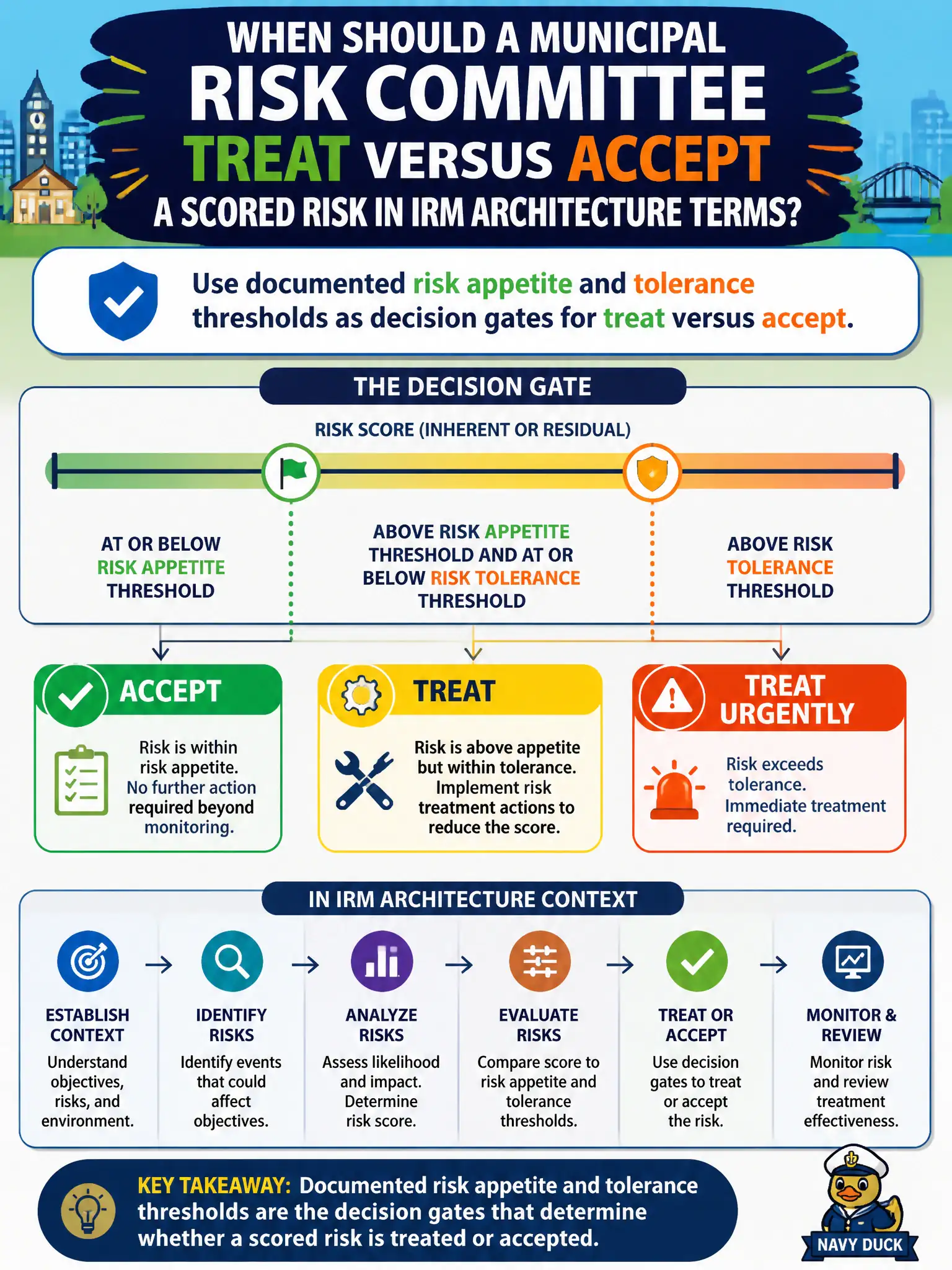
When should a municipal risk committee treat versus accept a scored risk in IRM architecture terms?
Select an answer to reveal the explanation.
Short Explanation
Appetite and tolerance are the speed-limit signs. Below the line you might accept with eyes open; above it you treat. Without those thresholds, treat-versus-accept is just gut feel in a council meeting.
Full Explanation
A municipal risk committee should use documented risk appetite and tolerance thresholds as decision gates for treat versus accept. Thresholds turn gut feel into governed civic risk decisions. Treating whenever any indicator exists and never allowing acceptance fails by concept because indicators inform; they do not abolish acceptance as a valid treatment below appetite. Accepting every risk below the maximum numeric score by default fails by concept because the top of the scale is not an appetite threshold. Treating only when Internal Audit opens an engagement fails by concept because audit presence is not the appetite gate for residual. Exam caveat: CIS-RC bases treat-versus-accept decisions on documented appetite and tolerance, not indicator absolutism or audit triggers alone. Operational check: publish appetite and tolerance thresholds for the municipal framework, compare a scored risk to those gates, and record treat or accept consistently with the documented bands. In civic IRM programs, retain configuration and decision evidence so examiners can reconstruct why this design supports public services. In civic IRM programs, retain configuration and decision evidence so examiners can reconstruct why this design supports public services.