
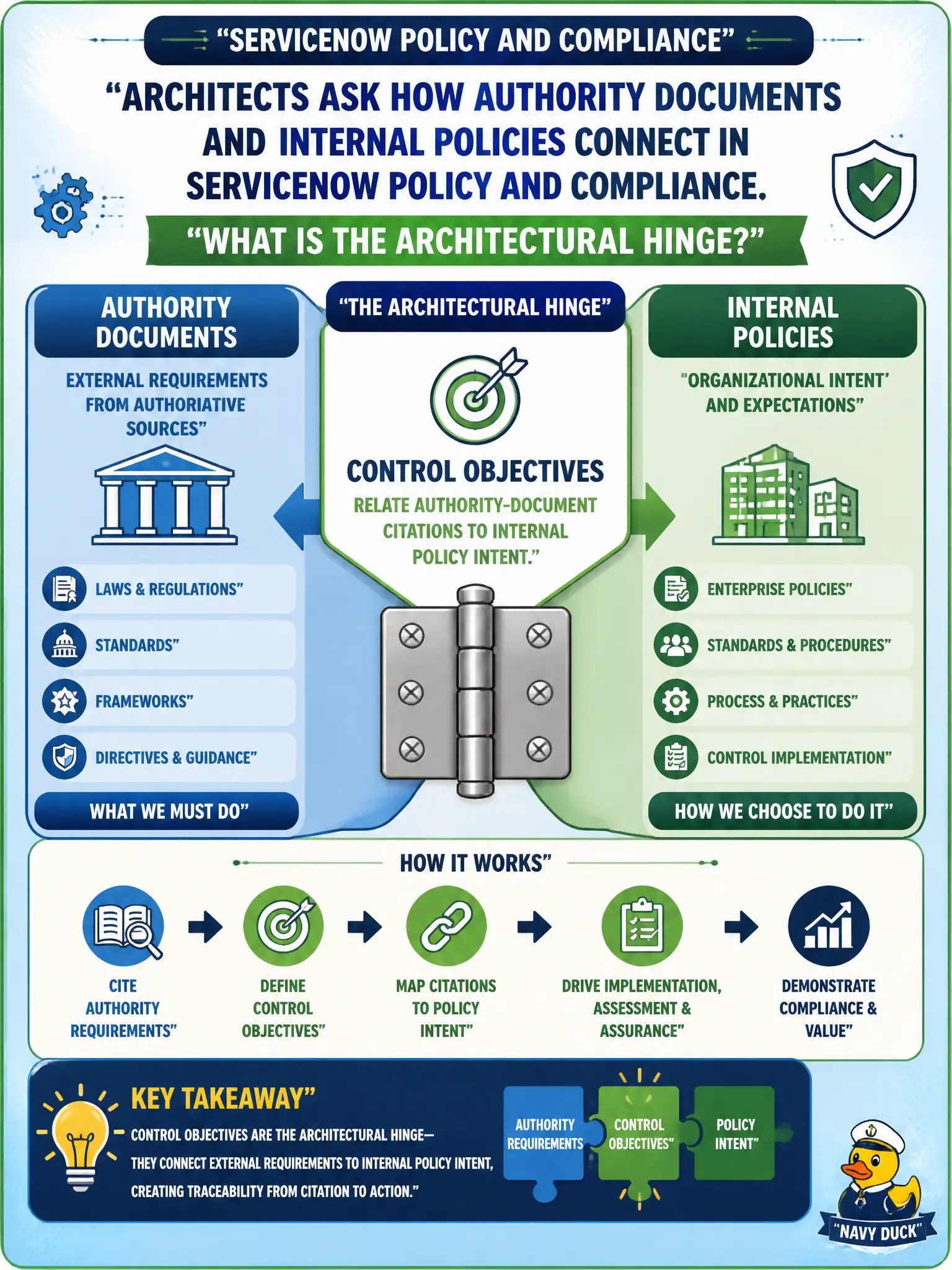
Architects ask how authority documents and internal policies connect in ServiceNow Policy and Compliance. What is the architectural hinge?
Select an answer to reveal the explanation.
Short Explanation
Picture two bookshelves—regulators on one side, city policies on the other. Control objectives are the bridge shelf that says what ‘good’ looks like for both. That is the hinge between external authority content and internal policy.
Full Explanation
Architecturally, control objectives relate authority-document citations to internal policy intent and are the hinge between external rules and internal wording in ServiceNow Policy and Compliance. When architects ask how authority documents and internal policies connect, that hinge is the answer. Issues alone do not join external rules to internal wording without objectives sitting in the chain. Entity classes replace neither policies nor authority documents in the model; they organize entities. Indicators do not automatically rewrite policies whenever a citation changes; content authors still manage mappings and impacts. Understanding the hinge helps city architects explain why content mapping work matters before generation and testing begin. Exam caveat: the hinge is relational—without maintained citation-to-objective and policy relationships, reporting by regulation and by internal policy both degrade over time. Operational check: pick one citation and one internal policy theme, confirm they meet at a control objective, show generated controls and a test result, and diagram the hinge for municipal content authors. Include relationship completeness checks when onboarding new mandates so the hinge does not become an undocumented assumption during staff turnover.