
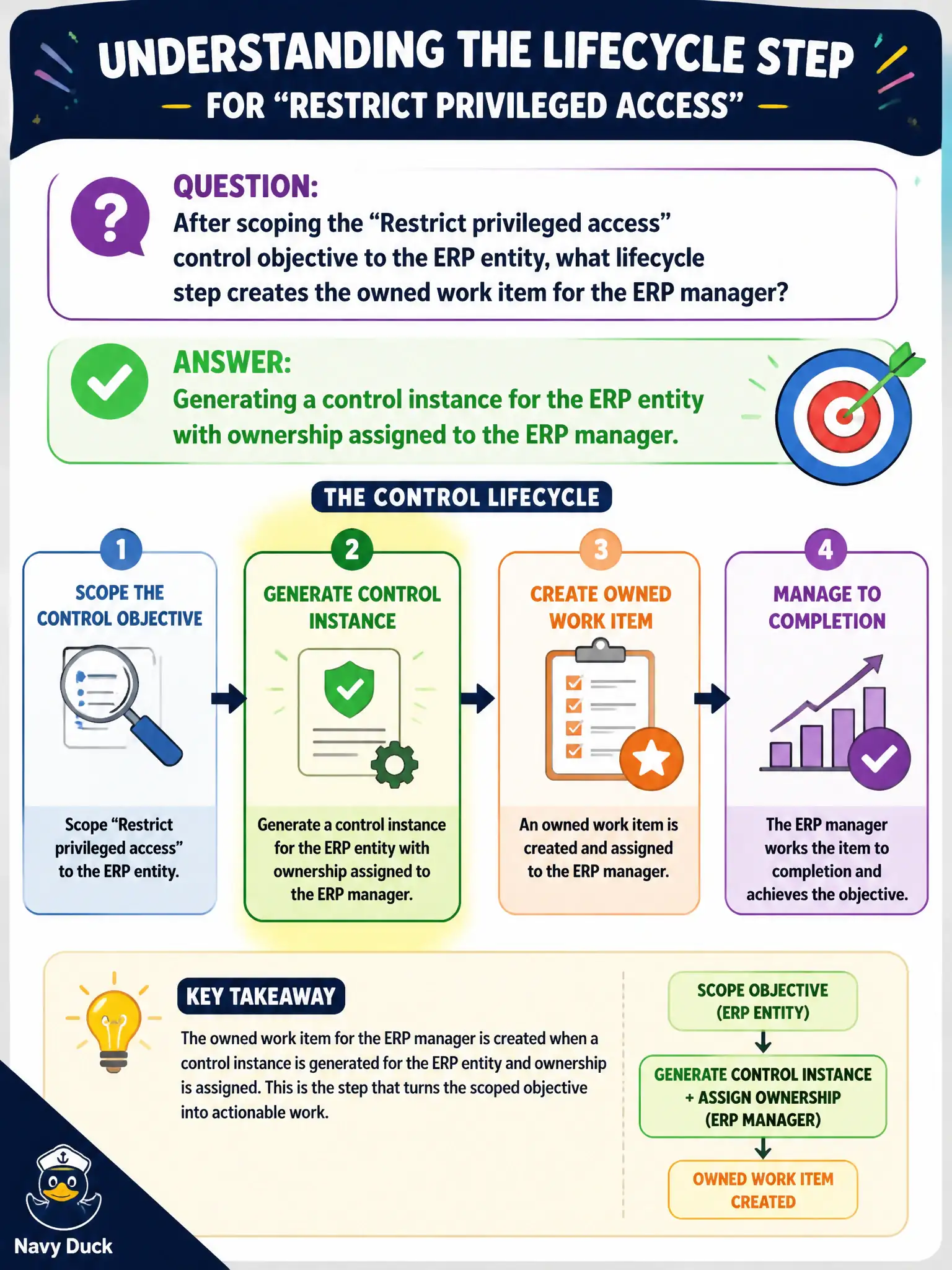
After scoping the “Restrict privileged access” control objective to the ERP entity, what lifecycle step creates the owned work item for the ERP manager?
Select an answer to reveal the explanation.
Short Explanation
Scoping the objective to ERP isn’t the finish line—generation creates the actual control instance the ERP manager owns. That’s the work item people attest and test. Without generation, the objective is still a template floating above the entity.
Full Explanation
Control generation applies a scoped control objective to a specific entity and creates a control record with ownership. After scoping the Restrict privileged access control objective to the ERP entity, the lifecycle step that creates the owned work item for the ERP manager is generating a control instance for that entity with ownership assigned to the ERP manager. Creating a citation with no entity scope and no owner does not produce the manager's work item. Deleting the control objective so owners receive email-only instructions destroys the structured model and evidence trail. Publishing an authority document with no generated controls leaves library content without entity-level obligations owners can execute. Exam caveat: generation without ownership still fails routing—confirm the ERP manager or owning group is populated on the control before announcing go-live of the campaign. Operational check: run generation for the ERP entity, verify the control appears owned by the ERP manager, open the attestation or test task path, confirm the manager receives work in IRM, and capture the vertical slice in municipal UAT evidence. Monitor the first week of tasks for unassigned controls that indicate ownership gaps on related entities.