
A platform owner asks where Integrated Risk Management sits architecturally relative to the rest of ServiceNow. Which placement is accurate?
Select an answer to reveal the explanation.
Short Explanation
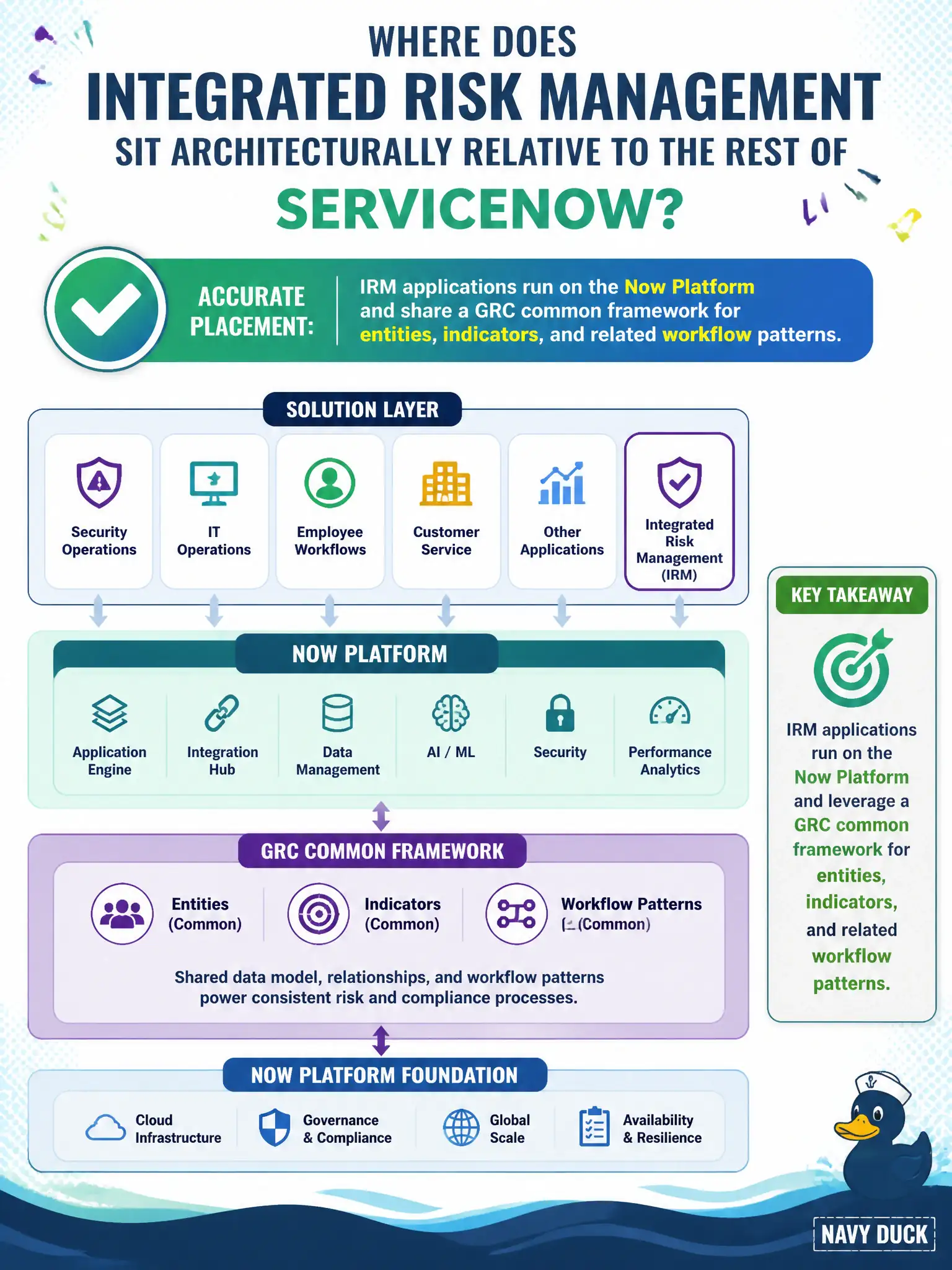
Think of IRM as apps living in the same house as the rest of Now—not a trailer parked outside. Entities, indicators, and shared GRC patterns ride the platform instead of inventing a parallel universe. That shared framework is what keeps risk and compliance data coherent.
Full Explanation
IRM applications run on the Now Platform and share a GRC common framework for entities, indicators, and related workflow patterns. Architecturally, IRM lives in the same house as the rest of Now rather than as a trailer parked outside with a separate data model or dedicated forever-isolated instance. That shared framework keeps risk and compliance data coherent with platform identity, CMDB references, reporting, and workflow engines municipalities already operate. Correct architecture answers emphasize co-existence and reusable GRC foundations instead of appliance thinking. Calling IRM a separate on-prem appliance that does not share the Now Platform data model contradicts product architecture. Saying IRM replaces the CMDB entirely and must run in its own dedicated instance forever invents isolation that breaks entity sourcing and increases cost. Reducing IRM to only a reporting overlay on CIS-SIR with no shared GRC framework objects erases Policy, Risk, Audit, and Entity Framework. Exam caveat: overview architecture items reward platform co-existence and common GRC foundations, not SIR-centric caricatures. Operational check for the platform owner: verify IRM tables and workspaces in the same instance as core platform apps, confirm an entity can reference CMDB or org data, and document that SIR remains a sibling application rather than the IRM foundation.