
A hospital compliance lead wants governance, risk, and compliance treated as one activity so meetings stay short. What distinction should the IRM coach still keep clear on an integrated platform?
Select an answer to reveal the explanation.
Short Explanation
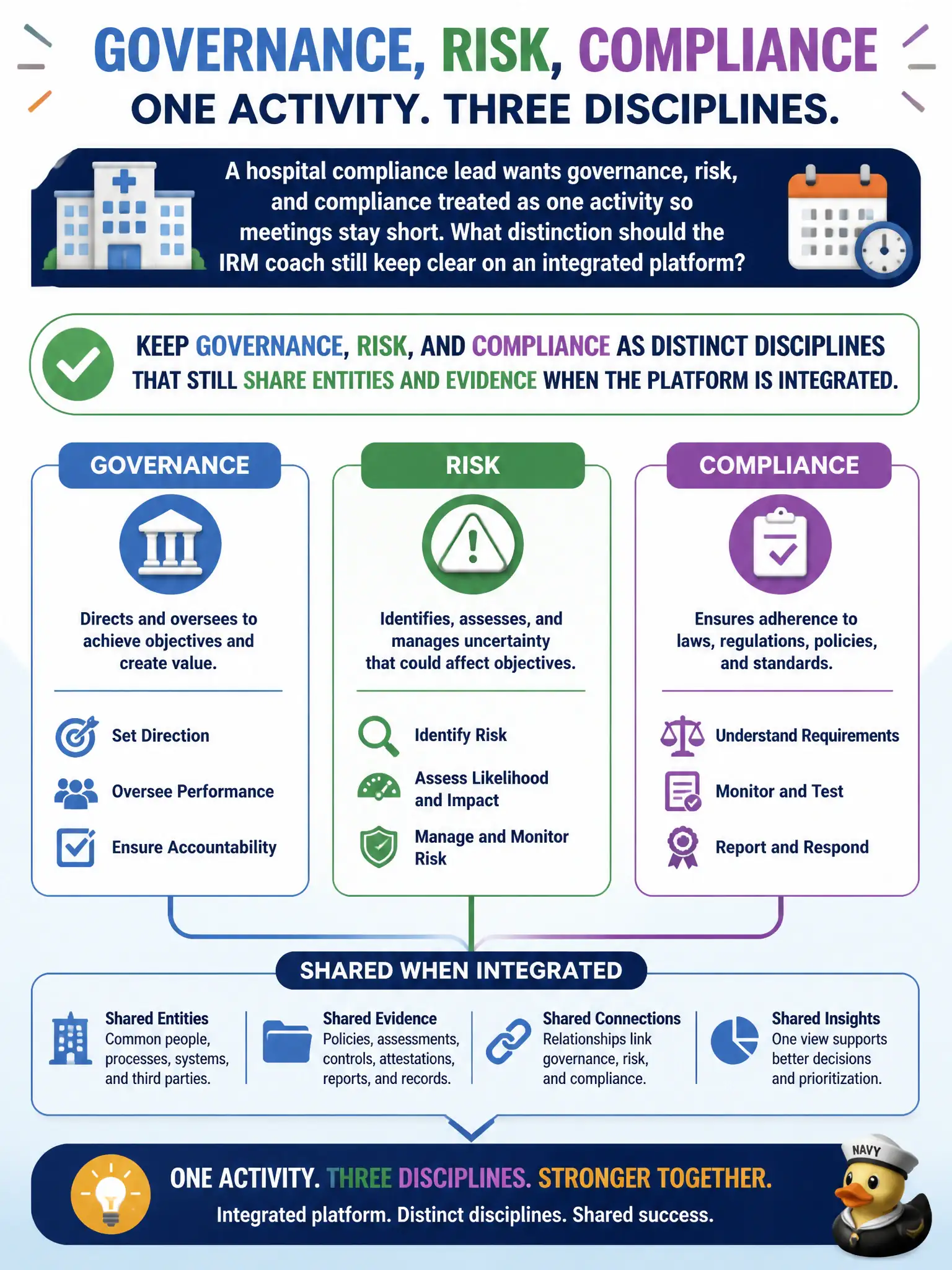
Integration is not amalgamation. Governance sets direction, risk weighs exposure, compliance proves obligations—one platform can link them without pretending they are the same job.
Full Explanation
An integrated platform links governance, risk, and compliance through shared entities and evidence, which shortens meetings by removing duplicate scavenger hunts—but it does not erase the three disciplines. Governance still sets direction and policy intent, risk still measures and treats exposure, and compliance still proves obligations; hospital stakeholders need that vocabulary even when one IRM instance holds the content. The coach should therefore keep the disciplines distinct while teaching how they share organizational objects and reusable proof. Collapsing all three into a single ITSM incident category labeled GRC turns assurance into ticket triage and loses policy lifecycle and risk methodology. Treating governance as vulnerability scanning, risk as patching, and compliance as SIR case closure remaps GRC into security-operations chores that belong to other products. Merging everything into a Software Asset reconciliation workflow substitutes license true-up for control testing and obligation mapping. Exam caveat: integration means shared framework objects, not amalgamation of jobs or replacement by ITSM, VR, or SAM processes. Operational check for the hospital: in a working session, map one clinical application entity to a policy citation, a risk assessment, and a control test, then show leadership three related but separate work items sharing the same entity rather than one blended ticket type.