
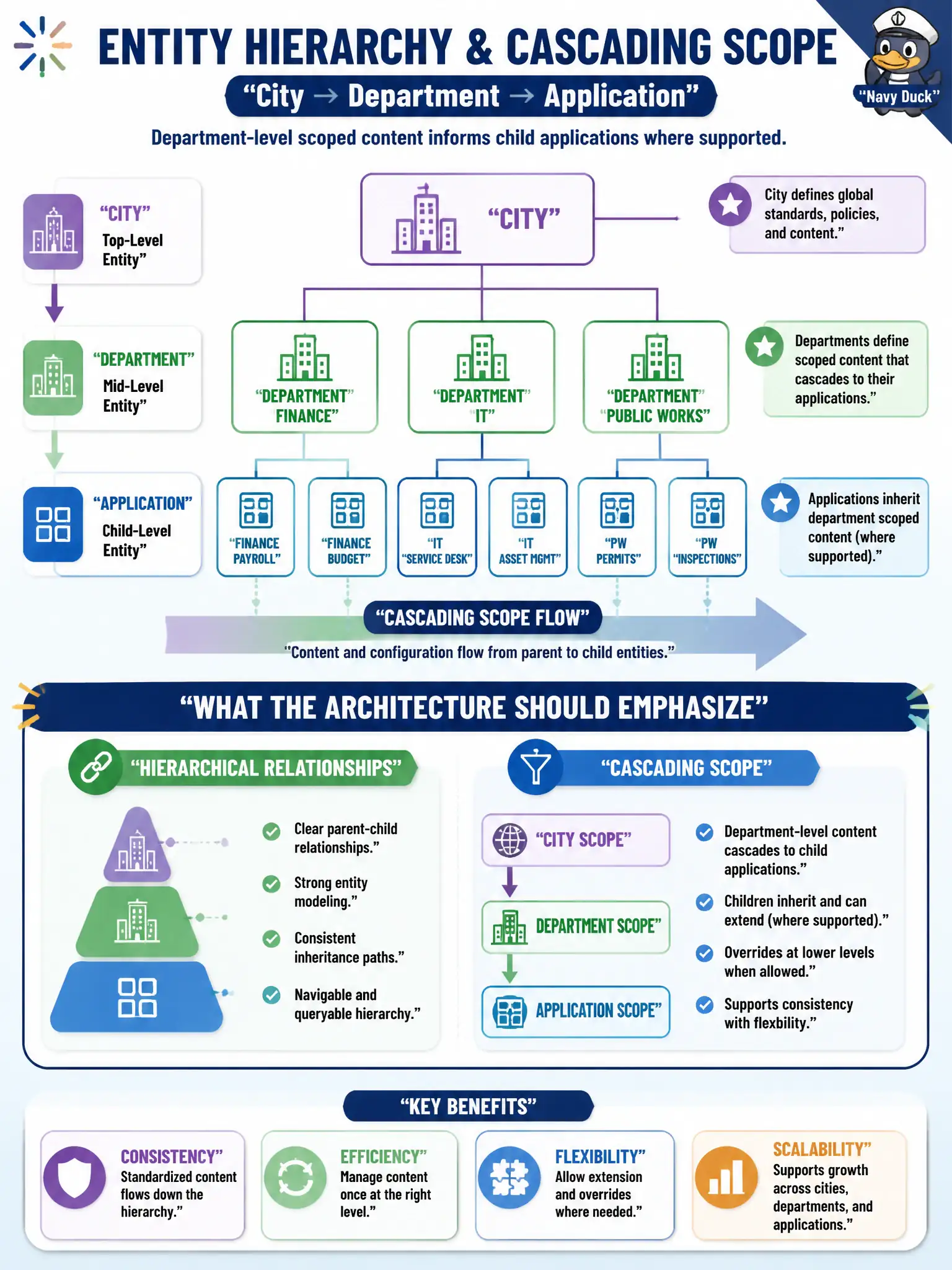
The entity hierarchy is city → department → application, and the team wants department-level scoped content to inform child applications where supported. What should the architecture emphasize?
Select an answer to reveal the explanation.
Short Explanation
Department sets the neighborhood rules; applications live on that street. Hierarchy lets scope cascade downhill where the platform supports it. Cut the parents and every app reinvents the rulebook.
Full Explanation
When the entity hierarchy is city → department → application and the team wants department-level scoped content to inform child applications where supported, architecture should emphasize hierarchical relationships and cascading scope from parent departments to child application entities. Department sets neighborhood rules; applications live on that street. Deleting department entities so applications float without parents removes cascade and ownership context and forces every app to reinvent obligations. Forcing every application to duplicate department content as unrelated manual records only creates drift and double maintenance. Blocking all parent/child links to keep each entity fully isolated forever prevents the coherent civic rollup the hierarchy was meant to provide. Exam caveat: confirm which cascade behaviors the configured IRM patterns actually support before promising automatic inheritance of every control or citation mapping. Operational check: model one department with two child applications, associate scoped content at the department, verify child visibility or generation behavior, document supported cascade rules for municipal implementers, and include hierarchy integrity checks after reorg-driven moves. Retest cascade assumptions after major IRM upgrades so city compliance leads know what still inherits and what must be explicitly associated.