
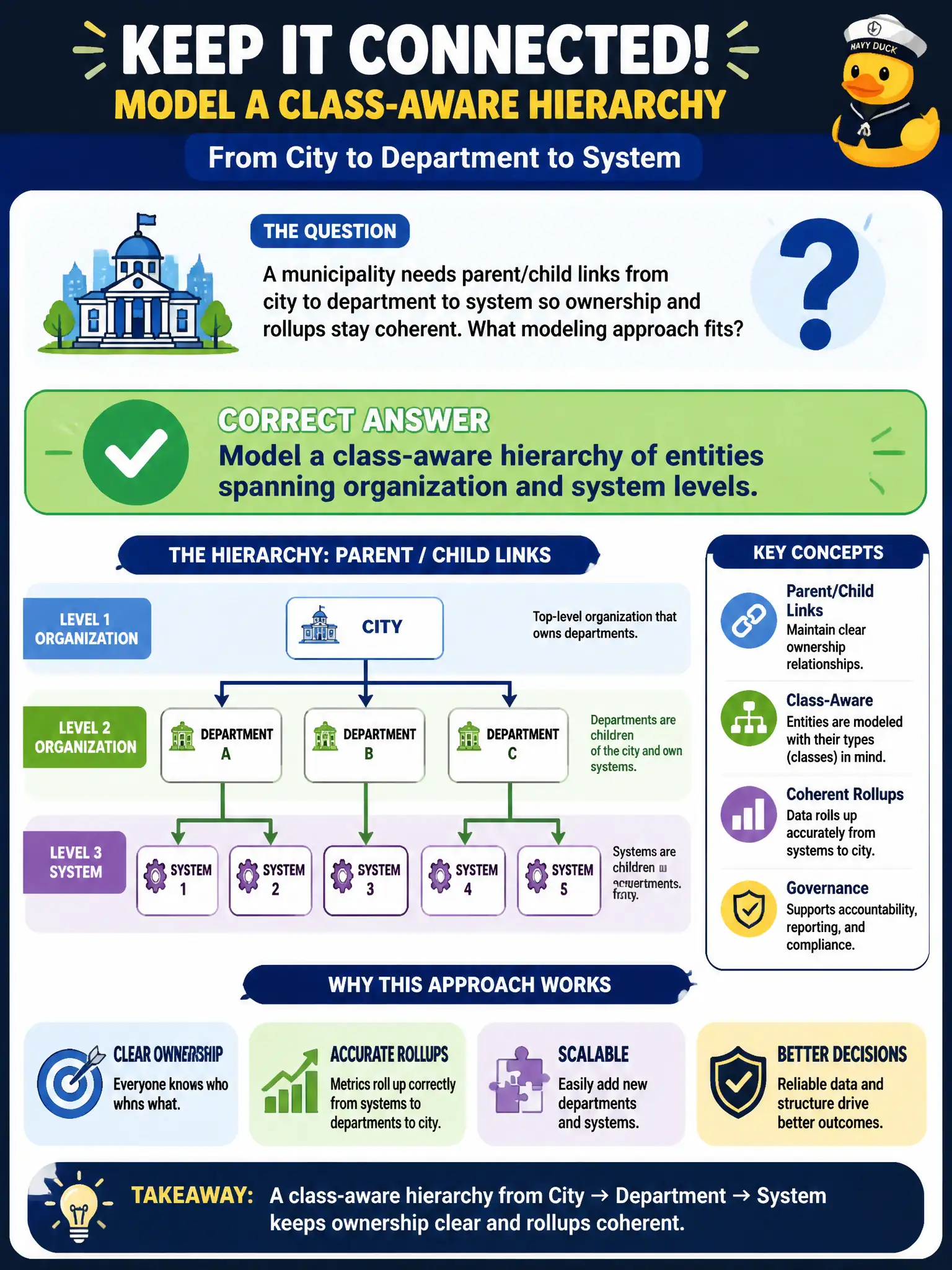
A municipality needs parent/child links from city to department to system so ownership and rollups stay coherent. What modeling approach fits?
Select an answer to reveal the explanation.
Short Explanation
City, department, system—like folders inside folders. Hierarchy keeps the org story readable when risk rolls upward. Tags without parents are sticky notes in a windstorm.
Full Explanation
A municipality that needs parent/child links from city to department to system so ownership and rollups stay coherent should model a class-aware hierarchy of entities spanning organization and system levels. Hierarchical relationships allow organization entities to parent department and system entities across appropriate classes, supporting ownership chains and rollup reporting from systems up to city leadership. Storing only leaf system entities and omitting organizational parents removes the civic ownership story auditors expect and forces every control conversation to reinvent context. Unrelated tag clouds with no parent field relationships cannot sustain coherent rollups when departments reorganize. Creating separate IRM plugins for each department with no shared parents fragments the system of record and multiplies administration. Exam caveat: hierarchy design must align with class taxonomy and cascade capabilities actually configured in the instance—do not promise inheritance the platform is not set up to deliver. Operational check: build city → department → application relationships for a pilot bureau, verify ownership and rollup widgets, confirm stewards can navigate parent/child in workspace, and record hierarchy rules in the municipal entity standard. Re-validate after reorgs that parent links were updated rather than abandoned for tags, and sample an audit request that traces a system risk to its department and city parents.