
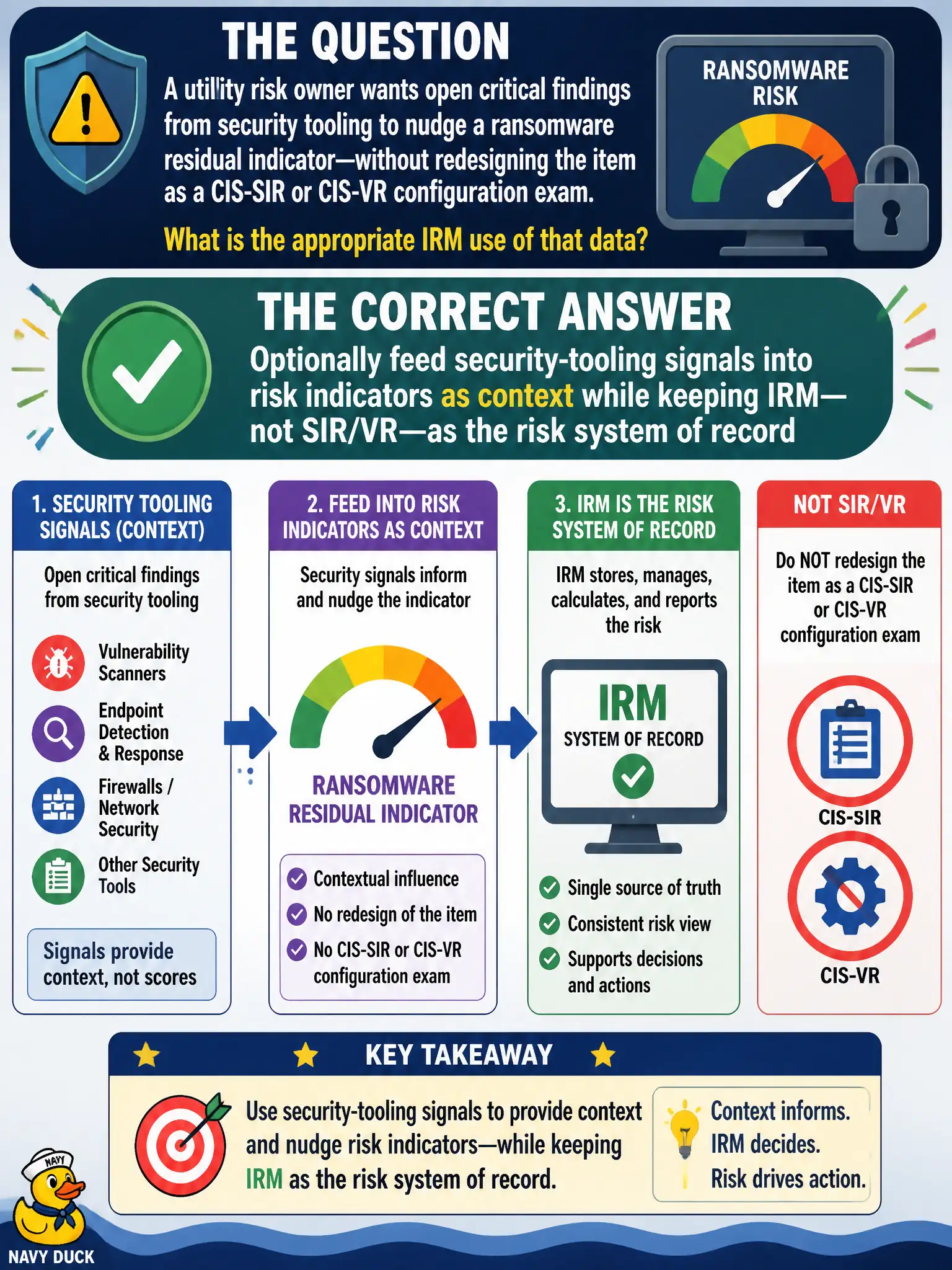
A utility risk owner wants open critical findings from security tooling to nudge a ransomware residual indicator—without redesigning the item as a CIS-SIR or CIS-VR configuration exam. What is the appropriate IRM use of that data?
Select an answer to reveal the explanation.
Short Explanation
Security scanners can whisper to a risk indicator without stealing the whole show. Use their signals as input context while IRM stays the risk book of record. Don't rip out indicators or turn VR into your only register.
Full Explanation
Open critical findings from security tooling may optionally feed risk indicators as context for a utility ransomware residual while IRM—not SIR/VR—remains the risk system of record. This is appropriate IRM use of security-tooling data: inform residual indicators without redesigning the item as a CIS-SIR or CIS-VR configuration exam. Product boundaries stay clear; signal reuse stays useful.
Rebuilding the entire Vulnerability Response group workflow as the only allowed risk register replaces Risk with VR. Disabling IRM risk indicators whenever any security tool is installed invents a false mutual exclusion. Treating every security alert as an authority-document citation requiring policy republish confuses operational alerts with regulatory text management.
Exam caveat: security signals → risk indicators (optional context); IRM remains risk SoR. Do not equate VR/SIR with the risk register.
Operational check: map critical tooling findings into a ransomware-related indicator; confirm residual context updates; verify VR/SIR still own their remediation/incident processes separately.
Agree with security operations which severity of tooling findings feed indicators, and document that IRM consumes signals without owning VR group workflows. Periodic calibration meetings prevent either disabling indicators when tools exist or treating every alert as a policy citation event.