
A border-town authority asks how national laws interacted with Directive 95/46/EC compared with the GDPR. Which contrast correctly describes the implementation model change?
Select an answer to reveal the explanation.
Short Explanation
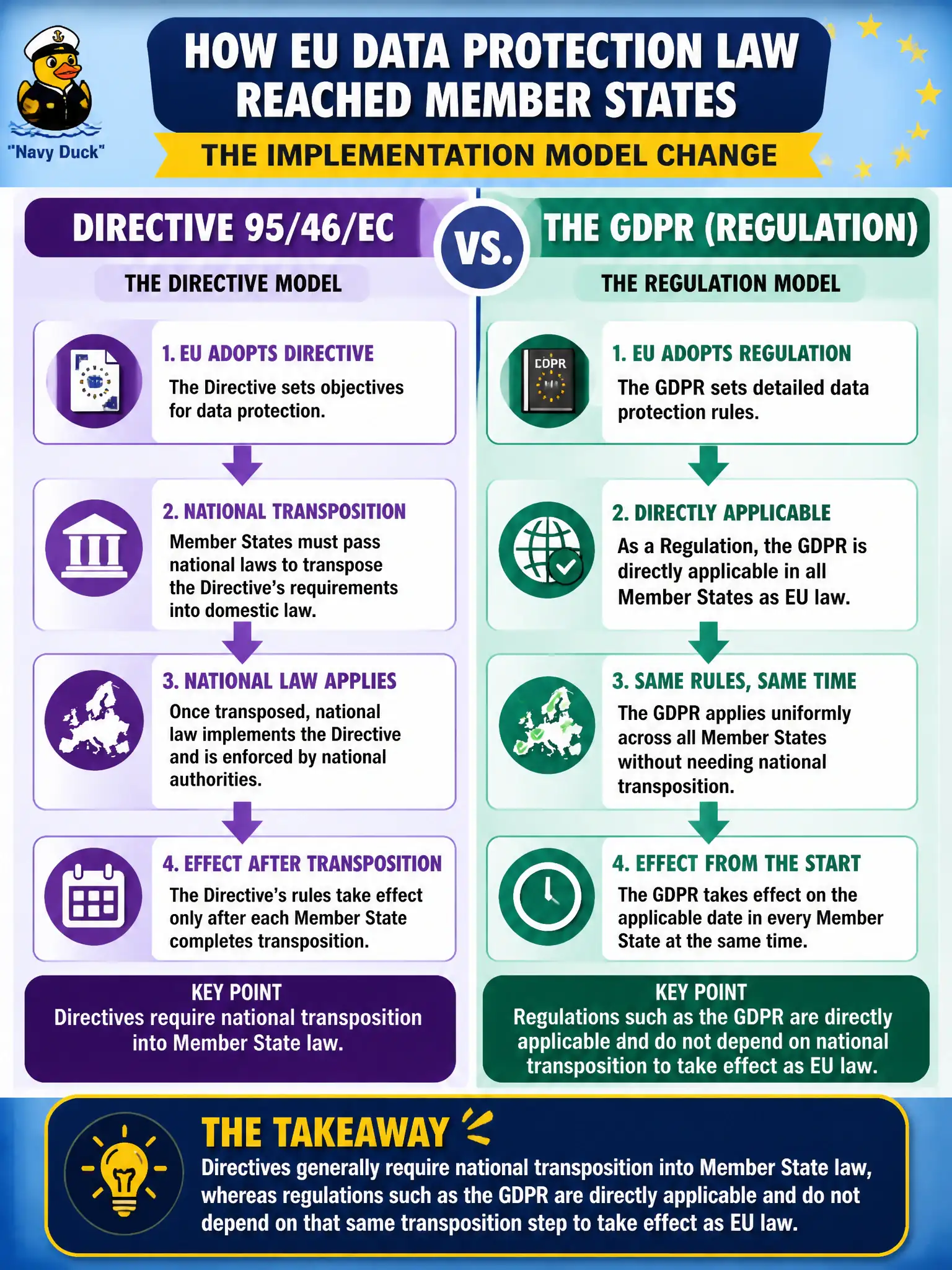
Picture a recipe card versus a finished dish delivered to every kitchen. A directive tells Member States to cook the rules into national law; a regulation like the GDPR largely shows up ready-made and binds across the Union. That is why moving from Directive 95/46 to the GDPR changed the everyday implementation story.
Full Explanation
Directives generally require national transposition into Member State law, whereas regulations such as the GDPR are directly applicable and do not depend on that same transposition step to take effect as EU law. A border-town authority comparing Directive 95/46/EC with the GDPR should emphasise that shift: fragmented national implementing acts under the Directive versus a directly applicable regulation designed to reduce fragmentation. Directives and regulations do not have identical legal effect. The GDPR is not a directive that each Member State must rewrite from scratch before it can apply to controllers. Directive 95/46 was not directly applicable without transposition while the GDPR waited on each city council. Exam caveat: implementation-model questions test directive transposition versus regulation direct applicability. Operational check: when explaining why local “privacy acts” still exist beside the GDPR, distinguish residual Member State specifications permitted by the Regulation from the old full transposition model—and cite the GDPR itself as the primary operative text for general processing. For municipal teams, keep a one-page decision note that states the governing instrument, why competing labels fail, and what evidence would change the conclusion.