
A civic open-data group asks why electronic commerce rules appear in a European privacy body of knowledge. Which explanation correctly places the e-Commerce Directive in the European data-protection legislative stack?
Select an answer to reveal the explanation.
Short Explanation
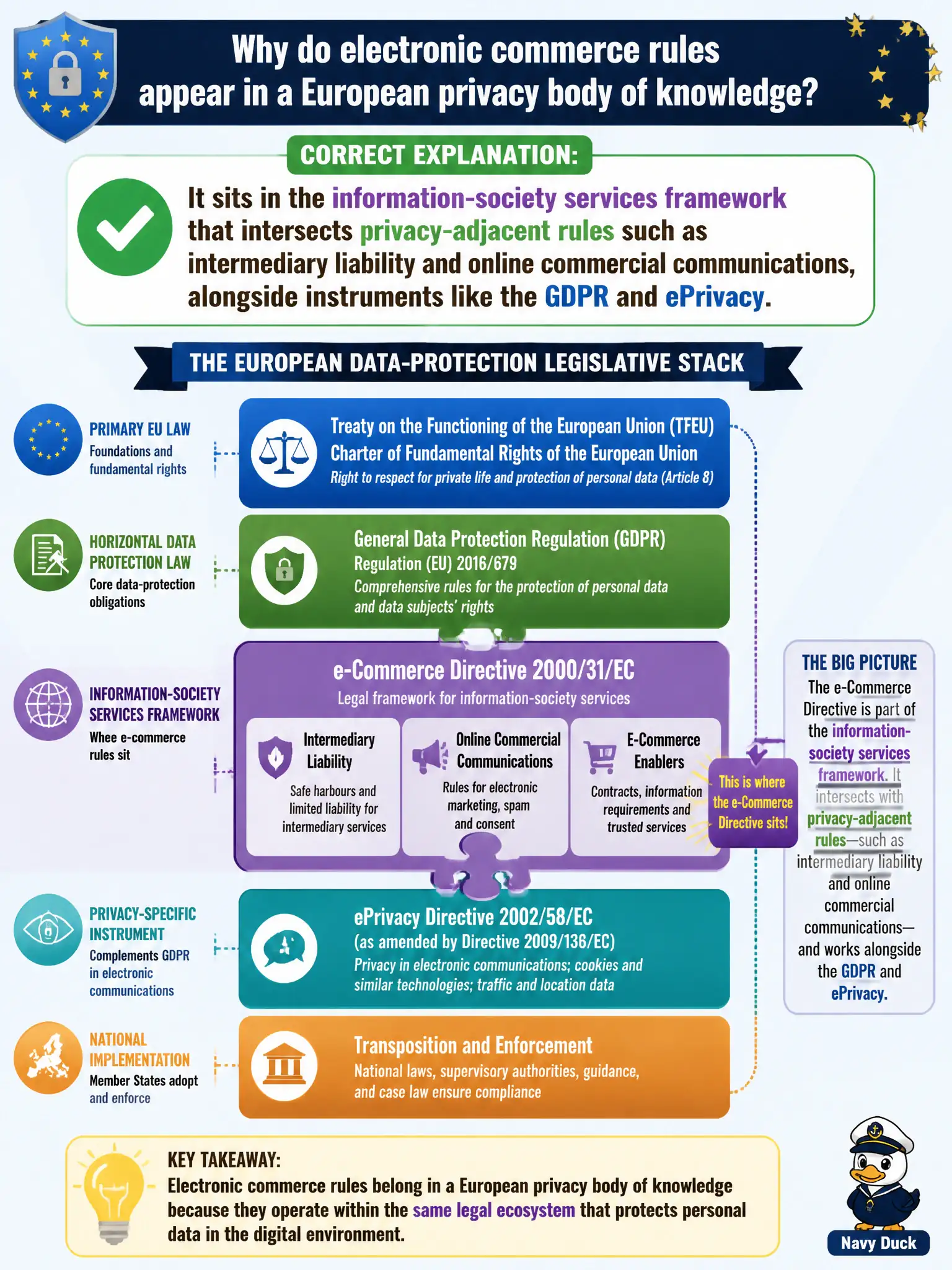
Think of the EU rulebook as a bookshelf, not one single binder. The e-Commerce Directive lives on the information-society shelf—how online services, hosting, and commercial messages work—while GDPR and ePrivacy sit nearby and often bump into the same website. Knowing the stack means knowing why that commerce instrument shows up in a privacy BoK without pretending it is the GDPR.
Full Explanation
Directive 2000/31/EC on electronic commerce sits in the European information-society services framework that intersects privacy-adjacent rules such as intermediary liability and online commercial communications, alongside instruments like the GDPR and ePrivacy. Civic open-data groups should treat it as a related layer in the wider European stack, not as the primary personal-data statute. It did not replace the GDPR as the Union’s general personal-data law. It is not a United States federal e-commerce privacy act used for adequacy decisions. It does not solely regulate biometric border controls with no link to online services. Locating the Directive correctly prevents product and legal teams from closing GDPR gaps by citing hosting or intermediary language alone. Exam caveat: BoK related-legislation items reward correct stacking—information-society rules beside, not instead of, GDPR. Operational check: maintain a civic compliance matrix with separate rows for e-Commerce Directive themes and GDPR personal-data duties whenever a portal enables third-party postings or online commercial communications. For municipal teams, keep a one-page decision note that states the governing instrument, why competing labels fail, and what evidence would change the conclusion.