
A council workshop asks for the GDPR’s main goals in one breath. Which statement captures the twin aims?
Select an answer to reveal the explanation.
Short Explanation
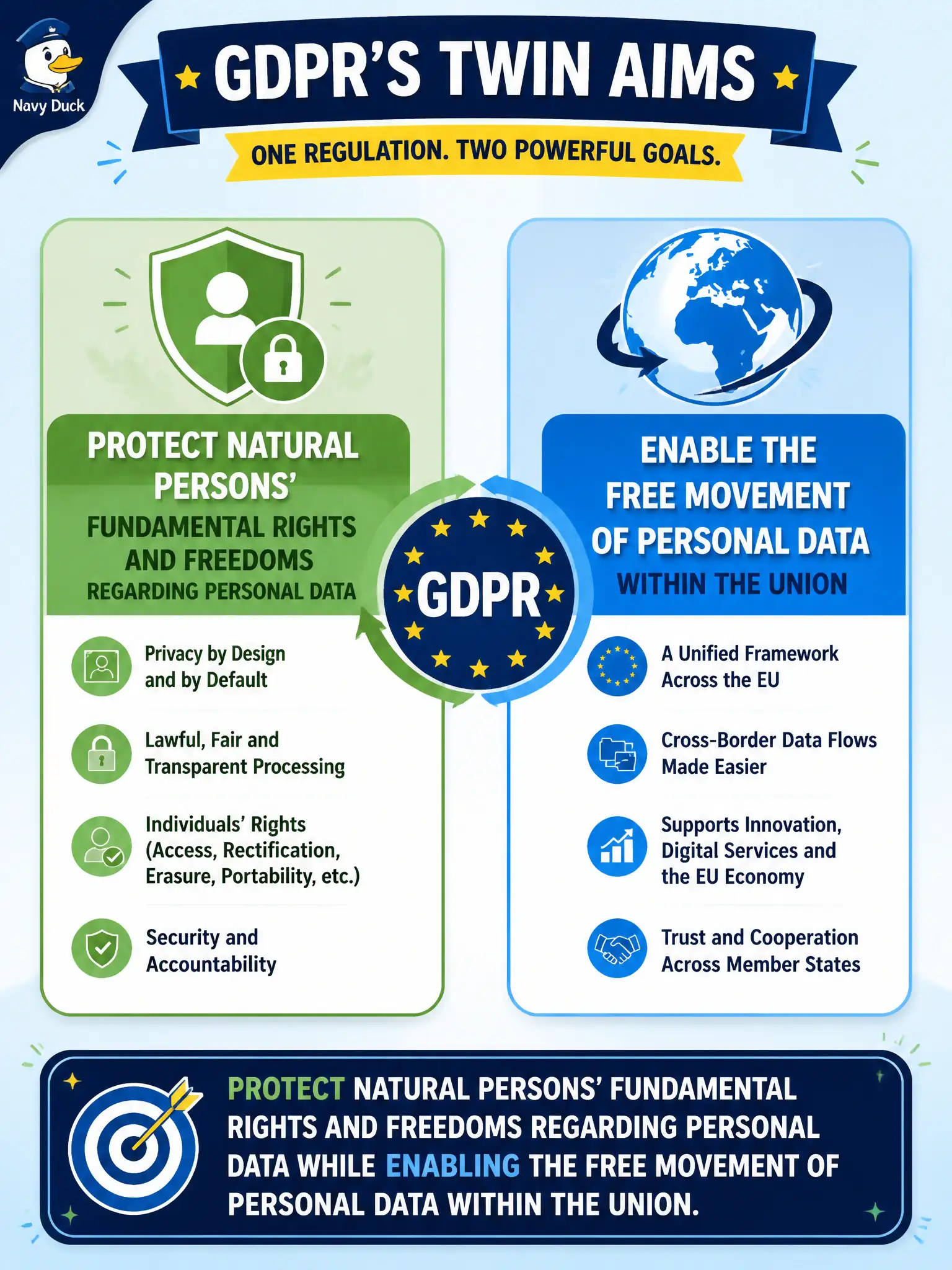
The GDPR wants two things at once: real protection for people and a single market where personal data can still move. It is not “lock everything in a vault” or “ship data with no rules.” Twin aims — dignity and free flow.
Full Explanation
Article 1 of the GDPR captures twin aims: protecting natural persons’ fundamental rights and freedoms with regard to personal data while enabling the free movement of personal data within the Union. Council workshops should state both goals in one breath so sponsors do not hear only “block data” or only “move data.” Maximising advertising revenue and eliminating all cross-border flows permanently is the opposite of the balanced design. Standardising only cookie banner colours ignores substantive rights and free-flow policy. Replacing all Member State constitutions with a privacy marketing code misstates both constitutional law and the Regulation’s objectives. Exam caveat: twin-aims stems are scored on rights protection plus intra-Union free flow—not localisation absolutism or ad-tech maximisation. Operational check: open every major civic data-sharing business case with a one-line Article 1 framing, then show how safeguards enable lawful sharing rather than treating protection and free flow as enemies. For municipal teams, keep a one-page decision note that states the governing instrument, why competing labels fail, and what evidence would change the conclusion. Document the decision trail so auditors can see how the civic team matched facts to the correct legal category rather than to a slogan.