
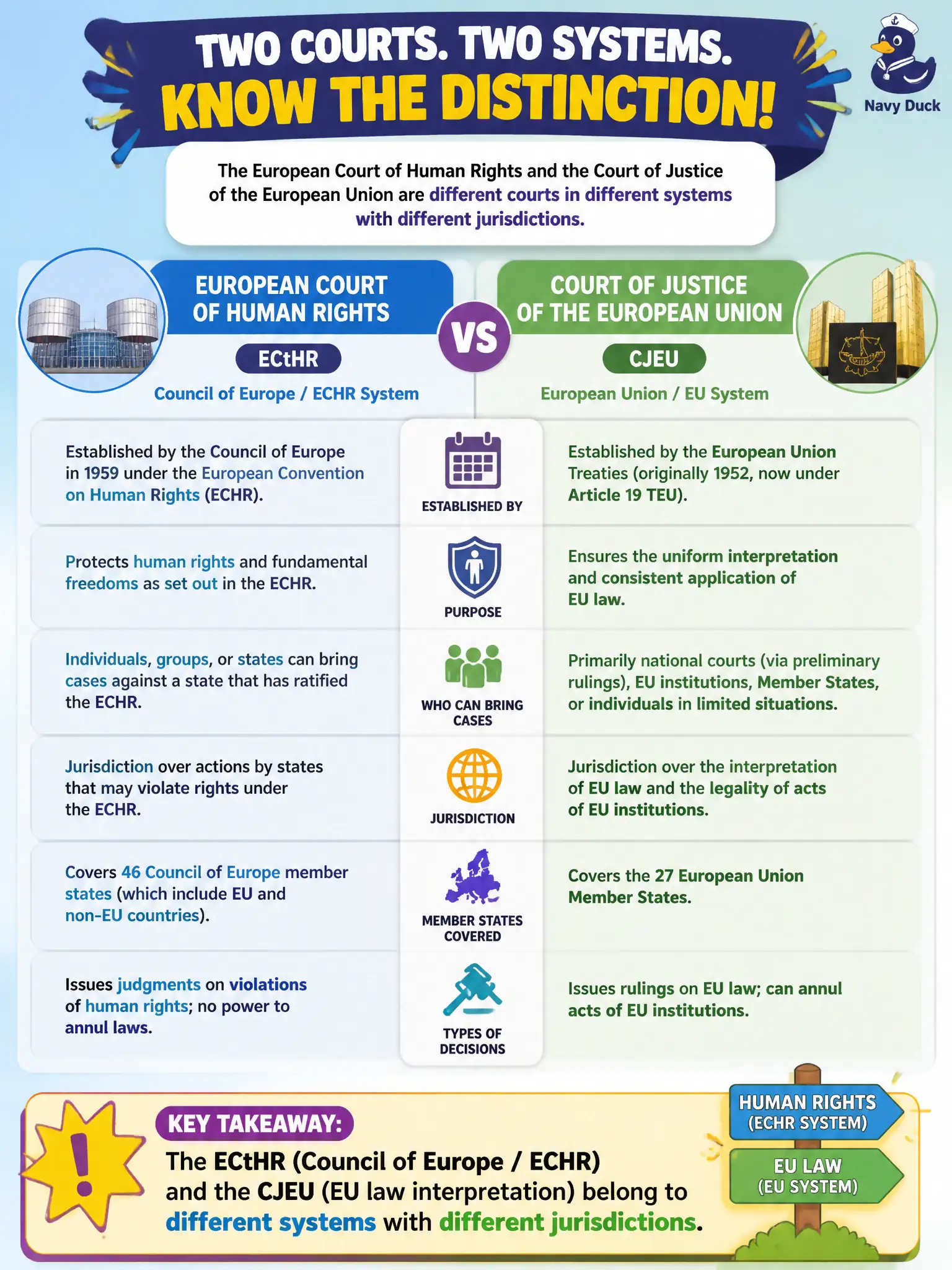
A human-rights clinic confuses the European Court of Human Rights with the Court of Justice of the European Union. Which distinction should trainers teach?
Select an answer to reveal the explanation.
Short Explanation
Two European courts, two different clubs. The ECtHR sits in the Council of Europe world guarding the ECHR; the CJEU is the EU’s court for Union law, including the GDPR. Mixing them up is like swapping the soccer referee with the rugby referee and wondering why the rules feel wrong.
Full Explanation
The European Court of Human Rights (ECtHR) operates in the Council of Europe system under the European Convention on Human Rights, while the Court of Justice of the European Union (CJEU) interprets and ensures uniform application of EU law, including the GDPR. Human-rights clinic trainers should teach two legal orders: ECtHR judgments speak to ECHR obligations of CoE states; CJEU judgments bind on EU law questions referred or litigated in the Union system. They are not identical EU institutions limited to competition cases. The ECtHR is not a GDPR fine-appeal chamber for Commission filings. The CJEU is not a Council of Europe body interpreting the ECHR exclusively. Privacy practitioners who cite the European Court without specifying which court risk applying the wrong jurisdictional logic to a municipal case strategy. Exam caveat: name the court and the instrument—ECtHR/ECHR versus CJEU/EU law—whenever a stem uses overlapping European court language. Operational check: before relying on a judgment in a civic litigation memo, record the court, the legal order, and whether the holding constrains GDPR interpretation directly or informs parallel human-rights analysis. For municipal teams, keep a one-page decision note that states the governing instrument, why competing labels fail, and what evidence would change the conclusion.